

Current Affairs
UPSC SIPRI Report on Global Arms Import - English
Why in news: According to Stockholm International Peace Research Institute (SIPRI) report, India is the world’s largest arms importer for the period between 2018-22.
About SIPRI:
- It was founded in 1966 by the Swedish parliament as an independent research institute.
- Its main objective is to conduct research on issues related to international peace and security, including arms control, disarmament, and conflict resolution.
- It is funded by a combination of government grants, private donations, and project-based funding.
- SIPRI is based in Stockholm, Sweden, but has a global reach and influence, with its research and analysis informing policy decisions and public debates in many countries.
Key highlights of the report:
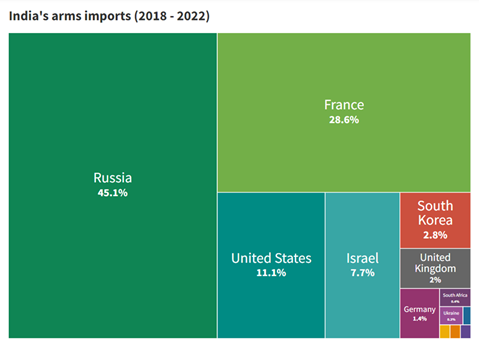
India’s Arms Imports and Exports:
- India is the biggest arms export market to Russia, France, and Israel and the second largest export market to South Korea.
- India was also the third largest market for South Africa which was ranked 21 in the list of arms exporters.
- For the same period, India remained the largest arms importer followed by Saudi Arabia, with Russia accounting for 45% of India’s imports followed by France (29%) and the US (11%).
- India was the third largest arms supplier to Myanmar after Russia and China accounting for 14% of its imports.
- India is now looking to become a significant exporter of defence equipment by aiming for $5 billion in exports and $22 billion in turnover by 2025.
Reasons for Decrease in India’s Arms Imports:
- India’s slow and complex arms procurement process,
- Efforts to diversify its arms suppliers,
- Attempts to replace imports with major arms that are designed and produced domestically.
Global Arms Transfers:
- The global level of international arms transfers decreased by 5.1%, imports of major arms by European states increased by 47% between 2013–17 and 2018–22 in the backdrop of the war in Ukraine.
Challenges of arms imports:
- Dependence on foreign suppliers: India remains heavily dependent on foreign suppliers for its arms imports, which can make it vulnerable to supply disruptions, geopolitical tensions, and changing global dynamics.
- Slow and complex procurement process: India’s arms procurement process is often slow and complex, which can delay the acquisition of necessary weapons and equipment.
- Domestic arms production: India is also attempting to produce more of its own arms domestically, but this requires significant investments in infrastructure, technology, and skilled labor.
- Replacement of imports: India is seeking to replace some of its imports with domestically designed and produced arms, but this process can be slow and challenging.
- Diversification of suppliers: India is making efforts to diversify its arms suppliers to reduce its dependence on any one country, but this process can be difficult and time-consuming.
Government of India Initiatives to steps domestic arms production and reduce the country’s reliance on arms imports:
- Make in India programme: The Make in India initiative encourages domestic production of defence equipment, including fighter jets, submarines, and helicopters, by providing incentives for private sector investment in the defence industry.
- Defence Manufacturing Policy: The government has formulated a Defence Manufacturing Policy that aims to create an ecosystem for domestic defence manufacturing, enhance self-reliance, and reduce dependence on imports.
- Strategic Partnership Model: The Strategic Partnership (SP) Model is a policy framework that allows private sector companies to partner with foreign Original Equipment Manufacturers (OEMs) to produce defence equipment in India.
- Technology Transfer: The government is encouraging technology transfer from foreign OEMs to Indian companies, enabling the latter to manufacture and maintain sophisticated defence equipment domestically.
- Defence Innovation Fund: The Defence Innovation Fund (DIF) has been set up to provide financial support to start-ups and MSMEs working on innovative defence technologies.
- Defence Exports: The government is promoting exports of defence equipment to other countries, which not only helps Indian defence manufacturers to grow but also enhances India’s reputation as a global defence supplier.
- Defence Corridors: The government has announced the establishment of two defence corridors, one in Uttar Pradesh and the other in Tamil Nadu, to promote defence manufacturing in these regions.
SI/POLICE ACHIEVERS Achievers
-

GOVINDARAJ
SI / POLICE SI / POLICE
