Link to this page from your website / blog (HTML code)
1.
Directions (1–5): Practice data (hypothetical). A bank branch has 2,400 customers; each has exactly one type of account – savings, current or fixed deposit (FD). 55% of the customers have savings accounts; the rest have current accounts and FDs in the ratio 5 : 7. 40% of the savings account holders are women; 30% of the current account holders are women; half of the FD holders are women.
How many of the customers are women?
Correct Answer:
E [978]
Explanation:
528 + 135 + 315 = 978.
2.
By how many is the number of men with savings accounts more than the number of women with FDs?
Correct Answer:
A [477]
Explanation:
Men (savings) = 1,320 − 528 = 792; women (FD) = 315 → 477.
What is the ratio of women with current accounts to women with savings accounts?
Correct Answer:
D [45 : 176]
Explanation:
135 : 528 = 45 : 176.
5.
If 20% of the FD holders move to savings accounts, how many savings account holders will there be?
Correct Answer:
C [1,446]
Explanation:
20% of 630 = 126 → 1,320 + 126 = 1,446.
6.
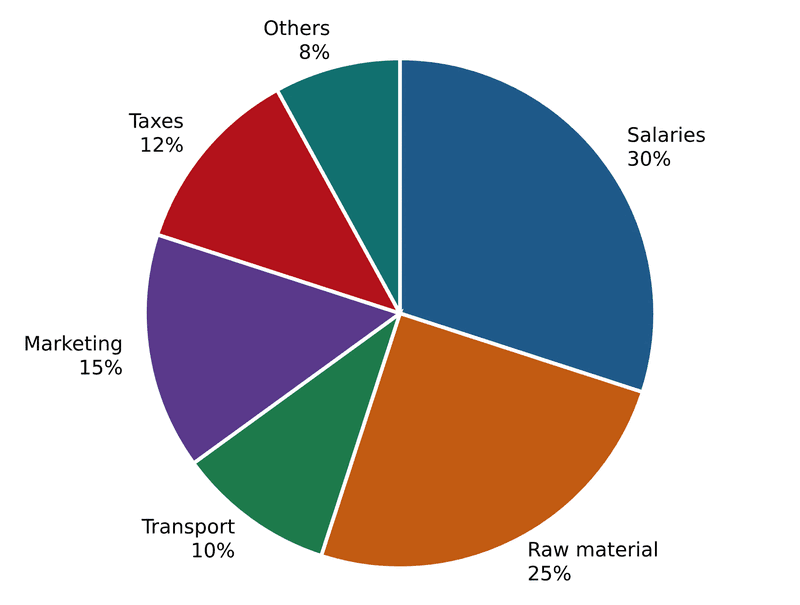
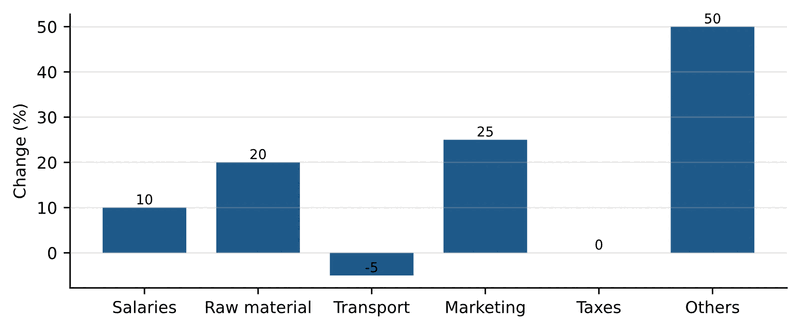
Directions (6–10): Practice data (hypothetical). The pie chart shows the distribution of a company's expenditure of ₹ 1,200 crore in 2024 among six heads. The bar chart shows the percentage change in the expenditure on each head in 2025 over 2024.
What was the expenditure (₹ crore) on Marketing in 2025?
Correct Answer:
B [225]
Explanation:
15% of 1,200 = 180 → × 1.25 = 225.
7.
What was the total expenditure (₹ crore) in 2025?
Correct Answer:
A [1,383]
Explanation:
396 + 360 + 114 + 225 + 144 + 144 = 1,383.
8.
By what per cent did the total expenditure rise from 2024 to 2025?
Correct Answer:
E [15.25%]
Explanation:
183 ÷ 1,200 × 100 = 15.25%.
9.
What is the ratio of the expenditure on Raw material to that on Salaries in 2025?
Correct Answer:
C [10 : 11]
Explanation:
360 : 396 = 10 : 11.
10.
What is the central angle (degrees) of the Transport sector in the 2024 pie chart?
Correct Answer:
D [36°]
Explanation:
10 × 3.6 = 36°.
11.
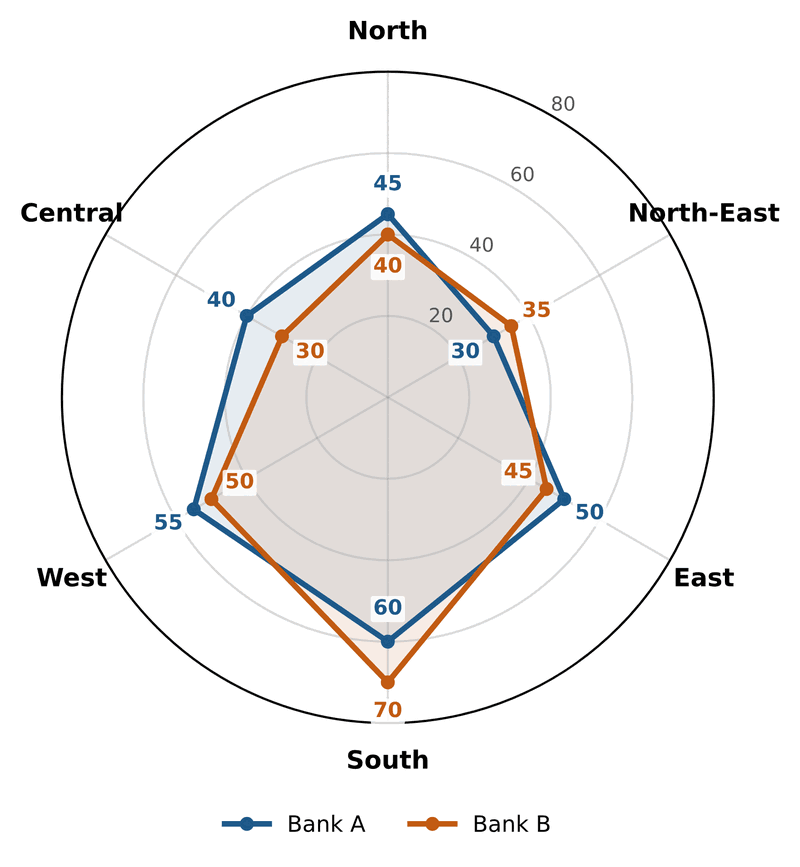
Directions (11–15): Practice data (hypothetical). The radar chart shows the number of loans (in hundreds) sanctioned by Bank A and Bank B in six regions.
What is the total number of loans (hundreds) sanctioned by Bank A?
Correct Answer:
D [280]
Explanation:
45 + 30 + 50 + 60 + 55 + 40 = 280.
12.
In how many regions did Bank B sanction more loans than Bank A?
Correct Answer:
B [2]
Explanation:
North-East (35 > 30) and South (70 > 60) → 2.
13.
By what per cent were Bank A's loans in the East more than Bank B's loans in the East?
Correct Answer:
C [11 1/9%]
Explanation:
(50 − 45) ÷ 45 × 100 = 11 1/9%.
14.
What is the average number of loans (hundreds) per region for Bank B?
Correct Answer:
E [45]
Explanation:
270 ÷ 6 = 45.
15.
What is the ratio of Bank A's total to Bank B's total?
Correct Answer:
A [28 : 27]
Explanation:
280 : 270 = 28 : 27.
16.
Directions (16–19): In each question two equations I and II are given. Solve them and choose: A) x > y, B) x < y, C) x ≥ y, D) x ≤ y, E) x = y or the relation cannot be established.
I. x² − 11x + 24 = 0 II. y² + 4y − 12 = 0
Correct Answer:
A [x > y]
Explanation:
x = 3, 8; y = −6, 2. All pairs → x > y.
17.
I. x² + 14x + 45 = 0 II. y² + y − 12 = 0
Correct Answer:
B [x < y]
Explanation:
x = −9, −5; y = −4, 3. All pairs → x < y.
18.
I. 2x² − 15x + 7 = 0 II. y² − 10y + 21 = 0
Correct Answer:
E [x = y or the relation cannot be established]
Explanation:
x = 1/2, 7; y = 3, 7. All pairs → x = y or the relation cannot be established.
19.
I. 3x² − 10x + 8 = 0 II. y² − 7y + 10 = 0
Correct Answer:
D [x ≤ y]
Explanation:
x = 4/3, 2; y = 2, 5. All pairs → x ≤ y.
20.
Directions (20–24): Compare Quantity I and Quantity II and choose: A) Quantity I > Quantity II, B) Quantity I < Quantity II, C) Quantity I ≥ Quantity II, D) Quantity I ≤ Quantity II, E) Quantity I = Quantity II or the relation cannot be established.
Quantity I: the simple interest on ₹ 12,000 at 10% per annum for 2 years. Quantity II: the compound interest on the same sum at the same rate for 2 years (compounded annually).
Correct Answer:
B [Quantity I < Quantity II]
Explanation:
SI = ₹ 2,400; CI = ₹ 2,520 → I < II.
21.
Quantity I: the speed (km/h) of a 300 m long train that crosses a 200 m bridge in 25 seconds. Quantity II: 70 km/h.
Correct Answer:
A [Quantity I > Quantity II]
Explanation:
500 m in 25 s = 20 m/s = 72 km/h > 70.
22.
Quantity I: the probability of a total of 7 when two dice are thrown. Quantity II: the probability of a head and a 3 when a coin is tossed and a die is thrown.
Quantity I: the area (cm²) of a square whose diagonal is 14 cm. Quantity II: the area (cm²) of a rectangle 14 cm by 7 cm.
Correct Answer:
E [Quantity I = Quantity II or relation cannot be established]
Explanation:
Square: d²/2 = 98; rectangle: 98 → equal → E.
25.
Directions (25–27): Each question has two statements. Choose: A) Statement I alone is sufficient, B) Statement II alone is sufficient, C) Either statement alone is sufficient, D) Both statements together are needed, E) Both statements together are not sufficient.
What is the speed of a train? I. It passes a pole in 10 seconds. II. It is 150 m long.
Correct Answer:
D [Both statements together are needed]
Explanation:
I gives L/v only, II gives L only; together v = 150 ÷ 10 = 15 m/s → both needed.
26.
What is the ratio of the ages of A and B? I. A is 25% older than B. II. The sum of their ages is 54 years.
Correct Answer:
A [Statement I alone is sufficient]
Explanation:
I alone: A = 1.25B → 5 : 4.
27.
What is the principal? I. The simple interest on it for 2 years at 10% per annum is ₹ 1,200. II. The compound interest on it for 2 years at 10% per annum (compounded annually) is ₹ 1,260.
Correct Answer:
C [Either statement alone is sufficient]
Explanation:
I: P = 1,200 ÷ 0.2 = 6,000.
28.
Directions (28–31): Find the missing term (28, 29) or the wrong term (30, 31).
What should come in place of the question mark (?) in the series? 4, 6, 12, 30, 84, ?
Correct Answer:
B [246]
Explanation:
Differences 2, 6, 18, 54 (× 3) → next +162 → 246.
29.
What should come in place of the question mark (?) in the series? 1, 3, 10, 41, 206, ?
Directions (32–33): Find the approximate value of the question mark (?).
44.98% of 1599.7 + 31.97 × 14.02 ≈ ?
Correct Answer:
E [1,168]
Explanation:
45% of 1600 = 720; 32 × 14 = 448 → 1,168.
33.
(2449.9 ÷ 49.03) × 11.98 − 15.02² ≈ ?
Correct Answer:
E [375]
Explanation:
2450 ÷ 49 = 50 → 50 × 12 = 600 → 600 − 225 = 375.
34.
Directions (34–40): Answer the following questions.
A is twice as efficient as B, and together they can finish a work in 18 days. A works alone for the first 6 days and then B joins him. In how many days in all is the work finished?
Correct Answer:
B [20 days]
Explanation:
A + B = 1/18 with A = 2B → A = 1/27.
35.
A train passes a 300 m platform in 30 seconds and a man standing on the platform in 12 seconds. What is the length of the train?
Correct Answer:
D [200 m]
Explanation:
L = 12v, L + 300 = 30v → v = 50/3 m/s → L = 200 m.
36.
A vessel has 80 litres of milk. 8 litres is taken out and replaced with water; this is done once more. How much milk is left?
Correct Answer:
C [64.8 litres]
Explanation:
80 × (1 − 8/80)² = 80 × 0.81 = 64.8 litres.
37.
A shopkeeper marks goods 30% above cost, allows a 10% discount and uses a 900 g weight in place of 1 kg. What is his profit per cent?
Correct Answer:
A [30%]
Explanation:
For 900 g bought (cost 0.9) he receives 1.3 × 0.9 = 1.17 → profit 0.27 ÷ 0.9 = 30%.
38.
A starts a business with ₹ 20,000. After 4 months B joins with ₹ 30,000, and 2 months after that C joins with ₹ 40,000. Out of a year's profit of ₹ 27,000, what is C's share?
Here you get the answer with a one-line explanation. 842 questions, each with a full step-by-step explanation · shortcuts, tables, trap alerts · Prelims + Mains sectional mocks. All 5 books together: ₹599.