

SSC CGL Geography – Universe & the Solar System – Level 2 · Exam Level · Tier I Sprint
← Back
Light-year = distance light covers in a year; 4.2 ly away ⇒ light takes ≈ 4.2 years.
₹599 →
SSC CGL Geography – Universe & the Solar System – Level 2 · Exam Level · Tier I Sprint – 15 questions, subject: Geography – India & World. Every question has the correct answer with a one-line explanation; tap "Show Answer". Free practice for TNPSC, UPSC, SSC, Bank and RRB exams – Shanmugam IAS Academy, Coimbatore.
Get daily current affairs & exam alerts – follow us
YouTube
WhatsApp Channel
Telegram Channel
Facebook Page
Instagram
Share with friends & study groups
Link to this page from your website / blog (HTML code)
1.
Statement-basedConsider the statements:
I. Sunspots look dark because they are cooler than the area around them.
II. The corona can be seen with the naked eye on any clear day.
Which is/are correct?
I. Sunspots look dark because they are cooler than the area around them.
II. The corona can be seen with the naked eye on any clear day.
Which is/are correct?
Correct Answer: C [Only I]
Explanation:
Sunspots are cooler patches; the corona is seen only during a total solar eclipse (or with special instruments).
2.
Arrange in orderArrange in decreasing order of size: Saturn, Earth, Uranus, Mars
Correct Answer: A [Saturn, Uranus, Earth, Mars]
Explanation:
J-SUN-EVM-M: Saturn > Uranus > Earth > Mars.
3.
Match the followingMatch the planet with its feature:
P. Mercury Q. Saturn R. Uranus S. Earth
1. densest planet 2. spins on its side 3. average density less than water 4. shortest year
P. Mercury Q. Saturn R. Uranus S. Earth
1. densest planet 2. spins on its side 3. average density less than water 4. shortest year
Correct Answer: D [P-4, Q-3, R-2, S-1]
Explanation:
Mercury 88-day year; Saturn less dense than water; Uranus tilt ≈ 98°; Earth densest.
4.
Odd one outMercury, Venus, Mars, Neptune
Correct Answer: B [Neptune]
Explanation:
The other three are rocky inner planets; Neptune is an ice giant.
5.
Diagram-basedThe figure shows the positions of three bodies at one moment (not to scale). Which event can be seen?
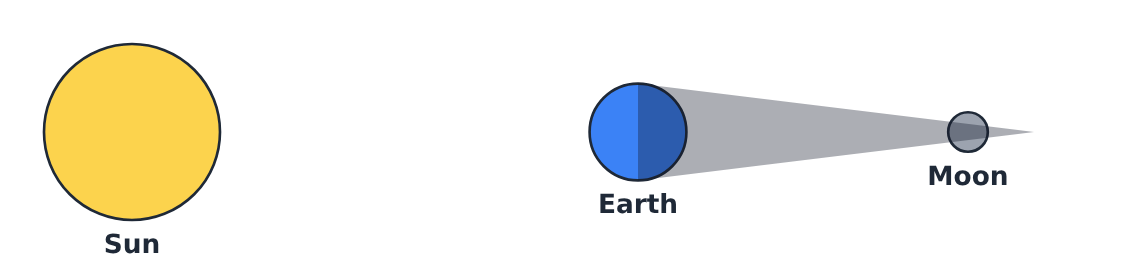
Correct Answer: C [Lunar eclipse]
Explanation:
Earth is in the middle and its shadow falls on the Moon → lunar eclipse (full moon).
6.
Assertion–Reason
A: There is no weather on the Moon.
R: The Moon has no atmosphere.
A: There is no weather on the Moon.
R: The Moon has no atmosphere.
Correct Answer: B [Both A and R are true and R explains A]
Explanation:
Weather needs air; with no atmosphere the Moon has no wind, clouds or rain.
7.
Sunlight takes approximately how long to reach the Earth?
Correct Answer: D [8 min 20 s]
Explanation:
1 AU ÷ c ≈ 499 s ≈ 8 min 20 s.
8.
Which of the following is NOT a dwarf planet?
Correct Answer: A [Titan]
Explanation:
Titan is Saturn's largest moon; Ceres, Eris and Makemake are dwarf planets.
9.
The tail of a comet always points:
Correct Answer: B [away from the Sun]
Explanation:
Solar wind and sunlight pressure push the tail away from the Sun.
10.
How many statements are trueHow many of these statements are true?
I. Mercury has no natural moon.
II. Venus has one natural moon.
III. Mars has two natural moons.
IV. The Earth has one natural moon.
I. Mercury has no natural moon.
II. Venus has one natural moon.
III. Mars has two natural moons.
IV. The Earth has one natural moon.
Correct Answer: D [3]
Explanation:
I, III and IV are true; Venus has no moon.
11.
Diagram-basedIn the figure the planets are shown in order from the Sun. Which planet is at the place marked '?'

Correct Answer: A [Saturn]
Explanation:
Sixth from the Sun: M-V-E-M-J- S → Saturn.
12.
A meteorite is:
Correct Answer: C [a piece of rock from space that reaches the Earth's surface]
Explanation:
Meteoroid in space → meteor in the sky → meteorite on the ground.
13.
Two-quantity comparison
Quantity I: time taken by light to travel from the Moon to the Earth
Quantity II: 1 second
Quantity I: time taken by light to travel from the Moon to the Earth
Quantity II: 1 second
Correct Answer: A [Quantity I > Quantity II]
Explanation:
3,84,400 ÷ 2,99,792 ≈ 1.28 s, which is more than 1 s.
14.
Which planet was discovered by William Herschel in 1781?
Correct Answer: D [Uranus]
Explanation:
Uranus (1781) – the first planet found with a telescope; Neptune followed in 1846.
15.
Spot My Mistake“Proxima Centauri is 4.2 light-years away, so its light takes 4.2 light-years to reach us.” What is the right correction?
Correct Answer: B [A light-year is a distance; the light takes about 4.2 years]
Explanation:
Light-year = distance light covers in a year; 4.2 ly away ⇒ light takes ≈ 4.2 years.
➤ Full notes, shortcuts and every answer explained – SSC CGL 2026 Geography – India & World book (₹149): www.shanmugamiasacademy.in/study-materials/ssc-cgl-geography-india-world
📘 TNPSC பொது அறிவு அலகு II — இந்தியாவின் புவியியல் (Geography of India) – முழுமையான பாடநூல்
Here you get the answer with a one-line explanation. TNPSC பொது அறிவு அலகு II இந்தியப் புவியியல் முழுவதும் · 14 அத்தியாயங்கள் · 340 பயிற்சி வினாக்கள் விளக்கத்துடன் · 2 மாதிரித் தேர்வுகள் (100 வினாக்கள்) · வரைபடங்கள், 14 மனவரைபடங்கள் · ஒவ்வோர் அத்தியாயத்திலும் தமிழ்நாடு பார்வை
Get the book – ₹299 More quizzes
› SSC CGL Geography – Mock Test 3 – Tier II Style – Mock Test 3 · Tier II Style
› SSC CGL Geography – Mock Test 2 – Tier I Style – Mock Test 2 · Tier I Style
› SSC CGL Geography – Mock Test 1 – Tier I Style – Mock Test 1 · Tier I Style
› SSC CGL Geography – Environment, Ecology & Climate Change – Tier II Level · Marathon
› SSC CGL Geography – Environment, Ecology & Climate Change – Level 3 · Challenge
› SSC CGL Geography – Environment, Ecology & Climate Change – Level 2 · Exam Level · Tier I Sprint
Score: 0
Answered: 0 / 0
