

SSC CGL Geography – Interior of the Earth & Rocks – Level 2 · Exam Level · Tier I Sprint
← Back
Granite → gneiss; limestone → marble.
₹599 →
SSC CGL Geography – Interior of the Earth & Rocks – Level 2 · Exam Level · Tier I Sprint – 15 questions, subject: Geography – India & World. Every question has the correct answer with a one-line explanation; tap "Show Answer". Free practice for TNPSC, UPSC, SSC, Bank and RRB exams – Shanmugam IAS Academy, Coimbatore.
Get daily current affairs & exam alerts – follow us
YouTube
WhatsApp Channel
Telegram Channel
Facebook Page
Instagram
Share with friends & study groups
Link to this page from your website / blog (HTML code)
1.
Statement-basedConsider:
I. The oceanic crust is thinner than the continental crust.
II. The oceanic crust is made mainly of SIAL.
Which is/are correct?
I. The oceanic crust is thinner than the continental crust.
II. The oceanic crust is made mainly of SIAL.
Which is/are correct?
Correct Answer: B [Only I]
Explanation:
Oceanic crust ≈ 5 km and SIMA; continental ≈ 30 km and SIAL.
2.
Match the followingMatch the rock with its group:
P. Basalt Q. Shale R. Slate S. Rock salt
1. metamorphic 2. chemically formed sedimentary 3. igneous 4. mechanically formed sedimentary
P. Basalt Q. Shale R. Slate S. Rock salt
1. metamorphic 2. chemically formed sedimentary 3. igneous 4. mechanically formed sedimentary
Correct Answer: A [P-3, Q-4, R-1, S-2]
Explanation:
Basalt – cooled lava; shale – deposited fragments; slate – changed shale; rock salt – precipitated from water.
3.
Diagram-basedThe figure shows a section of the Earth with four layers W, X, Y and Z. Which layer is solid in spite of very high temperature, because of enormous pressure?
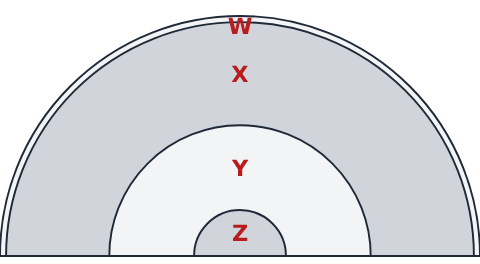
Correct Answer: C [Z]
Explanation:
From outside: W crust, X mantle, Y outer core (liquid), Z inner core (solid under enormous pressure).
4.
Arrange in orderArrange the discontinuities from the surface towards the centre: Lehmann, Moho, Gutenberg, Conrad
Correct Answer: D [Conrad, Moho, Gutenberg, Lehmann]
Explanation:
Chennai Metro Goes Long: Conrad → Moho → Gutenberg → Lehmann.
5.
Odd one outPumice, Basalt, Granite, Chalk
Correct Answer: B [Chalk]
Explanation:
Chalk is an organically formed sedimentary rock; the others are igneous.
6.
Assertion–Reason
A: S-waves are not recorded at stations more than 105° away from the epicentre.
R: The outer core of the Earth is liquid.
A: S-waves are not recorded at stations more than 105° away from the epicentre.
R: The outer core of the Earth is liquid.
Correct Answer: C [Both A and R are true and R explains A]
Explanation:
S-waves cannot cross the liquid outer core.
7.
How many statements are trueHow many of these statements are true?
I. P-waves are the fastest earthquake waves.
II. Surface waves are the most destructive.
III. S-waves can travel through liquids.
IV. P-waves can pass through gases.
I. P-waves are the fastest earthquake waves.
II. Surface waves are the most destructive.
III. S-waves can travel through liquids.
IV. P-waves can pass through gases.
Correct Answer: A [3]
Explanation:
Only III is false – S-waves travel through solids only.
8.
The second most abundant element in the Earth's crust (by weight) is:
Correct Answer: D [Silicon]
Explanation:
O 46.60% > Si 27.72% > Al 8.13% > Fe 5.00%.
9.
Which of these minerals can scratch quartz?
Correct Answer: A [Topaz]
Explanation:
Topaz (8) > quartz (7); the others are below 7.
10.
Two-quantity comparison
Quantity I: Mohs hardness of orthoclase
Quantity II: Mohs hardness of apatite
Quantity I: Mohs hardness of orthoclase
Quantity II: Mohs hardness of apatite
Correct Answer: A [Quantity I > Quantity II]
Explanation:
Orthoclase = 6, apatite = 5.
11.
The asthenosphere is a part of the:
Correct Answer: C [upper mantle]
Explanation:
Soft, partly molten upper mantle below the lithosphere.
12.
Diagram-basedIn the figure, station S is 155° away from the epicentre. Which earthquake waves will it record?
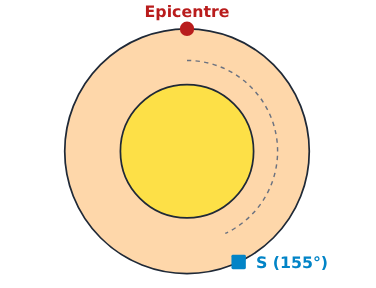
Correct Answer: D [Only P]
Explanation:
Beyond 145° P-waves arrive after passing through the core; S-waves cannot cross the liquid outer core.
13.
Coal is a/an:
Correct Answer: B [organically formed sedimentary rock]
Explanation:
Coal forms from buried plant remains.
14.
Reverse question“I am coarse-grained, light-coloured, rich in silica and I formed deep underground.” Which rock am I?
Correct Answer: D [Granite]
Explanation:
Coarse + deep = intrusive; light + silica-rich = acid → granite.
15.
Spot My Mistake“Gneiss is formed by the metamorphism of limestone.” What is the correct statement?
Correct Answer: C [Gneiss is formed from granite]
Explanation:
Granite → gneiss; limestone → marble.
➤ Full notes, shortcuts and every answer explained – SSC CGL 2026 Geography – India & World book (₹149): www.shanmugamiasacademy.in/study-materials/ssc-cgl-geography-india-world
📘 TNPSC பொது அறிவு அலகு II — இந்தியாவின் புவியியல் (Geography of India) – முழுமையான பாடநூல்
Here you get the answer with a one-line explanation. TNPSC பொது அறிவு அலகு II இந்தியப் புவியியல் முழுவதும் · 14 அத்தியாயங்கள் · 340 பயிற்சி வினாக்கள் விளக்கத்துடன் · 2 மாதிரித் தேர்வுகள் (100 வினாக்கள்) · வரைபடங்கள், 14 மனவரைபடங்கள் · ஒவ்வோர் அத்தியாயத்திலும் தமிழ்நாடு பார்வை
Get the book – ₹299 More quizzes
› SSC CGL Geography – Mock Test 3 – Tier II Style – Mock Test 3 · Tier II Style
› SSC CGL Geography – Mock Test 2 – Tier I Style – Mock Test 2 · Tier I Style
› SSC CGL Geography – Mock Test 1 – Tier I Style – Mock Test 1 · Tier I Style
› SSC CGL Geography – Environment, Ecology & Climate Change – Tier II Level · Marathon
› SSC CGL Geography – Environment, Ecology & Climate Change – Level 3 · Challenge
› SSC CGL Geography – Environment, Ecology & Climate Change – Level 2 · Exam Level · Tier I Sprint
Score: 0
Answered: 0 / 0
