

SSC CGL Geography – Hydrosphere – Oceans, Currents & Tides – Level 2 · Exam Level · Tier I Sprint
← Back
Their algae need sunlight; mud and fresh water harm them.
₹599 →
SSC CGL Geography – Hydrosphere – Oceans, Currents & Tides – Level 2 · Exam Level · Tier I Sprint – 15 questions, subject: Geography – India & World. Every question has the correct answer with a one-line explanation; tap "Show Answer". Free practice for TNPSC, UPSC, SSC, Bank and RRB exams – Shanmugam IAS Academy, Coimbatore.
Get daily current affairs & exam alerts – follow us
YouTube
WhatsApp Channel
Telegram Channel
Facebook Page
Instagram
Share with friends & study groups
Link to this page from your website / blog (HTML code)
1.
Statement-basedConsider:
I. The highest salinity of the open ocean is found right at the equator.
II. The Baltic Sea has low salinity.
Which is/are correct?
I. The highest salinity of the open ocean is found right at the equator.
II. The Baltic Sea has low salinity.
Which is/are correct?
Correct Answer: A [Only II]
Explanation:
The maximum is in the subtropics; the equator gets heavy rain.
2.
Match the followingMatch:
P. Kuroshio Q. Canary R. Agulhas S. Peru (Humboldt)
1. Atlantic, cold 2. Indian, warm 3. Pacific, cold 4. Pacific, warm
P. Kuroshio Q. Canary R. Agulhas S. Peru (Humboldt)
1. Atlantic, cold 2. Indian, warm 3. Pacific, cold 4. Pacific, warm
Correct Answer: C [P-4, Q-1, R-2, S-3]
Explanation:
Warm West, Cold East of each ocean.
3.
Diagram-basedThe figure shows an ocean between two continents in the Northern Hemisphere. The current X, flowing along the eastern side of the ocean towards the equator, is most likely:
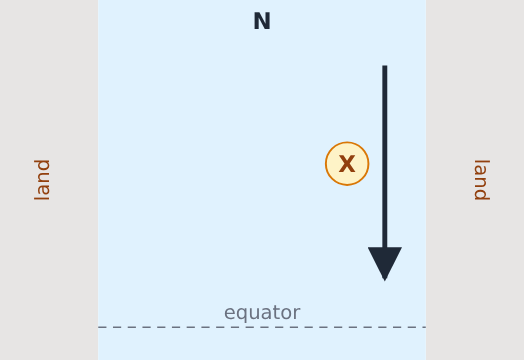
Correct Answer: B [a cold current]
Explanation:
Eastern side of an ocean (west coast of a continent), flowing to the equator → cold.
4.
Two-quantity comparison
Quantity I: grams of salt in 3 kg of sea water of salinity 35‰
Quantity II: grams of salt in 2.5 kg of sea water of salinity 40‰
Quantity I: grams of salt in 3 kg of sea water of salinity 35‰
Quantity II: grams of salt in 2.5 kg of sea water of salinity 40‰
Correct Answer: A [Quantity I > Quantity II]
Explanation:
105 g vs 100 g.
5.
Arrange in orderArrange the oceans from the largest to the smallest: Arctic, Pacific, Indian, Atlantic
Correct Answer: D [Pacific, Atlantic, Indian, Arctic]
Explanation:
Please Accept Indian Sweet Apples.
6.
Odd one outGulf Stream, Kuroshio, Brazil Current, Benguela Current
Correct Answer: B [Benguela Current]
Explanation:
Benguela is cold; the rest are warm.
7.
Assertion–Reason
A: The seas off Japan are among the richest fishing grounds of the world.
R: The warm Kuroshio meets the cold Oyashio there.
A: The seas off Japan are among the richest fishing grounds of the world.
R: The warm Kuroshio meets the cold Oyashio there.
Correct Answer: A [Both A and R are true and R explains A]
Explanation:
The mixing of warm and cold water favours plankton.
8.
How many statements are trueHow many of these statements are true?
I. Neap tides occur on quarter-moon days.
II. Tides come about 50 minutes later each day.
III. The Sun's tide-raising force is greater than the Moon's.
IV. Spring tides have the smallest tidal range.
I. Neap tides occur on quarter-moon days.
II. Tides come about 50 minutes later each day.
III. The Sun's tide-raising force is greater than the Moon's.
IV. Spring tides have the smallest tidal range.
Correct Answer: C [2]
Explanation:
I and II are true; the Moon's force is about twice the Sun's, and spring tides have the largest range.
9.
Which pair (current – region) is correctly matched?
Correct Answer: D [Benguela – off south-west Africa]
Explanation:
Labrador – off Canada; Kuroshio – off Japan; Agulhas – off south-east Africa.
10.
Diagram-basedThe figure shows the positions of the Sun, the Earth and the Moon. What kind of tide will the Earth have?
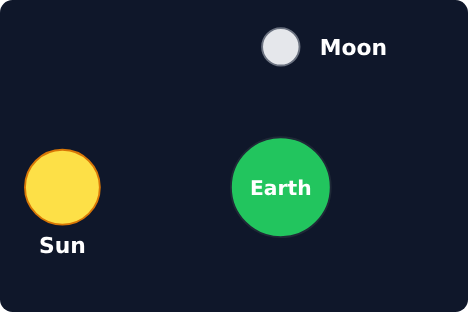
Correct Answer: B [Neap tide]
Explanation:
Sun and Moon at right angles → neap tide.
11.
High tide at a port is at 7:40 a.m. The next high tide will be at about:
Correct Answer: D [8:05 p.m.]
Explanation:
Add 12 h 25 min.
12.
Reverse question“I am an underwater volcanic mountain with a flat top.” What am I?
Correct Answer: C [Guyot]
Explanation:
A seamount with a flat top.
13.
Spot My Mistake“Warm currents flow from the poles towards the equator.” What is correct?
Correct Answer: A [Warm currents flow from the equator towards the poles]
Explanation:
Cold currents flow towards the equator.
14.
Icebergs break off (calve) mainly from the glaciers and ice shelves of:
Correct Answer: B [Greenland and Antarctica]
Explanation:
Ice is a little lighter than sea water, so icebergs float with most of their bulk below the surface.
15.
Coral reefs grow best in:
Correct Answer: A [warm, clear, shallow and salty water]
Explanation:
Their algae need sunlight; mud and fresh water harm them.
➤ Full notes, shortcuts and every answer explained – SSC CGL 2026 Geography – India & World book (₹149): www.shanmugamiasacademy.in/study-materials/ssc-cgl-geography-india-world
📘 TNPSC பொது அறிவு அலகு II — இந்தியாவின் புவியியல் (Geography of India) – முழுமையான பாடநூல்
Here you get the answer with a one-line explanation. TNPSC பொது அறிவு அலகு II இந்தியப் புவியியல் முழுவதும் · 14 அத்தியாயங்கள் · 340 பயிற்சி வினாக்கள் விளக்கத்துடன் · 2 மாதிரித் தேர்வுகள் (100 வினாக்கள்) · வரைபடங்கள், 14 மனவரைபடங்கள் · ஒவ்வோர் அத்தியாயத்திலும் தமிழ்நாடு பார்வை
Get the book – ₹299 More quizzes
› SSC CGL Geography – Mock Test 3 – Tier II Style – Mock Test 3 · Tier II Style
› SSC CGL Geography – Mock Test 2 – Tier I Style – Mock Test 2 · Tier I Style
› SSC CGL Geography – Mock Test 1 – Tier I Style – Mock Test 1 · Tier I Style
› SSC CGL Geography – Environment, Ecology & Climate Change – Tier II Level · Marathon
› SSC CGL Geography – Environment, Ecology & Climate Change – Level 3 · Challenge
› SSC CGL Geography – Environment, Ecology & Climate Change – Level 2 · Exam Level · Tier I Sprint
Score: 0
Answered: 0 / 0
