

SSC CGL History – Socio-Religious Reform Movements – Level 3 · Challenge
← Back
1856 – Hindu Widows' Remarriage Act (Canning).
₹299 →
SSC CGL History – Socio-Religious Reform Movements – Level 3 · Challenge – 8 questions, subject: History & Culture of India. Every question has the correct answer with a one-line explanation; tap "Show Answer". Free practice for TNPSC, UPSC, SSC, Bank and RRB exams – Shanmugam IAS Academy, Coimbatore.
Get daily current affairs & exam alerts – follow us
YouTube
WhatsApp Channel
Telegram Channel
Facebook Page
Instagram
Share with friends & study groups
Link to this page from your website / blog (HTML code)
1.
Assertion–ReasonAssertion (A): The Deoband school opposed British rule.
Reason (R): The Deoband school promoted English education among Muslims.
Reason (R): The Deoband school promoted English education among Muslims.
Correct Answer: A [A is true but R is false]
Explanation:
A true; R false – Deoband stood for traditional Islamic learning; Aligarh promoted English education.
2.
Assertion–ReasonAssertion (A): Periyar is called 'Vaikom Veerar'.
Reason (R): Periyar took a leading part in the Vaikom Satyagraha against caste restrictions on temple roads.
Reason (R): Periyar took a leading part in the Vaikom Satyagraha against caste restrictions on temple roads.
Correct Answer: B [Both A and R are true and R is the correct explanation of A]
Explanation:
Both true; his role at Vaikom earned him the title.
3.
Two-stepThe reformer whose campaign led to the Age of Consent Act (1891) belonged to which community?
Correct Answer: D [Parsi]
Explanation:
Age of Consent → Behramji Malabari → a Parsi reformer.
4.
Statement-basedConsider the following statements:
I. Annie Besant founded the Central Hindu College at Benares.
II. The Central Hindu College was the forerunner of Aligarh Muslim University.
Which of the statements given above is/are correct?
I. Annie Besant founded the Central Hindu College at Benares.
II. The Central Hindu College was the forerunner of Aligarh Muslim University.
Which of the statements given above is/are correct?
Correct Answer: A [Only I]
Explanation:
CHC (1898) – Besant (true); it grew into Banaras Hindu University, not AMU (false).
5.
Spot My Mistake“Annie Besant, born in Dublin, joined the Theosophical Society in 1889.” Which correction is needed?
Correct Answer: C [Replace Dublin with London]
Explanation:
Besant was born in London (1847), of Irish parents; she joined in 1889.
6.
Chronological orderArrange the laws in chronological order:
1. Age of Consent Act
2. Child Marriage Restraint Act
3. Bengal Sati Regulation
4. Hindu Widows' Remarriage Act
1. Age of Consent Act
2. Child Marriage Restraint Act
3. Bengal Sati Regulation
4. Hindu Widows' Remarriage Act
Correct Answer: C [3, 4, 1, 2]
Explanation:
Bengal Sati Regulation (1829) → Hindu Widows' Remarriage Act (1856) → Age of Consent Act (1891) → Child Marriage Restraint Act (1929).
7.
Data tableLaws: Sati ban 1829; Widow Remarriage 1856; Age of Consent 1891; Sarda Act 1929. How many years separate the first and last law?
Correct Answer: D [100]
Explanation:
1929 − 1829 = 100 years.
8.
Diagram-basedIn the ladder of laws, which law stands on the step labelled 1856?
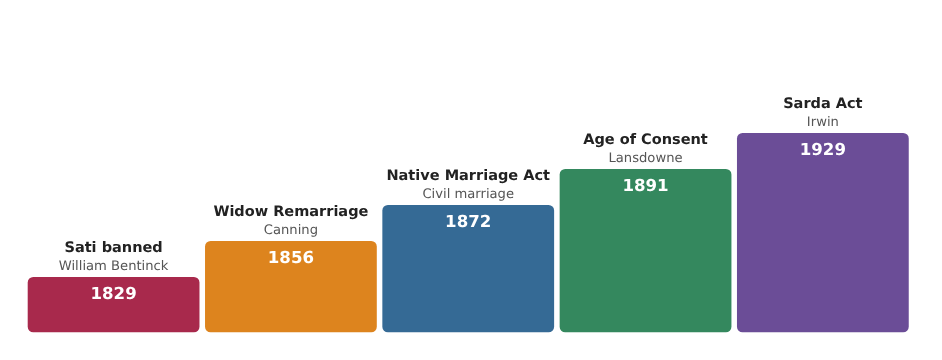
Correct Answer: B [Widow Remarriage]
Explanation:
1856 – Hindu Widows' Remarriage Act (Canning).
➤ Full notes, shortcuts and every answer explained – SSC CGL 2026 History & Culture of India book (₹149): www.shanmugamiasacademy.in/study-materials/ssc-cgl-history-culture-of-india
📘 இந்திய வரலாறு — முந்தைய ஆண்டு வினா – விடை – விளக்கம் (2020 – 2026)
Here you get the answer with a one-line explanation. 426 வினாக்கள் தமிழ் + ஆங்கிலத்தில் · சரிபார்க்கப்பட்ட விடை + விளக்கம் · 137 அட்டவணைகள் & குறிப்புகள் · 20 அலகுகள் (25 பகுதிகள்) · 2020 – 2026 TNPSC தேர்வுகள்
Get the book – ₹149 More quizzes
› SSC CGL History – Mock Test 3 – Tier II Style – Mock Test 3 · Tier II Style
› SSC CGL History – Mock Test 2 – Tier I Style – Mock Test 2 · Tier I Style
› SSC CGL History – Mock Test 1 – Tier I Style – Mock Test 1 · Tier I Style
› SSC CGL History – Dance, Music, Theatre, Literature & Festivals – Tier II Level · Marathon
› SSC CGL History – Dance, Music, Theatre, Literature & Festivals – Level 3 · Challenge
› SSC CGL History – Dance, Music, Theatre, Literature & Festivals – Level 2 · Exam Level · Tier I Sprint
Score: 0
Answered: 0 / 0
