

Chance of limiting warming to 1.5°C with no or limited overshoot is gone – UNEP Emissions Gap Report 2026 warns
23-10-2026 · English
Topics: International & Important Days · 23 October 2026 Current Affairs (UPSC / TNPSC / SSC / RRB)
News
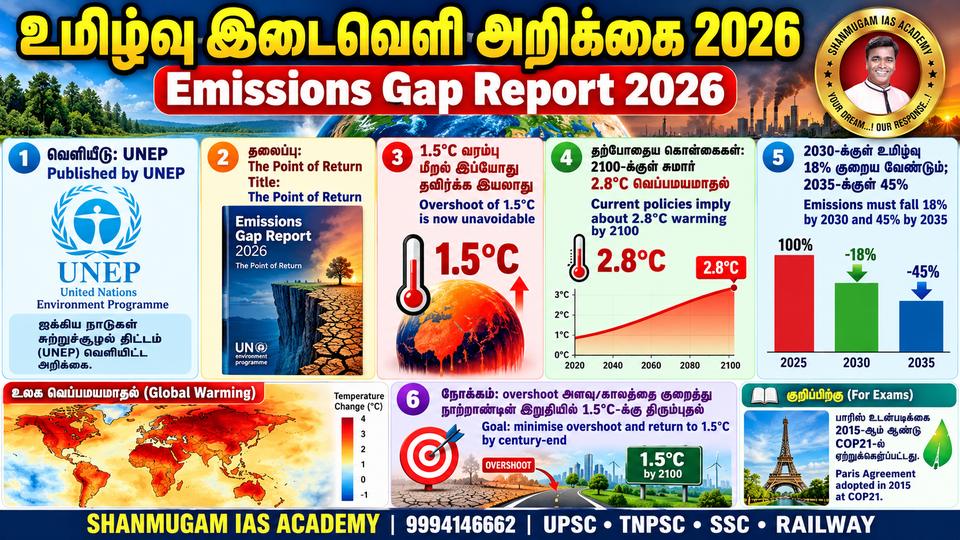
The UN Environment Programme (UNEP) released its 17th annual report, 'Emissions Gap Report 2026: The Point of Return', on 21 Oct 2026. It warns that the chance of holding global warming below 1.5°C above pre-industrial levels with no or limited overshoot is gone. Current policies would lead to about 2.8°C of warming this century; full delivery of national pledges (NDCs) to about 2.6°C; and NDCs plus net-zero targets to about 2.1°C. Global greenhouse-gas emissions in 2025 were about 58.4 billion tonnes CO2-equivalent – roughly level with 2024; G20 members account for about 76%. The report came ahead of COP31 at Antalya, Türkiye, on 9–20 Nov 2026.
Key facts
| Release | 21 Oct 2026 – UNEP; 17th edition; title 'The Point of Return' |
| Warming outlook | Current policies ~2.8°C; full NDCs ~2.6°C; NDCs + net zero ~2.1°C |
| 2025 emissions | 58.4 Gt CO2e; G20 ~76% |
| Cuts needed | For the lowest-overshoot path: 18% by 2030 and 45% by 2035, from 2025 levels |
| Best case | Peak ~1.7–1.8°C around mid-century; 50% chance of returning to 1.5°C by 2100 |
| COP31 | 9–20 Nov 2026 – Antalya, Türkiye |
Background
- 'Emissions gap' means the difference between the emissions expected in 2030/2035 under countries' pledges and the level needed to meet the 1.5°C or 2°C goal. The report has been issued every year since 2010. Earlier titles: 2023 'Broken Record', 2024 'No more hot air… please!', 2025 'Off Target'.
- Paris Agreement: adopted at COP21 on 12 Dec 2015; in force 4 Nov 2016. Goal – keep warming 'well below' 2°C and pursue efforts to limit it to 1.5°C. Each country submits a 'Nationally Determined Contribution' (NDC) every five years. The report cites the US withdrawal from the Agreement as one reason for this year's worse outlook.
- India's targets: updated NDC (2022) – cut emissions intensity of GDP by 45% from 2005 levels by 2030; 50% non-fossil power capacity. New NDC (2031–35, March 2026) – 47% intensity cut by 2035, 60% non-fossil capacity, an additional 3.5–4.0 billion tonne carbon sink. Net zero by 2070 (COP26, Glasgow 2021). Mission 'LiFE' (Lifestyle for Environment) was launched on 20 Oct 2022 at Ekta Nagar, Gujarat.
- Science: the main greenhouse gases are carbon dioxide (CO2), methane (CH4), nitrous oxide (N2O) and fluorinated gases. Different gases are converted to CO2-equivalent (CO2e) using their Global Warming Potential (GWP). The report says every five years of CO2 emissions at current levels adds about 0.1°C to peak warming.
Tamil Nadu link: to institutionalise the State's climate action, the 'Tamil Nadu Green Climate Company' (TNGCC) was set up in 2021 as a special purpose vehicle under Section 8 of the Companies Act, 2013 (office: Nandanam, Chennai). It runs four flagship missions – the Tamil Nadu Climate Change Mission, Green Tamil Nadu Mission, Wetlands Mission and Coastal Restoration Mission (TN-SHORE) – aiming to put Tamil Nadu on a net-zero pathway well before 2070. Every district has a District Climate Change Mission.
Source: UNEP / PBL Netherlands (21.10.2026); Down To Earth (21.10.2026); The Star / AP (21.10.2026); Drishti IAS (India's NDC, 28.3.2026); TNGCC website
Join our UPSC classroom or online batch: UPSC coaching in Coimbatore · Fees · Call 99941 46662.
Link to this page from your website / blog (HTML code)
BANK Achievers
-

SUJATHA
BANK BANK
