

Indian Army receives 'Nagastra-2' anti-tank loitering munitions – made by Nagpur's Solar Defence & Aerospace
23-10-2026 · English
Topics: Science, Economy & Defence · 23 October 2026 Current Affairs (UPSC / TNPSC / SSC / RRB)
News
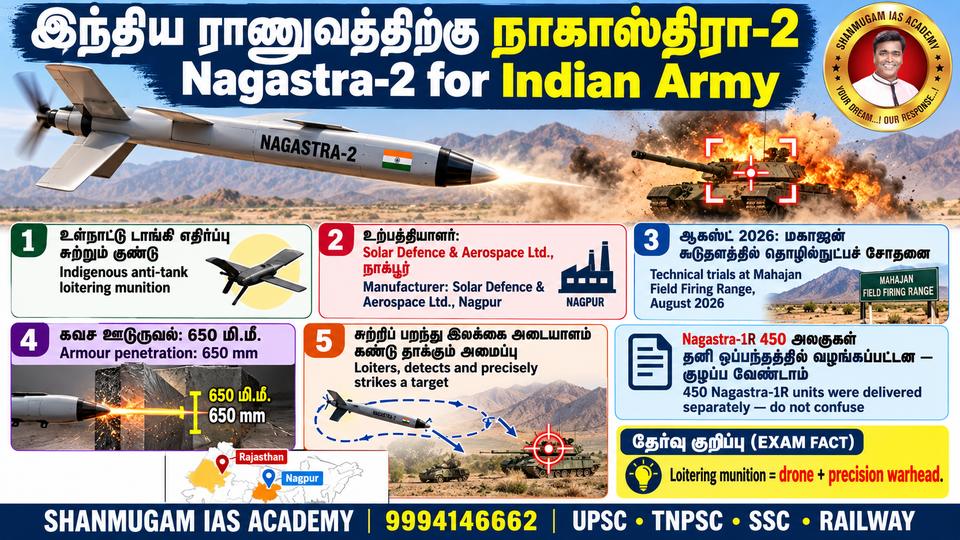
Reports on 23 Oct 2026 said Nagpur-based Solar Defence and Aerospace Ltd (SDAL, Solar Industries group) has delivered its indigenous 'Nagastra-2' anti-tank loitering munitions to the Indian Army. Deliveries began after technical trials at the Mahajan Field Firing Range (Rajasthan) in August 2026; the Nagastra family has also been tested in high-altitude Ladakh and the plains of Babina (UP). Its 4 kg tandem shaped-charge warhead can pierce 650 mm of rolled homogeneous armour; range 25 km in recover-and-reuse mode and 50 km in fire-and-forget mode; endurance up to 60 minutes. Shortly before, on 13–14 Oct 2026, about 450 'Nagastra-1R' units were delivered.
Key facts
| Maker | Solar Defence & Aerospace Ltd (SDAL), Nagpur – Solar Industries group |
| Role | Strike tanks and armoured vehicles |
| Warhead | 4 kg tandem shaped charge – pierces 650 mm RHA |
| Range / endurance | 25 km (recoverable), 50 km (fire-and-forget); up to 60 min |
| Features | Day/night EO/IR cameras; encrypted links; ECCM against GPS jamming & spoofing |
| Trials | Mahajan range (Aug 2026); Nagastra family – Ladakh, Babina (UP) |
Background
- A loitering munition ('kamikaze drone') is an unmanned aircraft that hovers over a target area, watches it, and then dives into the target and explodes. It combines a missile's strike power with a drone's surveillance; many models can abort the attack and be recovered.
- Nagastra-1: developed by Economic Explosives Ltd (EEL, Nagpur), a Solar Industries subsidiary, with Bengaluru's Z-Motion; over 75% indigenous. The first batch (120) reached the Army in June 2024; it was used in 'Operation Sindoor' (2025). Nagastra-1 has a small (1–1.5 kg) fragmentation warhead; Nagastra-2 carries a heavier anti-tank warhead.
- Background – missile programme: DRDO's Integrated Guided Missile Development Programme (IGMDP, 1983), led by A.P.J. Abdul Kalam, produced five missiles – Prithvi, Agni, Trishul, Akash and Nag. Nag is a third-generation fire-and-forget anti-tank guided missile (ATGM).
- Science: a tandem warhead has two shaped charges – the first sets off the tank's outer explosive reactive armour (ERA); the second pierces the main armour.
Tamil Nadu link: The Madras Institute of Technology (MIT), Chromepet, Chennai (1949, founded by Chinnaswami Rajam) was the first in India to offer an undergraduate course in aeronautical engineering; A.P.J. Abdul Kalam studied aeronautical engineering here. This Anna University campus houses the 'Dr. Kalam Advanced UAV Research Centre' (2019), with which the 'Tamil Nadu Unmanned Aerial Vehicles Corporation' (TNUAVC) was set up in 2022.
Source: The Week, India TV, The Defense News, 23 Oct 2026; Wikipedia (Nagastra-1, MIT); MIT CASR website
Join our UPSC classroom or online batch: UPSC coaching in Coimbatore · Fees · Call 99941 46662.
Link to this page from your website / blog (HTML code)
TNPSC Achievers
-

ANNAMALAI
TNPSC TNPSC
