

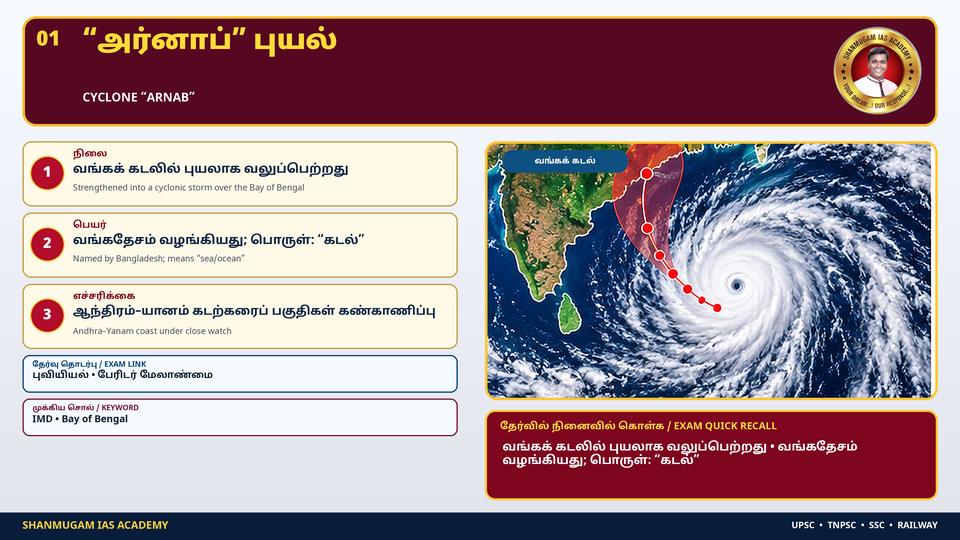
Bay of Bengal deep depression intensifies into Cyclone 'Arnab' (named by Bangladesh; means 'sea') – to cross Andhra coast on 28 Oct
26 October 2026 · English InternationalEnvironment & Ecology
Topics: Tamil Nadu, Weather & Space · 26 October 2026 Current Affairs (UPSC / TNPSC / SSC / RRB)
News
On the morning of 26 Oct 2026 (Monday), the India Meteorological Department (IMD) said a deep depression had intensified into Cyclonic Storm 'Arnab', centred over the east-central and adjoining west-central Bay of Bengal. It moved west at about 15 km/h. It was forecast to become a severe cyclonic storm on the night of 26 Oct and a very severe cyclonic storm on 27 Oct, and to cross the Andhra Pradesh and Yanam coast between Bapatla and Visakhapatnam in the forenoon of 28 Oct, with winds of 115–125 km/h gusting to 140 km/h. Andhra Pradesh and Odisha were put on high alert, and evacuations began in vulnerable areas of Andhra Pradesh. Tamil Nadu faces no direct impact, but the Regional Meteorological Centre, Chennai, issued an orange alert for heavy to very heavy rain in Pudukottai, Sivaganga and Ramanathapuram districts on 26 Oct.
Key facts
| Name | Arnab (IMD pronunciation 'Ornab') – contributed by Bangladesh; Bengali for 'sea' |
| Became cyclone | 26 Oct 2026 – east-central & adjoining west-central Bay of Bengal |
| Forecast | Severe cyclonic storm (26 Oct night) → very severe cyclonic storm (27 Oct) |
| Landfall | 28 Oct forenoon – between Bapatla and Visakhapatnam (near Yanam); 115–125 km/h, gusts 140 |
| Tamil Nadu | No direct impact; 26 Oct – orange (heavy rain) alert for Pudukottai, Sivaganga, Ramanathapuram |
| Next name | Murasu – contributed by India |
Background
- Naming: North Indian Ocean (Bay of Bengal and Arabian Sea) cyclones have been named since 2004. The list is drawn up by the WMO/ESCAP Panel on Tropical Cyclones (set up in 1972). Its 13 members: Bangladesh, India, Iran, Maldives, Myanmar, Oman, Pakistan, Qatar, Saudi Arabia, Sri Lanka, Thailand, UAE and Yemen. A new list of 169 names (13 countries × 13) was released in April 2020. Names are assigned by IMD's Regional Specialised Meteorological Centre (RSMC) New Delhi – one of the world's six RSMCs.
- IMD classification (maximum sustained wind): Depression 31–49 km/h; Deep Depression 50–61; Cyclonic Storm 62–88 (the stage at which a name is given); Severe Cyclonic Storm 89–117; Very Severe 118–166; Extremely Severe 167–221; Super Cyclonic Storm 222 and above.
- Science: a tropical cyclone needs sea-surface temperature above about 26.5°C, the Coriolis force, low vertical wind shear and a pre-existing disturbance. Its energy comes from latent heat released when water vapour condenses. The Coriolis force is zero at the Equator, so cyclones rarely form within about 5° of it. In the Northern Hemisphere cyclones rotate anticlockwise.
- Geography: the Bay of Bengal sees more cyclones than the Arabian Sea – because of warmer water and the remnants of systems moving west from the Pacific / South China Sea. Cyclone seasons: pre-monsoon (Apr–May) and post-monsoon (Oct–Dec).
Tamil Nadu link: in the 2020 list, the name after 'Arnab' is 'Murasu' – a Tamil word (the drum) contributed by India. Cyclones that hit Tamil Nadu: Thane – between Cuddalore and Puducherry, 30 Dec 2011; Vardah (named by Pakistan) – near Chennai, 12 Dec 2016; Gaja (very severe cyclonic storm) – between Nagapattinam and Vedaranyam, early 16 Nov 2018.
Source: Daily Thanthi, Minnambalam, DT Next, India.com (26 Oct 2026); Deccan Herald (25 Oct 2026); WMO – North Indian Ocean name list; WMO Panel on Tropical Cyclones membership
Join our UPSC classroom or online batch: UPSC coaching in Coimbatore · Fees · Call 99941 46662.
Link to this page from your website / blog (HTML code)
TNPSC Achievers
-

E. SHANMUGA PRIYA
TNPSC TNPSC
