

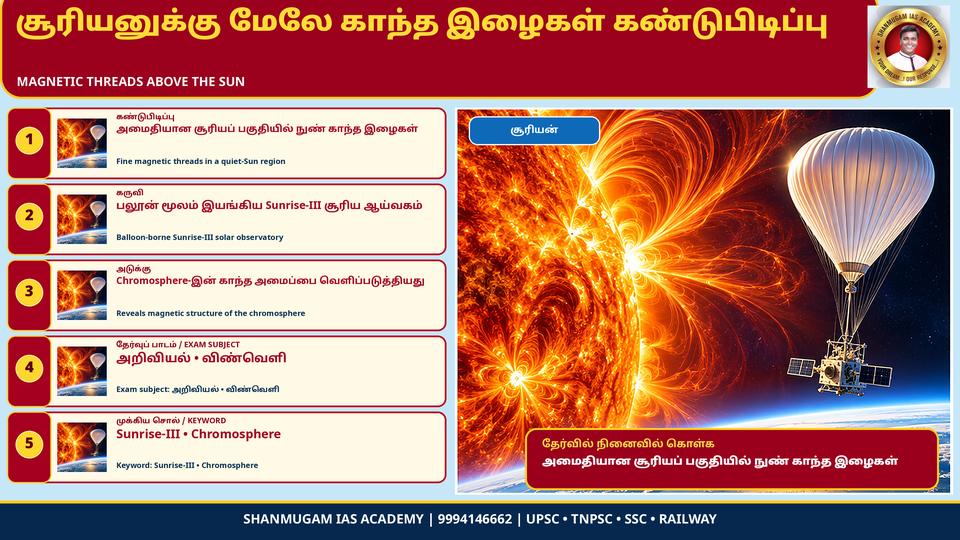
Fine magnetic threads above quiet regions of the Sun – NAOJ-led study using balloon telescope 'Sunrise III'
27 October 2026 · English Sports
Topics: Sports, International, Science & Environment · 27 October 2026 Current Affairs (UPSC / TNPSC / SSC / RRB)
News
An international team led by the National Astronomical Observatory of Japan (NAOJ), using data from the balloon-borne solar telescope 'Sunrise III', has found fine thread-like magnetic structures woven into the 'magnetic canopy' that spreads through the chromosphere above the Sun's 'quiet' regions. The study says motions on the solar surface twist magnetic field lines to form them; computer simulations reproduce the pattern. At the solar limb the team also measured magnetic fields inside spicules – narrow jets of plasma. The study appeared in The Astrophysical Journal Letters (NAOJ release 30 Sep 2026; widely reported 23–25 Oct 2026).
Key facts
| Telescope | Sunrise III – balloon-borne solar telescope with 1-m mirror; flew at about 35–36 km (stratosphere) |
| Flight | Launched 10 July 2024 from Esrange Space Center near Kiruna, Sweden; landed in north-western Canada on 16 July 2024 |
| Instrument | SCIP – Sunrise Chromospheric Infrared spectroPolarimeter; led by NAOJ |
| Mission lead | Max Planck Institute for Solar System Research (MPS), Germany; balloon operations – NASA's CSBF |
| Journal | The Astrophysical Journal Letters, 2026; first author Masahito Kubo (NAOJ) |
| Significance | Helps explain how energy moves up and heats the solar atmosphere even in calm-looking regions |
Background
- Layers of the Sun: core → radiative zone → convective zone → photosphere (visible surface, about 5,500–6,000°C) → chromosphere → transition region → corona (over 1 million °C). Why the corona is far hotter than the surface is the 'coronal heating problem'.
- Why a balloon? At about 35 km it sits above most of Earth's atmosphere, so UV and infrared light can be measured cleanly, at far lower cost than a space telescope. Sunrise flew earlier in 2009 and 2013. Sunrise III carried three instruments from Germany (SUSI), Japan (SCIP) and Spain (TuMag).
- India's Aditya-L1: launched on 2 Sep 2023 by PSLV-C57 from Sriharikota; placed on 6 Jan 2024 in a halo orbit around the Sun–Earth L1 point, about 1.5 million km from Earth. Seven payloads; the largest, the Visible Emission Line Coronagraph (VELC), was built by the Indian Institute of Astrophysics (IIA), Bengaluru. SUIT images both the photosphere and the chromosphere.
Tamil Nadu link: Kodaikanal Solar Observatory in Kodaikanal, Dindigul district, began in 1899 and is now run by IIA. In 1909 John Evershed discovered here the radial flow of gas in sunspot penumbrae (the 'Evershed effect'). It holds over a century of solar images. Nigar Shaji, Project Director of India's solar mission Aditya-L1, hails from Sengottai, Tenkasi district.
Source: NAOJ release, 30 Sep 2026; ScienceDaily, 23 Oct 2026; ApJ Letters (Kubo et al., 2026); Leibniz Institute for Solar Physics (KIS); ISRO (Aditya-L1, VELC)
Join our UPSC classroom or online batch: UPSC coaching in Coimbatore · Fees · Call 99941 46662.
Link to this page from your website / blog (HTML code)
BANK Achievers
-

N. NARMADHA
BANK BANK
TNPSC குரூப் 1, 2/2A, 4 – நேரடி வகுப்புகள் · கோவை & மதுரை
2006 முதல் சண்முகம் IAS அகாடமி · Classroom & online coaching in Coimbatore and Madurai
