

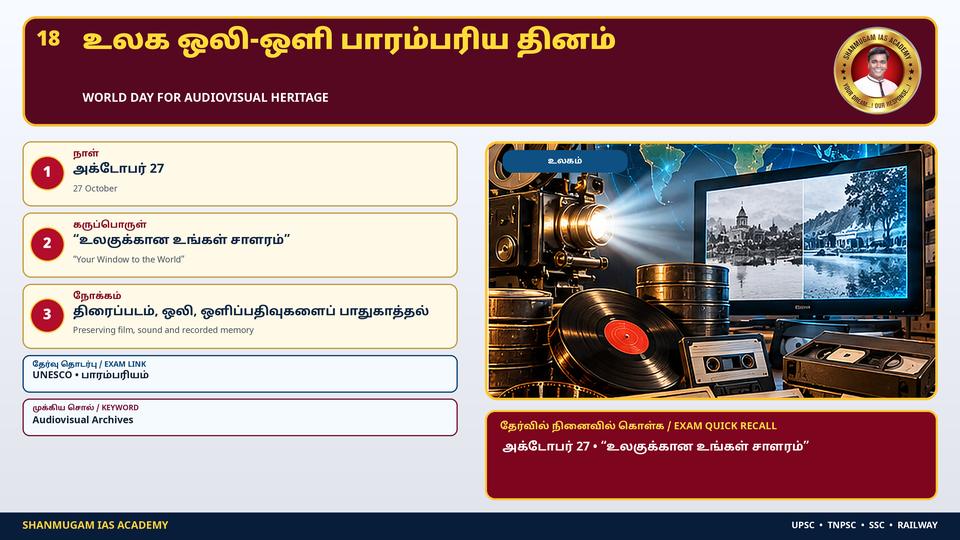
World Day for Audiovisual Heritage 2026 (27 Oct) – theme 'Your Window to the World'
26 October 2026 · English Important Days
Topics: Important Days · 26 October 2026 Current Affairs (UPSC / TNPSC / SSC / RRB)
News
UNESCO observes the 'World Day for Audiovisual Heritage' every year on 27 Oct. The 2026 theme is 'Your Window to the World', highlighting the role of audiovisual records in connecting and understanding societies. Film and sound archives worldwide hold events together with the Coordinating Council of Audiovisual Archives Associations (CCAAA). The Day aims to raise awareness that film reels, audio tapes and radio–TV recordings are at risk of being lost, and that urgent measures are needed to preserve them.
Key facts
| Date | 27 October (annual) |
| 2026 theme | 'Your Window to the World' |
| Proclaimed | UNESCO General Conference, 2005 |
| Commemorates | 1980 'Recommendation for the Safeguarding and Preservation of Moving Images' (21st General Conference) |
| Coordination | UNESCO + CCAAA |
| Indian archive | NFAI (Pune, 1964) – part of NFDC since 2022 |
Background
- UNESCO: its 21st General Conference (1980) adopted the 'Recommendation for the Safeguarding and Preservation of Moving Images'; to mark it, the 2005 General Conference proclaimed 27 Oct as this Day. UNESCO launched the 'Memory of the World' programme in 1992 to protect documentary heritage.
- India in the Memory of the World Register: 1997 – the I.A.S. Tamil Medical Manuscript Collection (Institute of Asian Studies, Chennai; India's first entry); 2005 – Shaiva manuscripts in Pondicherry; 2007 – Rigveda manuscripts (Bhandarkar Oriental Research Institute, Pune); 2017 – Gilgit manuscripts; 2025 – Bhagavad Gita and Bharata's Natyashastra, taking India's total to 14.
- Indian film heritage: the first full-length Indian feature film was 'Raja Harishchandra' (1913, Dadasaheb Phalke); the first talkie was 'Alam Ara' (14 March 1931, Ardeshir Irani; Majestic Cinema, Bombay) – no print of it survives today, a stark reminder of why audiovisual preservation matters. The National Film Archive of India (NFAI, Pune, 1964) was merged into the NFDC in March 2022 along with Films Division, the Directorate of Film Festivals and the Children's Film Society; the National Film Heritage Mission (NFHM – digitisation and restoration) is now run by the NFDC.
- Science angle: old nitrate film is highly inflammable; acetate film suffers chemical decay called 'vinegar syndrome'; magnetic tapes also degrade over time. Cool, humidity-controlled storage and digitisation are therefore essential.
Tamil Nadu link: the first silent film made in South India was 'Keechaka Vadham' (1917–18), directed by R. Nataraja Mudaliar and produced by his India Film Company (1917), Madras. The first Tamil talkie, 'Kalidas', directed by H.M. Reddy, was released on 31 Oct 1931 – the same year as 'Alam Ara'. In 1897 M. Edwards held Madras's first film screenings at the Victoria Public Hall. And India's very first Memory of the World entry (1997) is the Tamil medical palm-leaf manuscript collection of the Institute of Asian Studies, Chennai – covering Siddha, Ayurveda, Unani, agriculture and animal husbandry.
Source: UNESCO (WDAH page); CCAAA – WDAVH 2026; South African Govt calendar; GKToday (Memory of the World, Apr 2025); India TV (NFDC merger, 30 Mar 2022); LiveHistoryIndia (Alam Ara); Wikipedia (Tamil cinema)
Join our UPSC classroom or online batch: UPSC coaching in Coimbatore · Fees · Call 99941 46662.
Link to this page from your website / blog (HTML code)
TET Achievers
-

MANIGANDAN
TNTET TNTET
