

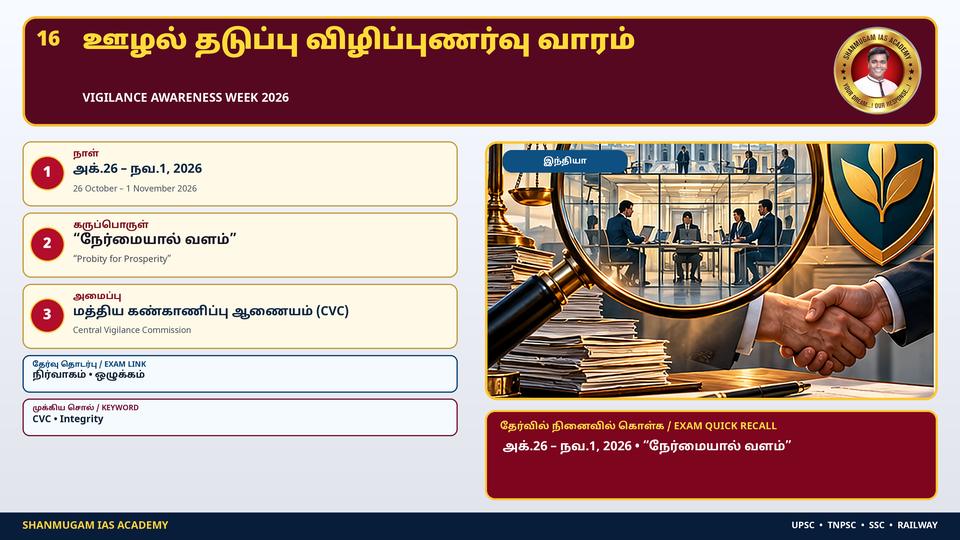
Vigilance Awareness Week 2026 (26 Oct – 1 Nov) – theme 'Probity for Prosperity'
26 October 2026 · English Important Days
Topics: Important Days · 26 October 2026 Current Affairs (UPSC / TNPSC / SSC / RRB)
News
By Circular No. 05/09/26 dated 18 Sep 2026, the Central Vigilance Commission (CVC) announced that Vigilance Awareness Week 2026 will be observed from 26 Oct to 1 Nov. Theme: 'Probity for Prosperity' (Hindi: 'सत्यनिष्ठा से समृद्धि'). The week opens with public servants taking the Integrity Pledge at 11 am on 26 Oct; citizens can take the e-pledge on the CVC website. It is preceded by a three-month 'preventive vigilance campaign' from 17 Aug to 16 Nov 2026. The week is observed every year in the week that includes 31 Oct, the birthday of Sardar Vallabhbhai Patel.
Key facts
| Dates | 26 Oct – 1 Nov 2026 |
| Theme | 'Probity for Prosperity' (सत्यनिष्ठा से समृद्धि) |
| Organiser | Central Vigilance Commission (CVC), New Delhi – Circular 05/09/26 (18.09.2026) |
| Preceding campaign | 17 Aug – 16 Nov 2026: pending complaints/cases, capacity building, digital initiatives, contract management |
| Earlier themes | 2024 – 'Culture of Integrity for Nation's Prosperity'; 2025 – 'Vigilance: Our Shared Responsibility' |
| Why this week? | 31 Oct – birthday of Sardar Vallabhbhai Patel |
Background
- History of the CVC: it was set up by a government resolution in February 1964 on the recommendation of the Committee on Prevention of Corruption (Santhanam Committee, 1962–64). In 'Vineet Narain v. Union of India' (1997) the Supreme Court directed that the CVC be given statutory status; after a 1998 Ordinance it became a statutory body under the Central Vigilance Commission Act, 2003.
- Structure (polity): a Central Vigilance Commissioner + up to two Vigilance Commissioners, appointed by the President on the recommendation of a committee of the Prime Minister, the Union Home Minister and the Leader of the Opposition in the Lok Sabha. Term: 4 years or up to age 65. The CVC is a statutory, not a constitutional, body; it submits its annual report to the President.
- Anti-corruption laws: the Prevention of Corruption Act, 1988 – its 2018 amendment made bribe-giving an offence and added prior approval (Section 17A) for inquiry against a public servant. The Lokpal and Lokayuktas Act, 2013 – Lokpal at the Centre and Lokayuktas in the States. The first Administrative Reforms Commission (1966, Morarji Desai) first recommended Lokpal and Lokayukta.
- Economic angle: corruption raises the cost of public procurement, erodes investor confidence and stops welfare benefits from reaching the right people – which is why the 2026 theme links 'probity' with 'prosperity'. Digital tools such as e-procurement and Direct Benefit Transfer (DBT) are instruments of preventive vigilance.
Tamil Nadu link: K. Santhanam (1895–1980), who headed the Santhanam Committee, was born in Madras; he was a freedom fighter, the first editor of 'The Indian Express', a Constituent Assembly member from Madras and Chairman of the Second Finance Commission (1956). Tamil Nadu set up its State Vigilance Commission and the Directorate of Vigilance and Anti-Corruption (DVAC; HQ Alandur, Chennai) in 1964. The State Lokayukta was created under the Tamil Nadu Lokayukta Act, 2018.
Source: CVC Circular 05/09/26 (18.09.2026) – StaffNews, IIFT notice; Vikaspedia; ICICI Direct (2025 theme); Govt of Goa (2024 theme); constitutionofindia.net, Ashoka University Archives (K. Santhanam); DVAC (Wikipedia)
Join our UPSC classroom or online batch: UPSC coaching in Coimbatore · Fees · Call 99941 46662.
Link to this page from your website / blog (HTML code)
BANK Achievers
-

REVATHI
BANKING BANKING
