

Mains Analysis: NMC withdraws MSMER-2023 – simplification or a softer watch on medical colleges?
27 October 2026 · English Health
இந்தப் பகுப்பாய்வைத் தமிழில் படிக்க →
Topics: Health · GS-II · UPSC Mains Analysis
Context
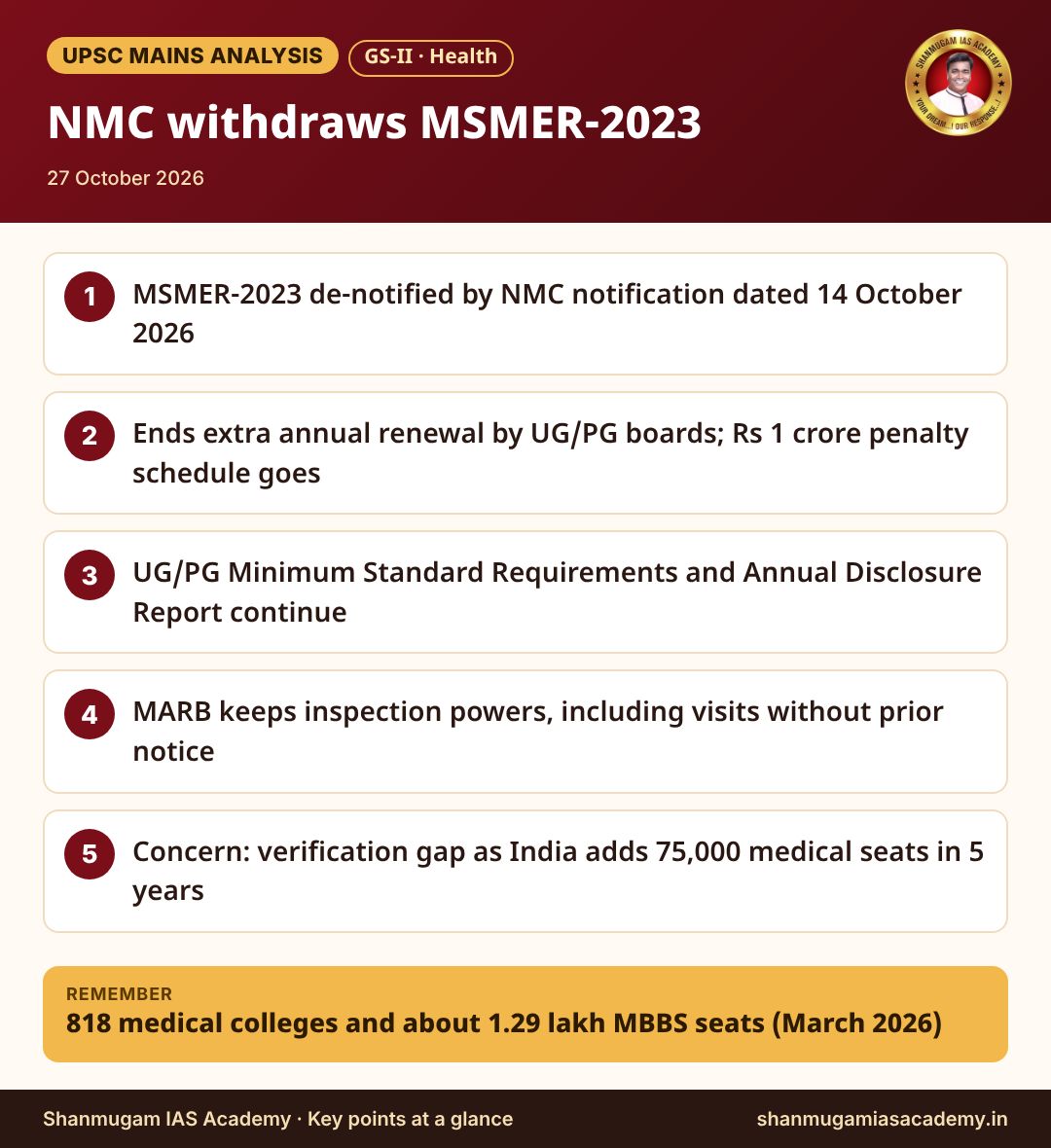
By a notification dated 14 October 2026, the National Medical Commission (NMC) de-notified (withdrew) the Maintenance of Standards of Medical Education Regulations, 2023 (MSMER-2023), with effect from publication in the Gazette. MSMER-2023, notified in September 2023, had set up a system of annual evaluation and renewal of every medical college by the UG and PG education boards, backed by heavy monetary penalties. On 22 October 2026 the NMC issued a clarification: the move is "regulatory rationalisation" that removes a duplicate process, and "regulatory simplification must not be mistaken for regulatory relaxation". The Minimum Standard Requirements (MSR) for UG and PG courses, the Annual Disclosure Report (ADR) and inspections by the Medical Assessment and Rating Board (MARB) continue. The debate is whether a lighter compliance regime is wise at a time when the country is adding medical seats faster than ever.
Background: the regulatory architecture
- NMC Act, 2019 repealed the Indian Medical Council Act, 1956 and replaced the Medical Council of India (MCI), whose credibility had been damaged by allegations of corruption in college approvals. The NMC became operational on 25 September 2020.
- Four autonomous boards (Section 16): (1) Under-Graduate Medical Education Board (UGMEB), (2) Post-Graduate Medical Education Board (PGMEB) – both set curricula and minimum standards; (3) Medical Assessment and Rating Board (MARB, Section 26) – permits new colleges, new PG courses and seat increases, inspects and rates institutions and can act against deficient ones; (4) Ethics and Medical Registration Board – national register and professional conduct.
- Medical Advisory Council (Sections 11–13): the main platform for States and UTs to give their views to the NMC.
- Other powers: guidelines on fees for 50% of seats in private colleges and deemed universities (Section 10); National Exit Test (NEXT, Section 15).
- MSMER-2023 (notified 19 September 2023) required an annual disclosure report and annual renewal certificate; it provided fines of up to Rs 1 crore on colleges for non-compliance and up to Rs 5 lakh on doctors or heads who submit false declarations or records.
What changes and what stays
| Item | Position after October 2026 |
|---|---|
| MSMER-2023 (annual evaluation and renewal by UGMEB/PGMEB, penalty schedule) | Withdrawn. The NMC says the only procedural change is the end of the additional annual renewal. |
| UG-MSR and PG-MSR (faculty, beds, clinical material, infrastructure) | Remain fully applicable, says the NMC – all existing faculty, infrastructure and clinical requirements continue. |
| Annual Disclosure Report (Sections 24(i), 25(h) of the Act) | Continues; can be verified by MARB. |
| MARB assessments | Continue, including inspections without prior notice; action under the Establishment of Medical Institutions, Assessment and Rating Regulations, 2023. |
| Past actions and pending cases | Saved – approvals, liabilities and pending proceedings under MSMER-2023 are not affected. |
| Reason given | Overlap with MARB's statutory role, alignment with the NMC Act, 2019, after "judicial observations" (not specified publicly). |
The bigger picture: expansion of seats
- Growth: medical colleges rose from 387 (2013-14) to 818, and MBBS seats from about 51,000 to about 1.29 lakh (Health Ministry reply in Lok Sabha, March 2026).
- Target: 75,000 additional medical seats in five years. In September 2025 the Union Cabinet approved 5,023 MBBS and 5,000 PG seats in government colleges by 2028-29 at a cost of about Rs 15,034 crore (cost ceiling of Rs 1.5 crore per seat).
- Faculty relaxations (2025): the Medical Institutions (Qualifications of Faculty) Regulations, 2025 allow non-teaching government hospitals with 220+ beds to be teaching institutions, let experienced specialists become faculty without senior residency, and raise the cap on non-medical (MSc/PhD) teachers in some pre- and para-clinical subjects to 30%. The NMC called faculty shortage "a critical bottleneck".
- Doctor availability: the Government told Parliament (December 2025) that the doctor–population ratio is about 1:811, assuming 80% of registered allopathic (13.88 lakh) and AYUSH (7.51 lakh) practitioners are available – a figure that includes AYUSH.
Arguments for the change
- One regulator, one process: the Act gives assessment to MARB; a second annual evaluation by the education boards created duplication and delay.
- Ease of compliance: annual renewal paperwork for 800+ colleges absorbs regulator capacity that could go into targeted, surprise inspections.
- Expansion needs speed: rural and district hospitals need doctors; a predictable rule-set helps new government colleges start on time.
- Legal soundness: regulations that go beyond the parent Act invite litigation; aligning with the Act reduces that risk.
Concerns
- Verification gap: self-disclosure without strong checking can become a paper exercise. A CBI FIR made public in July 2025 named 34 people, including health ministry officials and NMC assessors, for allegedly leaking inspection schedules, arranging ghost faculty and dummy patients, and taking bribes.
- Deterrence: the explicit penalty schedule of MSMER-2023 is gone; enforcement now rests on MARB's capacity and will.
- Quality under stretch: faster expansion plus relaxed faculty eligibility may dilute clinical exposure, especially in new colleges.
- Policy by notification: withdrawal without public consultation or a published reasoned note reduces trust; the "judicial observations" are not disclosed.
- Federal friction: States fund and run many colleges. Tamil Nadu, Karnataka and Puducherry opposed the 2023 cap of 100 MBBS seats per 10 lakh population, which the NMC deferred in November 2023 – a reminder that central norms can penalise States that invested early.
The federal angle
Medical education falls under Entry 25 of the Concurrent List, while "coordination and determination of standards" in higher education is a Union subject (Entry 66, Union List); public health and hospitals are State subjects. So the NMC sets standards, but States build and pay for most government colleges and hospitals. The Medical Advisory Council is only advisory. A durable system needs States in the design of standards, not just in their implementation.
Way forward
- Strengthen MARB: more full-time assessors, random and unannounced visits, video records and geo-tagged biometric data shared in real time.
- Make ADRs public and auditable: publish faculty lists, bed occupancy and patient load college-wise; let students and the public flag mismatches.
- Move to outcome-based regulation: judge colleges by student competencies, NEXT/licensing results and patient-care indicators, not only by inputs.
- Third-party accreditation and rating: independent agencies, conflict-of-interest rules and published ratings, as in higher-education accreditation.
- Build the faculty pipeline: more PG seats in government hospitals, DNB expansion, incentives for teaching in district colleges.
- Consult before change: publish draft amendments with reasons; use the Medical Advisory Council meaningfully.
Mains practice question
Answer framework: Introduction – NMC Act 2019, MSMER-2023 withdrawn in October 2026 · Body – (a) why expansion: 818 colleges, 75,000-seat target, doctor shortage; (b) the change and NMC's case (duplication, MARB's role); (c) concerns: verification gap, CBI case, faculty relaxations, federal issues · Way forward – MARB capacity, public ADRs, outcome-based regulation, third-party accreditation · Conclusion – faculty-view line below.
Prelims pointers
- NMC Act, 2019 replaced the Indian Medical Council Act, 1956; NMC operational from 25 September 2020.
- Four autonomous boards under Section 16: UGMEB, PGMEB, MARB, Ethics and Medical Registration Board.
- MARB (Section 26) grants permission for new medical colleges, PG courses and seat increases.
- Medical Advisory Council (Sections 11–13) – platform for States/UTs.
- NMC fee guidelines cover 50% of seats in private medical colleges and deemed universities.
The real question is not "more rules or fewer rules" but what the regulator measures. India is moving from input norms (beds, teachers, buildings) towards "outcome-based regulation" – judging a medical college by the competence of its graduates and the care its hospital gives. Fewer forms are welcome only if verification becomes stronger and data becomes public.
- A shift to note: MSMER-2023 is gone, but MSR, ADR and MARB stay – write "rationalisation with a verification test", not simply "relaxation".
- What to watch next: (1) whether the NMC publishes ADR data college-wise, (2) the number and results of unannounced MARB inspections, (3) progress of the CBI inspection-bribery case, (4) the roll-out of NEXT as an outcome check.
- Ready-made conclusion line: "A regulator is judged not by how many forms it collects, but by how many weak colleges it can find and fix – more doctors must also mean better doctors."
Sources: NMC notification dated 14 October 2026 and NMC clarification of 22 October 2026; NMC Act, 2019; MSMER-2023 (Gazette, September 2023); PIB, September 2025; Lok Sabha reply, March 2026; Rajya Sabha reply, December 2025; Medical Institutions (Qualifications of Faculty) Regulations, 2025. Original analysis by Shanmugam IAS Academy.
Link to this page from your website / blog (HTML code)
BANK Achievers
-

R. RAMYA
BANK BANK
