

Mains Analysis: The Loss and Damage Fund – Climate Justice Needs Speed, Not Just Money
27 October 2026 · English Environment & Ecology
இந்தப் பகுப்பாய்வைத் தமிழில் படிக்க →
Topics: Environment · GS-III · UPSC Mains Analysis
Context
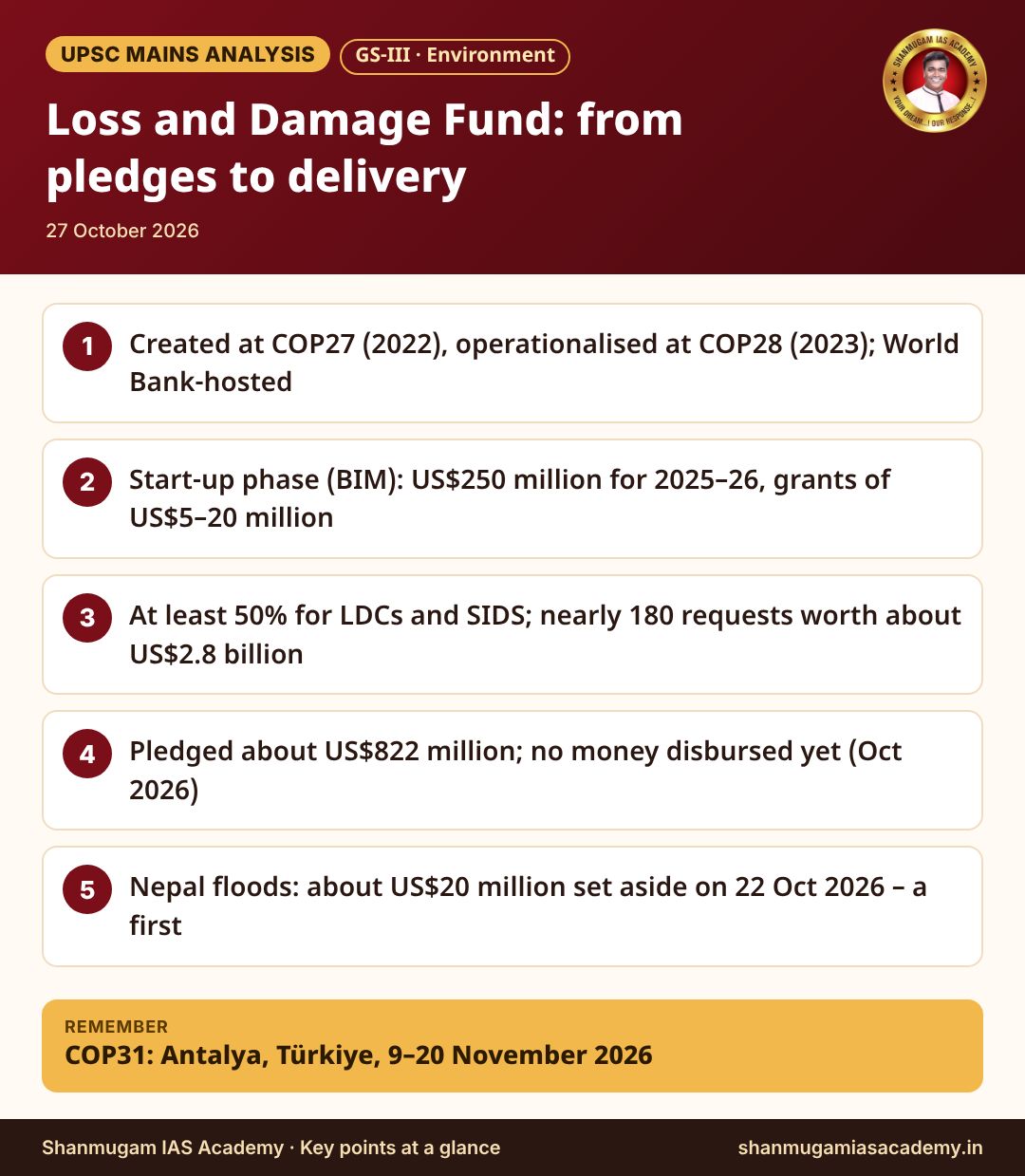
On 22 October 2026, the Board of the Fund for responding to Loss and Damage (FRLD) met in its first-ever extraordinary meeting and provisionally set aside about US$20 million for Nepal (US$21.6 million including fees, as per the Fund). Nepal had asked for help on 31 August, five days after flash floods on 26 August 2026 – triggered by a collapse of glacial rock and ice in the Himalaya – swept down the Bhote Koshi valley, killing more than 1,400 people, with thousands still missing and hydropower plants, roads and bridges destroyed. It is the first time the Fund has reserved money for a specific disaster. Yet the sum is reported to be under 1% of Nepal's estimated damage, and the Fund – three years after it was made operational – has still not disbursed money to any country. The case raises a basic question for climate justice: can a fund meant for disasters work at the speed of disasters?
Background – from Warsaw to the Fund
| Year / meeting | Milestone |
|---|---|
| 2013 – COP19, Warsaw | Warsaw International Mechanism (WIM) for loss and damage set up – knowledge and dialogue, no money. |
| 2015 – Paris Agreement | Article 8 recognises the need to avert, minimise and address loss and damage. The decision adopting the Agreement says Article 8 does not provide a basis for any liability or compensation. |
| 2019 – COP25, Madrid | Santiago Network created to provide technical assistance. |
| 2022 – COP27, Sharm el-Sheikh | Parties decide to set up new funding arrangements for loss and damage, including a fund. |
| 2023 – COP28, Dubai | Fund operationalised on the opening day (30 November); World Bank to host it as a financial intermediary fund (FIF) and act as trustee for an interim period of four years; UAE and Germany pledge US$100 million each. |
| 2024 | First Board meeting (Abu Dhabi, April–May); Philippines selected to host the Board (July); Fund declared ready to receive contributions at COP29 (November). Secretariat in Washington DC. |
| 2025 | Barbados Implementation Modalities (BIM) adopted at the Board's fifth meeting in Bridgetown (April): a US$250 million start-up phase for 2025–26, grants of about US$5–20 million each, at least 50% for LDCs and SIDS. First call for funding requests launched at COP30, Belém (November), open 15 December 2025 to 15 June 2026. |
| 2026 | Nearly 180 requests seeking about US$2.8 billion – more than ten times the money on offer. Ninth Board meeting (Manila, July) deferred the first project approvals to the next regular meeting in mid-December. Nepal set-aside on 22 October. |
Governance in brief: a 26-member Board (12 from developed and 14 from developing countries) takes decisions; contributions are voluntary, with developed countries expected to take the lead and others encouraged to contribute. Pledges stand at about US$822 million; part of this is still to be transferred (reported paid-in figures vary), and by October 2026 no money had been disbursed to any country.
Why it matters – the climate-justice case
- Historical responsibility: countries that emitted least – Nepal, Pacific islands, African drylands – suffer losses that adaptation cannot prevent. This is the core of CBDR-RC (common but differentiated responsibilities and respective capabilities).
- The third pillar: climate action has rested on mitigation and adaptation; loss and damage covers what is left after both – destroyed homes, lost land, and non-economic losses such as culture, graves and identity.
- Debt trap: without grants, poor countries borrow to rebuild after each disaster, which deepens debt and reduces future resilience.
- Trust in the UNFCCC: the Fund is the clearest test of whether multilateral promises turn into cash for the most vulnerable.
- Himalayan relevance: glacier-linked floods like Nepal's are a shared risk for India's Himalayan states, showing that loss and damage is a South Asian issue, not only an island-state issue.
India's position
- India strongly supported the operationalisation of the Fund at COP28; the Environment Minister called it a landmark decision.
- India's stand rests on CBDR-RC and Article 9 of the Paris Agreement: developed countries are obliged to provide climate finance; developing countries may contribute only voluntarily.
- In climate-finance negotiations India has consistently resisted moves to widen the donor base to large developing economies, and favours grants and simple access over loans and complex procedures.
- As a Himalayan and coastal country with frequent extreme events, India also has an interest in a fund that pays quickly and fairly.
Challenges
- Scale: independent estimates of loss and damage in developing countries run into hundreds of billions of dollars a year; the Fund has less than US$1 billion pledged. Campaigners warn it could run short of money by 2027.
- Speed: the Fund was operational in 2023, but the first project approvals are expected only in December 2026; even Nepal's emergency set-aside took about seven weeks and is still not money in hand.
- Pledges vs payments: not all pledges have been paid in, and none of the money had reached a country by October 2026.
- Access: funding requests need detailed proposals and capable implementing entities – hard for small, disaster-hit administrations and impossible for local communities without direct access.
- Grants vs loans: the start-up phase is grant-based, but a wider financial-instruments policy is still to be decided; loan-based support would add to debt.
- No-liability clause: the Paris decision rules out liability and compensation, so the Fund depends on goodwill, not obligation.
- Precedent fears: some developed countries, such as Germany, accepted the Nepal set-aside but said it should not set a precedent – leaving rapid response as an exception rather than a rule.
Way forward
- Create a standing rapid-response window with pre-agreed triggers, so money moves within days of a declared disaster.
- Convert pledges into binding, multi-year contributions and agree a regular replenishment cycle, as in other climate funds.
- Find new sources: solidarity levies on aviation, shipping and fossil-fuel windfall profits; debt-for-resilience swaps.
- Keep it grant-based for the most vulnerable and allow direct budget support through national disaster systems.
- Enable direct and local access – small grants for communities, with simple, standard formats.
- Link with early warning and adaptation (Santiago Network, Early Warnings for All) so that losses are reduced before they happen.
Mains practice question
Answer framework: Introduction – COP27 decision, COP28 operationalisation, Nepal set-aside of October 2026 · Body – (a) significance: CBDR-RC, third pillar, debt; (b) design gaps: scale, speed, pledges vs payments, access, no-liability clause; (c) India's position · Way forward – rapid-response window, replenishment, new levies, direct access · Conclusion – faculty-view line below.
Prelims pointers
- Warsaw International Mechanism – COP19, 2013. Santiago Network – COP25, 2019.
- Article 8 of the Paris Agreement deals with loss and damage; Article 9 with finance.
- FRLD: created at COP27 (2022), operationalised at COP28 (2023); hosted by the World Bank as a FIF; Board seat in the Philippines.
- Barbados Implementation Modalities – US$250 million start-up phase for 2025–26; grants of US$5–20 million; 50% floor for LDCs and SIDS.
- COP31 – Antalya, Türkiye, 9–20 November 2026; Australia holds the role of President of Negotiations.
The debate is shifting from "how much money" to "how fast and how surely". Learn the term "pre-arranged finance": money whose amount, triggers and delivery channel are agreed before a disaster, so that it is released automatically when the event happens, instead of being negotiated afterwards. Insurance pools, contingency credit and trigger-based windows are examples. The Nepal case is the first step from after-the-event negotiation towards this model.
- What to watch next: (1) loss and damage and finance outcomes at COP31 in Antalya (9–20 November 2026); (2) the Board's mid-December meeting – first project approvals and Nepal's full proposal; (3) whether a permanent rapid-response window is created; (4) the resource-mobilisation and replenishment decision for 2027 onwards.
- India angle: link this to Himalayan glacial-lake and cloudburst risks, India's disaster-risk financing (SDRF/NDRF) and India's role as a voice of the Global South.
- Ready-made conclusion line: "Climate justice delayed is climate justice denied – the Loss and Damage Fund must move from pledges to pre-arranged finance that reaches victims in days, not years."
Sources: UNFCCC decisions (COP19, Paris Agreement, COP27, COP28) and UNFCCC news; FRLD official website (Board and news releases, 2024–2026); Government of Philippines (DFA); Government of Barbados; Australian PM release on COP31; Kathmandu Post, Climate Home News, Carbon Brief, Down To Earth, ThePrint, Eco-Business (latest facts, cross-checked). Original analysis by Shanmugam IAS Academy.
Link to this page from your website / blog (HTML code)
BANK Achievers
-

ASHOK
BANK BANK
