

Mains Analysis: Operation Trident – India catches the couriers; can it reach the kingpins and their money?
28 October 2026 · English
இந்தப் பகுப்பாய்வைத் தமிழில் படிக்க →
Topics: Internal Security · GS-III · UPSC Mains Analysis
Context
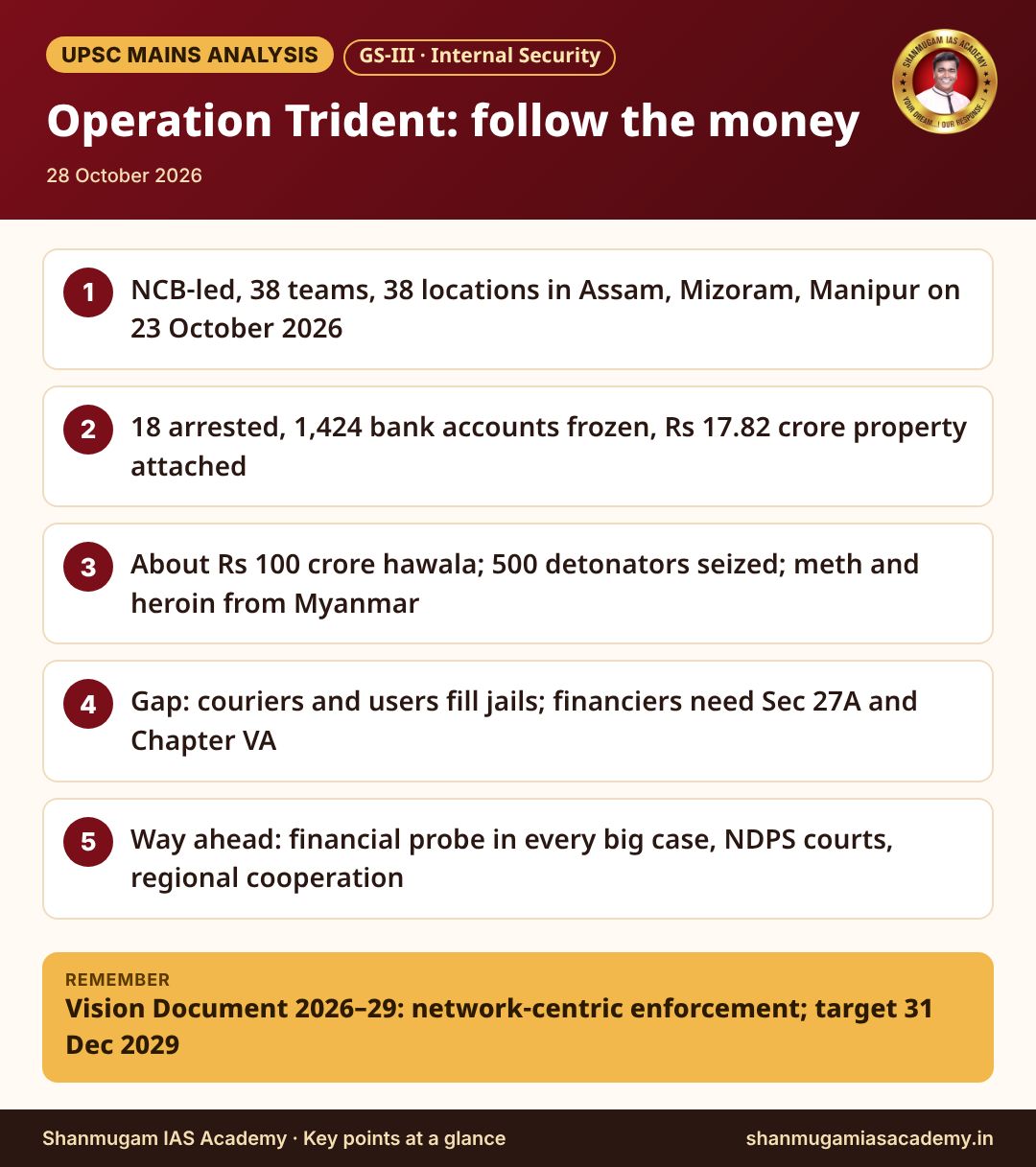
In the early hours of 23 October 2026, the Narcotics Control Bureau (NCB) led "Operation Trident": 38 multi-agency teams – with the Enforcement Directorate (ED), Mizoram Police, other central agencies and the police of three States – struck 38 locations at the same time in Assam, Mizoram and Manipur. According to the Government, 18 persons were arrested, 1,424 bank accounts were frozen, properties worth Rs 17.82 crore were attached, about Rs 100 crore of hawala transactions were uncovered, and 500 detonators and Rs 12 lakh cash were seized. The target was a transnational syndicate moving methamphetamine and heroin from Myanmar through the Mizoram–Manipur–Assam–Tripura corridor into mainland India and Bangladesh. Earlier phases of the same probe had already led to the arrest of the alleged Myanmar-based kingpin (in Delhi), its main hawala operator (August 2024) and its Assam logistics head (November 2025). The official release gives no figure for drugs seized in this round – it aimed at the money and the network. That is the core debate: India catches carriers and peddlers easily, while the financiers – the "big sharks" – mostly stay out of reach.
Background: the legal and institutional toolkit
- NDPS Act, 1985: punishment depends on quantity. Small quantity – rigorous imprisonment up to 1 year, or fine up to Rs 10,000, or both; between small and commercial – up to 10 years and fine up to Rs 1 lakh; commercial quantity – 10 to 20 years and fine of Rs 1–2 lakh. Section 64A gives immunity to an addict caught with a small quantity who volunteers for de-addiction.
- Section 27A: financing illicit traffic, or harbouring traffickers, is punished with 10–20 years and fine of Rs 1–2 lakh (more with reasons). A 2014 amendment broke its cross-reference, and it was repaired only by the NDPS (Amendment) Act, 2021 (with effect from 1 May 2014) – a sign of how rarely the financing provision was used.
- Chapter VA (from Section 68A, inserted in 1989): tracing, freezing (Section 68F) and forfeiture of property of traffickers, including property held through relatives and associates; the person must prove the property was lawfully acquired.
- PITNDPS Act, 1988: preventive detention of habitual traffickers. The Prevention of Money Laundering Act, 2002 lets the ED pursue drug proceeds.
- Institutions: NCB (constituted 1986, under the Home Ministry); NCORD (Narco-Coordination Centre, 2016) for Centre–State coordination; MANAS national narcotics helpline 1933 (launched 18 July 2024) for anonymous tips and de-addiction advice.
- Demand side: Nasha Mukt Bharat Abhiyaan (Ministry of Social Justice and Empowerment, launched 15 August 2020) had reached over 35 crore people by 22 October 2026, including about 13.94 crore youth.
- Policy direction: the Vision Document on Narcotics Control 2026–2029, released at the 10th NCORD apex meeting (26 June 2026), calls for "network-centric" enforcement; the Union Home Minister has set 31 December 2029 as the target to end the drug trade.
Why couriers get caught and kingpins do not
| Level of the chain | What enforcement usually does | What reaches them |
|---|---|---|
| Users and street peddlers | Most arrests and FIRs | Section 64A treatment route is little used; many end up in jail |
| Carriers / couriers | Seizure + arrest at check-posts, airports, coasts | Commercial-quantity cases give long sentences, but the network survives |
| Organisers and logistics | Need phone, travel and digital analysis | Backward and forward linkage probes; PITNDPS detention |
| Financiers and kingpins | Need financial investigation, foreign cooperation | Section 27A, Chapter VA forfeiture, PMLA, Interpol notices, extradition |
- Evidence problem: the NDPS case is built on recovery of the drug. The carrier is caught "in possession"; the financier is linked only by money trails and phone records, which need skilled investigators and time.
- Numbers that reward volume: success is still measured in kilograms seized and persons arrested. NCB alone seized about 1.33 lakh kg of drugs (worth about Rs 1,980 crore) and arrested 994 traffickers in 447 cases in 2025.
- Users counted as offenders: in Kerala, the State with the most NDPS cases, over 90% of NDPS cases and arrests in 2022 and 2023 were for personal consumption, not trafficking (NCRB data, as reported). Police effort goes to the bottom of the chain.
- Conviction gap: NCB reports a conviction rate of about two-thirds in its own cases in 2025 (up from about 60% in 2024); in 2025 it secured convictions of 265 offenders in 131 cases. But NCB handles a small share of all NDPS cases; most are State police cases, where trials are slow and financial charges are rare.
The changing map of trafficking
- Golden Triangle (Myanmar–Laos–Thailand) feeds the North-East by land – Operation Trident's route; the porous border and conflict in Myanmar make it hard to police. The Golden Crescent (Afghanistan–Pakistan–Iran) reaches India across the Punjab border, now also by drones, and by sea along the western coast.
- Maritime routes: in November 2024 the Indian Coast Guard seized about 6,016 kg of methamphetamine from a Myanmar fishing boat in the Andaman Sea – its biggest haul ever; the NIA later searched premises in Chennai and Madurai in the same case (August 2026).
- Darknet and crypto: in June–July 2025 NCB's "Operation MELON" broke "Ketamelon", a Kochi-based darknet vendor network that sold LSD and ketamine for cryptocurrency.
- Narco-terror overlap: 500 detonators in a drug-hawala network on the Myanmar border show how drug money, arms and insurgency can travel on the same route.
The Tamil Nadu angle
- Coast as a transit point: in October 2026 the Directorate of Revenue Intelligence (DRI) seized 137 kg of crystal methamphetamine (worth over Rs 100 crore) on the Nagapattinam coast, suspected to be bound for Sri Lanka; four persons were arrested. Ganja bound for Sri Lanka is also seized repeatedly on the Ramanathapuram coast across the Palk Strait.
- State response: Tamil Nadu Police's "Drive Against Drugs" campaign, financial investigations that freeze traffickers' property and bank accounts, a State-level NCORD with Customs, DRI, Coast Guard and NCB, and awareness drives among students.
Challenges
- Skill gap: few police stations have trained financial investigators, forensic accountants or crypto-tracing tools.
- Slow trials and weak prosecution: few special courts, delays in chemical analysis reports, procedural lapses in search and seizure (Sections 42, 50) that let accused walk free.
- Kingpins abroad: extradition and mutual legal assistance with Myanmar and other source countries are slow; conflict in Myanmar weakens cooperation.
Way forward
- Make every big seizure a financial case: a mandatory parallel financial probe (Section 27A, Chapter VA, PMLA) in every commercial-quantity case, with ED and FIU-IND data shared in real time.
- Change the scorecard: measure success by networks dismantled, kingpins convicted and assets forfeited, not only kilograms seized.
- Specialised capacity: State anti-narcotics task forces with financial, cyber and crypto units; dedicated NDPS courts and forensic labs to cut trial delay.
- Borders, coasts and partners: technology on the Myanmar border, counter-drone systems in Punjab, joint coastal patrols and intelligence-sharing with Sri Lanka, Myanmar and Bangladesh; FATF-standard tracing of virtual assets.
- Treat users as patients: use Section 64A and Nasha Mukt Bharat to divert users to de-addiction; turn their information into intelligence on suppliers through MANAS 1933.
Mains practice question
Answer framework: Introduction – Operation Trident (23 October 2026) · Body – (a) why couriers get caught: possession-based evidence, volume scorecards, users treated as offenders; (b) tools against kingpins: Section 27A, Chapter VA, PITNDPS, PMLA; (c) new routes: sea, drones, darknet, crypto; Tamil Nadu coast · Way forward – financial probes, new scorecard, courts, regional cooperation · Conclusion – faculty-view line.
Prelims pointers
- NDPS Act, 1985; NCB constituted in 1986; PITNDPS Act, 1988; Chapter VA (forfeiture of property) inserted in 1989.
- MANAS (Madak Padarth Nishedh Asuchna Kendra) helpline 1933 – launched 18 July 2024.
- Nasha Mukt Bharat Abhiyaan – Ministry of Social Justice and Empowerment, launched 15 August 2020.
- Golden Triangle: Myanmar, Laos, Thailand. Golden Crescent: Afghanistan, Pakistan, Iran.
The real test of drug policy is not the size of the seizure but whether the network survives it. A courier is replaced the next day; a frozen account, a forfeited house or a convicted financier is not. That is the logic of "network-centric enforcement" – investigating the whole chain from source to user, with the money trail at its centre, and treating the user as a patient, not as a statistic.
- A shift to note: Operation Trident reported arrests, frozen accounts and attached property – and no drug-seizure figure. Write "from seizure-centric to network-centric", not just "a big drug bust".
- What to watch next: (1) how many of the 1,424 frozen accounts end in forfeiture and convictions under Section 27A, (2) whether NCB annual reports start publishing networks dismantled and assets forfeited, (3) cooperation with Myanmar and Sri Lanka on maritime and border routes, (4) progress towards the 2029 target.
- Ready-made conclusion line: "Seizures make headlines, but only forfeiture and conviction of financiers break the trade – India must follow the money, not just the mule."
Sources: PIB/NCB release on Operation Trident, 25 October 2026; NCB year-end figures for 2025 (January 2026) and conviction release (April 2026); NCB release on the 10th NCORD apex meeting (June 2026); NDPS Act, 1985 and NDPS (Amendment) Act, 2021; Ministry of Social Justice and Empowerment data on Nasha Mukt Bharat Abhiyaan (October 2026); All India Radio on MANAS (July 2024); DRI and Coast Guard cases as reported. Original analysis by Shanmugam IAS Academy.
Link to this page from your website / blog (HTML code)
TNPSC Achievers
-

S.B. JAGAN
TNPSC TNPSC
TNPSC குரூப் 1, 2/2A, 4 – நேரடி வகுப்புகள் · கோவை & மதுரை
2006 முதல் சண்முகம் IAS அகாடமி · Classroom & online coaching in Coimbatore and Madurai
