

Mains Analysis: Rajasthan's Poisoned Rivers – Industrial Pollution and the Limits of State Capacity
28 October 2026 · English Environment & Ecology
இந்தப் பகுப்பாய்வைத் தமிழில் படிக்க →
Topics: Environment · GS-III · UPSC Mains Analysis
Context
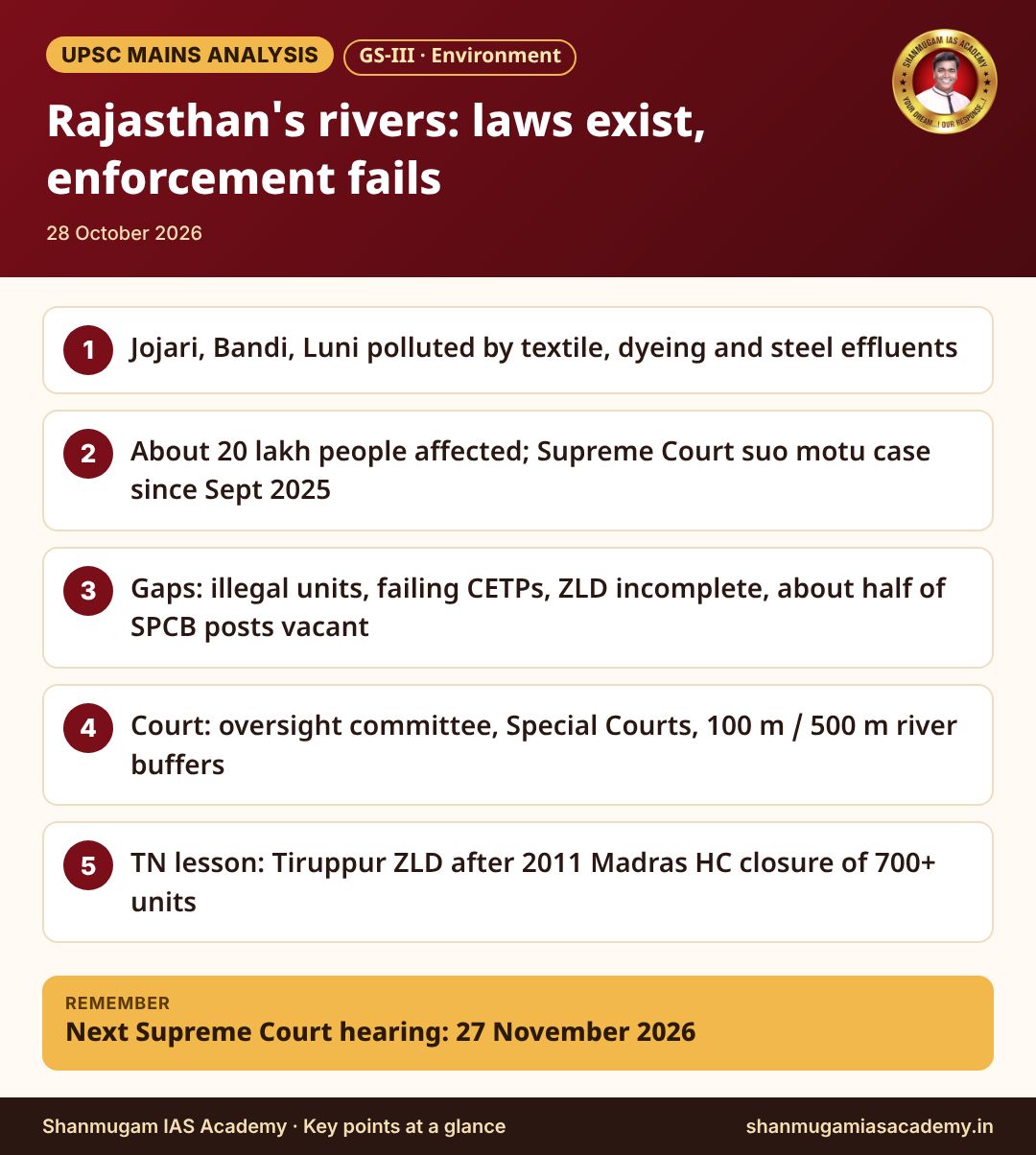
On 26 October 2026, a Supreme Court bench of Justices Vikram Nath and Sandeep Mehta, hearing the suo motu case In Re: 2 Million Lives at Risk, Contamination in Jojari River, Rajasthan, said the river system of western Rajasthan had been destroyed in full view of State authorities, and warned that a deeper probe could even need the CBI. The case concerns three rivers – the Jojari (Jodhpur), the Bandi (Pali) and the Luni (Balotra) – into which textile dyeing, printing and steel units, and untreated town sewage, have drained for years. The Court said the suffering of about 20 lakh people cannot be weighed against the economic interest of a few, ordered the State to bring a workable river-restoration plan, and listed the case for 27 November 2026. It also reportedly held that the polluter-pays principle binds the State itself. The real question: India has strong laws, but does the State have the capacity to enforce them?
Background – two decades of orders
| Year | Milestone |
|---|---|
| 1974 | Water (Prevention and Control of Pollution) Act: Central and State Pollution Control Boards (CPCB, SPCBs); Section 24 bars putting polluting matter into streams; Sections 25–26 need Board consent for any new outlet or discharge. |
| 1996 | Indian Council for Enviro-Legal Action v. Union of India (Bichhri village, Udaipur, Rajasthan): polluter pays applied to chemical units that poisoned groundwater – same State, a generation earlier. |
| 2020–21 | NGT monitoring committees chaired by former Chief Justice Prakash Chandra Tatia report heavy pollution of the Jojari, Bandi and Luni by textile and steel effluents. |
| 25 Feb 2022 | NGT final order: zero liquid discharge (ZLD), environmental compensation, closure of defaulters. RIICO and the municipal councils of Jodhpur, Pali and Balotra appeal to the Supreme Court; some directions are stayed. |
| Sept 2025 | Supreme Court takes suo motu cognisance on the basis of media reports. |
| 21 Nov 2025 | Court sets up a High-Level Ecosystem Oversight Committee headed by Justice Sangeet Lodha (retired judge, Rajasthan High Court) to prepare a river restoration blueprint; the stay, it says, had become an excuse for inaction. |
| 18 Mar 2026 | Detailed directions: Special Courts in Jodhpur, Pali and Balotra; seizure of illegal effluent tankers; no fresh consent for hazardous industries along river banks; machine-based measurement of effluent. |
| Aug 2026 | Office-bearers of the trust running Jodhpur's CETP arrested after an illegal pipeline was found carrying effluent to the river; Court bars construction within 100 m and hazardous activity within 500 m of the Jojari, and asks for an Integrated Coordination Group under the Chief Secretary. |
| Oct 2026 | Fortnightly action-taken reports and recovery of environmental compensation ordered (reported); hearing of 26 October. |
Where the regulatory chain broke
Facts as recorded in the Supreme Court's order of 18 March 2026 and later hearings.
| Link | What the law assumes | What happened on the ground |
|---|---|---|
| Consent (CTE/CTO) | No unit discharges without Board consent | Illegal units ran on farm and residential land; RSPCB closed or demolished 110 illegal textile units between September 2025 and January 2026 – after the Court stepped in. |
| CETPs | Small units send effluent to common plants that treat it to norms | Pali CETP-4 non-operational since November 2025; ZLD capacity at CETP-6 roughly halved; an illegal pipeline bypassed Jodhpur's CETP. |
| Measurement | Discharge is measured and monitored | Effluent volume was estimated from fabric output; the Court asked for machine-based measurement and online (SCADA/IoT) monitoring. |
| Sewage | Towns treat their own sewage | Jodhpur generates about 230 MLD against about 175 MLD treatment capacity. |
| Penalty | Polluter pays for damage | NGT compensation stayed for years; penalties small compared with profits. |
| People | A staffed, expert regulator | Nationally, about half of sanctioned SPCB posts were vacant (CPCB data to NGT, 2023); Rajasthan was reported to be among the worse-off States. |
Why it matters – what the case says about state capacity
- Law is not the gap, enforcement is: the Water Act has existed for over 50 years; the failure lies in inspection, measurement, prosecution and follow-up.
- Captured co-regulation: CETPs are run by industry trusts; when the regulated also run the treatment, a weak Board cannot police them.
- Article 21: clean drinking water and a pollution-free environment are part of the right to life; contaminated wells, handpumps, farmland and dying livestock make this a rights issue, not only an environmental one.
- Jobs versus environment is a false choice: continued pollution only shifts the cost to farmers and the poor downstream.
The Tamil Nadu lesson – Noyyal and Tiruppur
| Point | Tiruppur / Noyyal (Tamil Nadu) | Jodhpur–Pali–Balotra (Rajasthan) |
|---|---|---|
| Key order | Madras High Court, 28 January 2011: power cut and closure of over 700 dyeing and bleaching units that had missed the ZLD deadline | Supreme Court orders of 2025–26; NGT ZLD order of 2022 stayed for years |
| Rule | Reopen only after achieving zero liquid discharge, verified by TNPCB and a court monitoring committee | ZLD still incomplete; CETPs below capacity |
| Support | State interest-free loans and upgrades for CETPs | New CETP capacity planned but slow |
| Lesson | A hard, credible deadline plus financial help changed behaviour – at a real cost in jobs and money | Repeated orders without enforcement led to a collapse of trust |
Old contamination of the Noyyal remains, but Tiruppur shows that a clear rule (ZLD), an enforcing court, a monitoring committee and State money for common plants can change a cluster. The same Tamil Nadu precedent – Vellore Citizens' Welfare Forum (1996), on tanneries along the Palar – gave India the precautionary and polluter-pays principles as part of environmental law.
Challenges
- Consent as paperwork: consent is granted and renewed on documents; surprise inspections and real-time data are rare.
- CETP economics: small units resist paying for ZLD; CETP trusts lack money and accountability; hazardous sludge piles up.
- Weak Boards, diluted deterrence: Boards lack laboratory and legal capacity and depend on State governments for funds and posts; the Water (Amendment) Act, 2024 – applicable to Rajasthan, Himachal Pradesh and the UTs – replaces imprisonment for many offences with penalties of ₹10,000 to ₹15 lakh. This speeds up action, but only if penalties are actually imposed.
- Fragmented responsibility among RSPCB, RIICO, municipal bodies, water resources and revenue departments – everyone acts, no one owns; and stays and appeals let violations run for years.
Way forward
- Strengthen SPCBs: fill posts in a time-bound way, give financial autonomy (consent fees and penalties ring-fenced for the Board), and appoint members with technical expertise.
- Measure, then regulate: online monitoring at every CETP inlet and outlet, public dashboards for downstream villages, and third-party audits by IITs and engineering colleges.
- Fix CETP governance: professional operators, State co-funding (as in Tiruppur), cluster-level ZLD with reuse of treated water by industry.
- Make polluter-pays real: assess compensation for the full period of violation and use it in a dedicated river restoration fund.
- Single point of accountability: a river authority for the Luni basin with power over all departments.
- Link to national schemes: extend NRCP-style funding and Namami Gange lessons (sewage plus industrial compliance) to desert rivers.
Mains practice question
Answer framework: Introduction – Supreme Court suo motu case (2025–26), about 20 lakh people affected · Body – (a) legal framework: Water Act 1974, consent regime, Section 33A, NGT Act Section 20; (b) capacity gaps: staffing, consent as paperwork, CETP failure, measurement, fragmented responsibility, litigation delay; (c) contrast: Tiruppur ZLD after the 2011 Madras High Court order · Way forward – SPCB reform, online monitoring, CETP governance, restoration fund, basin authority · Conclusion – faculty-view line below.
Prelims pointers
- Luni: rises in the Pushkar valley of the Aravalli near Ajmer; inland drainage ending in the Rann of Kutch; becomes saline from about Balotra.
- Jojari is the only right-bank tributary of the Luni; Bandi, Sukri, Jawai and Guhiya are left-bank tributaries.
- Water Act, 1974: first law to set up the CPCB and SPCBs; Section 33A (added 1988) lets Boards order closure and stop power or water supply.
- NGT Act, 2010: Section 20 – NGT applies sustainable development, precautionary and polluter-pays principles.
- CPCB polluted river stretches: 351 (2018 report) → 311 (2022) → 296 (2025 report, 2022–23 data); a stretch is polluted when BOD exceeds 3 mg/L.
- NRCP – 1995 (rivers outside the Ganga programme); Namami Gange – 2014.
Learn the term "continuing mandamus": a court keeps a case open, issues step-by-step directions and asks the executive for regular compliance reports, instead of giving one final judgment. The Jojari case – with an oversight committee, fortnightly reports and frequent hearings – works in this mode. It is useful when institutions fail, but it is a stop-gap: the real test is whether the State builds a regulator that works after the court steps back. Use the term to show balance – credit the judiciary, but argue for institutional repair.
- What to watch next: (1) the State's river-restoration plan at the 27 November 2026 hearing; (2) whether Special Courts and environmental compensation actually deliver convictions and recovery; (3) completion of ZLD at Pali, Balotra and Jodhpur CETPs; (4) the next CPCB polluted-river-stretches assessment for Rajasthan.
- Tamil Nadu angle: compare with Tiruppur–Noyyal (2011 closure, ZLD) and the Vellore tanneries case for TNPSC Group 1 and UPSC answers.
- Ready-made conclusion line: "Courts can rescue a river through continuing mandamus, but only capable pollution control boards can keep it clean – India must move from judicial firefighting to institutional enforcement."
Sources: Supreme Court of India – In Re: 2 Million Lives at Risk, Contamination in Jojari River, Rajasthan (2025 INSC 1341; 2026 INSC 316) and hearing reports (PTI/ThePrint, LawBeat, Bar and Bench, IANS); NGT order of 25-02-2022 (as recorded by the Court); Water (Amendment) Act, 2024; CPCB polluted river stretches data; CPCB vacancy data before the NGT (Tribune, Bar and Bench); Down To Earth, Times of India and Financial Express on Tiruppur (2011); Rajasthan Patrika, ETV Bharat. Original analysis by Shanmugam IAS Academy.
Link to this page from your website / blog (HTML code)
BANK Achievers
-

KIRUBA
BANK BANK
TNPSC குரூப் 1, 2/2A, 4 – நேரடி வகுப்புகள் · கோவை & மதுரை
2006 முதல் சண்முகம் IAS அகாடமி · Classroom & online coaching in Coimbatore and Madurai
