

96% of the world's warm-water coral reef ecosystems Critically Endangered – risk of collapse by 2075: IUCN Red List of Ecosystems
28 October 2026 · English History, Art & Culture
Topics: History, Water, States, Environment & Science · 28 October 2026 Current Affairs (UPSC / TNPSC / SSC / RRB)
News
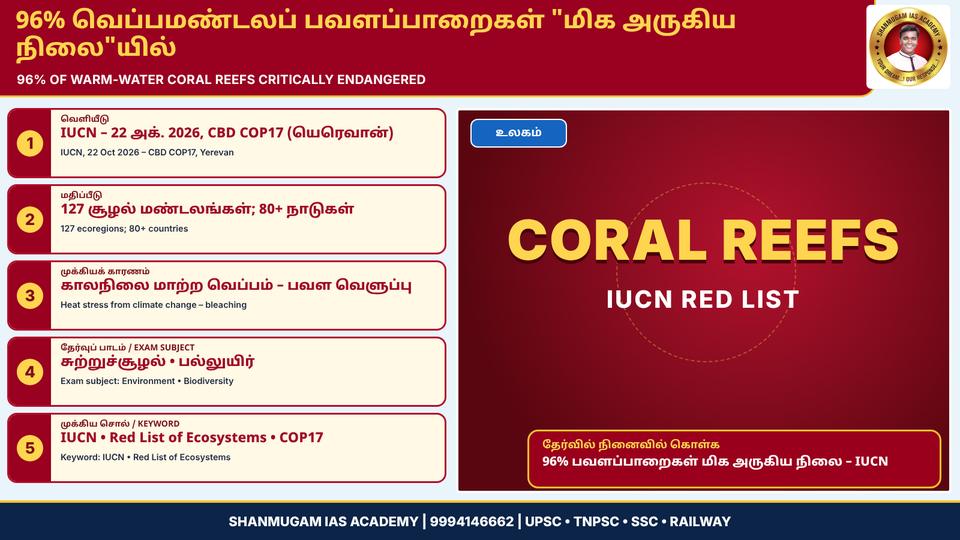
On 22 Oct 2026, on the sidelines of the UN Biodiversity Conference (CBD COP17, 19–30 Oct) in Yerevan, Armenia, the International Union for Conservation of Nature (IUCN) released the first global assessment of coral reefs under the 'IUCN Red List of Ecosystems'. It covered 188,362 sq km of reefs in 127 tropical and subtropical ecoregions. Including projected warming, 96% (122) are 'Critically Endangered' – an extremely high risk of collapse by 2075. Even on observed change over the past 50 years alone, 24% are Critically Endangered. The Western Galápagos reef has already 'Collapsed' since the 1982–83 El Niño; 4 ecoregions are Data Deficient.
Key facts
| Release | IUCN, 22 Oct 2026 – CBD COP17, Yerevan (Armenia) |
| Scope | 127 ecoregions; 188,362 sq km; 80+ countries, 250+ experts |
| Finding | 96% Critically Endangered (with projections); 24% (observed 50-year change only) |
| CR systems | Great Barrier Reef (Australia), Coral Triangle, Mesoamerican Barrier Reef, Red Sea |
| Main driver | Climate-driven heat stress – mass bleaching; overexploitation of key fish (parrotfish, grouper) threatens 63% of reef ecosystems |
| Coordinators | IUCN, IUCN CEM, University of Melbourne, CORDIO East Africa; funded by MSC Foundation |
Background
- IUCN – founded 1948; headquarters Gland (Switzerland). Its 'Red List of Threatened Species' assesses species; the 'Red List of Ecosystems' (RLE) assesses the 'risk of collapse' of whole ecosystems such as forests, wetlands and reefs. In the same period, IUCN reassessed 892 reef-building coral species and found 44% threatened with extinction.
- Science: corals are colonies of tiny animals called 'polyps' (phylum Cnidaria). Reef 'collapse' means hard corals are replaced by algae, rubble and sponges, so the reef can no longer support its rich life. The assessment uses the IPCC 'middle-of-the-road' scenario (about 2.7°C warming by 2100).
- Geography: reef types – fringing, barrier (e.g. the Great Barrier Reef off Queensland, Australia) and atoll (e.g. Lakshadweep, Maldives). India's main reef areas – Gulf of Mannar, Gulf of Kachchh, Lakshadweep, Andaman & Nicobar Islands.
- Other threats: coastal development, pollution, over-tourism, storms, freshwater floods and outbreaks of coral-eating crown-of-thorns starfish. Overfishing of parrotfish and grouper also harms reefs.
Tamil Nadu link: the Gulf of Mannar Marine National Park (1986) has 21 islands between Thoothukudi and Rameswaram, and became a biosphere reserve in 1989. One of India's main reef areas, it suffers bleaching during marine heatwaves.
Source: IUCN press release, 22 Oct 2026; Associated Press (AJC), 22 Oct 2026; InDaily, 23 Oct 2026; Clarity UPSC, 23 Oct 2026
Join our UPSC classroom or online batch: UPSC coaching in Coimbatore · Fees · Call 99941 46662.
Link to this page from your website / blog (HTML code)
BANK Achievers
-

M. NIVEDITHA
BANK BANK
TNPSC குரூப் 1, 2/2A, 4 – நேரடி வகுப்புகள் · கோவை & மதுரை
2006 முதல் சண்முகம் IAS அகாடமி · Classroom & online coaching in Coimbatore and Madurai
