

India should rethink its stand on GM crops – Nobel laureate Richard Roberts at ESTIC 2026, New Delhi
28 October 2026 · English Agriculture
Topics: History, Water, States, Environment & Science · 28 October 2026 Current Affairs (UPSC / TNPSC / SSC / RRB)
News
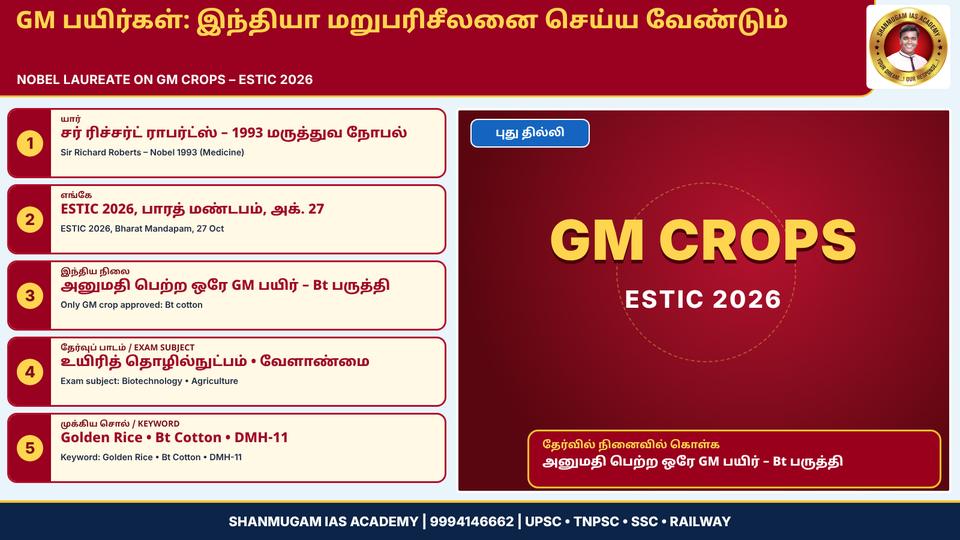
Sir Richard J. Roberts, British biochemist and 1993 Nobel laureate in Medicine, spoke on 27 Oct at the Emerging Science, Technology and Innovation Conclave (ESTIC 2026, 27–29 Oct) at Bharat Mandapam, New Delhi. He urged India to reconsider its approach to genetically modified (GM) crops and study biotech crops to improve nutrition, especially of the poor. He asked why 'Golden Rice', which can fight vitamin A deficiency, is not available in India; said no biotech-attributable safety problem had been shown in 35 years; and called for 'more science in politics and a little less politics in science'.
Key facts
| Who | Sir Richard J. Roberts (UK) – New England Biolabs; 1993 Nobel in Medicine (with Phillip Sharp) |
| Where / when | ESTIC 2026, Bharat Mandapam, New Delhi; 27 Oct 2026 |
| ESTIC 2026 | 27–29 Oct; coordinated by CSIR with 13 ministries; theme 'Creative Minds, Catalysing Science, Empowering Technologies' |
| Nobel work | Split genes – introns & gene splicing, adenovirus study 1977 |
| Golden Rice | GM rice producing beta-carotene (converted to vitamin A in the body) |
| India's status | Only GM crop approved for commercial cultivation – Bt cotton; GM mustard (DMH-11) case in Supreme Court |
Background
- Science: Roberts and Phillip Sharp won the 1993 Nobel for discovering 'split genes' – in eukaryotic genes, non-coding 'introns' lie between protein-coding 'exons' and are removed by RNA splicing. In 2016 he also signed the Nobel laureates' letter to Greenpeace supporting GM crops (precision agriculture).
- Regulation: the Genetic Engineering Appraisal Committee (GEAC) is a statutory body under the Environment (Protection) Act, 1986, functioning under the Ministry of Environment, Forest and Climate Change (MoEFCC); it approves environmental release of GMOs. GM foods must also meet FSSAI rules.
- Indian context: Bt cotton (2002) is the only commercial GM crop. Bt brinjal was put under a moratorium in February 2010. GEAC cleared environmental release of Delhi University's GM mustard DMH-11 in Oct 2022; on 23 July 2024 the Supreme Court (Justices B.V. Nagarathna and Sanjay Karol) gave a split verdict and directed the Centre to frame a national policy on GM crops.
- Genome editing: in May 2025 ICAR released two genome-edited (CRISPR-Cas, SDN-1) rice varieties – 'DRR Dhan 100 (Kamala)' (IIRR, Hyderabad; based on Samba Mahsuri) and 'Pusa DST Rice 1' (IARI, New Delhi; based on MTU 1010). As no foreign DNA is added, SDN-1/SDN-2 edits are exempt from GM rules.
Tamil Nadu link: Mahyco, which developed Bt brinjal, donated the technology to three institutions – Tamil Nadu Agricultural University (TNAU), Coimbatore; University of Agricultural Sciences, Dharwad; and the Indian Institute of Vegetable Research, Varanasi – to develop local varieties. Because of the 2010 moratorium, Bt brinjal never reached farmers in India.
Source: The Tribune, 27 Oct 2026; GKToday (ESTIC 2026); Wikipedia (Richard J. Roberts); Vajiram & Ravi (GM mustard verdict, July 2024); Vision IAS (genome-edited rice, May 2025); BioSpectrum (Bt brinjal)
Join our UPSC classroom or online batch: UPSC coaching in Coimbatore · Fees · Call 99941 46662.
Link to this page from your website / blog (HTML code)
UPSC Achievers
-

U. THAMIZH VENDHAN
SI/POLICE SI/POLICE
TNPSC குரூப் 1, 2/2A, 4 – நேரடி வகுப்புகள் · கோவை & மதுரை
2006 முதல் சண்முகம் IAS அகாடமி · Classroom & online coaching in Coimbatore and Madurai
