

Mains Analysis: The Supreme Court and the SIR – can India clean its electoral rolls without shutting out genuine voters?
30 October 2026 · English Polity & Governance
இந்தப் பகுப்பாய்வைத் தமிழில் படிக்க →
Topics: Polity · GS-II · UPSC Mains Analysis
Context
The Supreme Court heard two sets of cases on the Election Commission of India's (ECI) Special Intensive Revision (SIR) of electoral rolls this week. On 27 October 2026, a Bench of Chief Justice Surya Kant and Justices Joymalya Bagchi and V. Mohana gave petitioners time to reply to the ECI's affidavit defending its SIR decisions, and issued notice on a fresh plea alleging that the voter-registration process (Form 6) was changed without the Court's approval. On 28 October, in the Delhi SIR case, the same Bench asked the ECI why voters who were already on the roll but missed the enumeration stage must apply through Form 6, which is meant for new voters. It called this a "structural incongruity". The ECI said it would consider accepting late forms and extend the deadline if needed; the matter will be heard again after two weeks. Justice Bagchi also reportedly made clear that the legality of the ECI's "logical discrepancy" category is still open. The core question for Indian democracy: how can the ECI keep the roll accurate without wrongly removing eligible citizens?
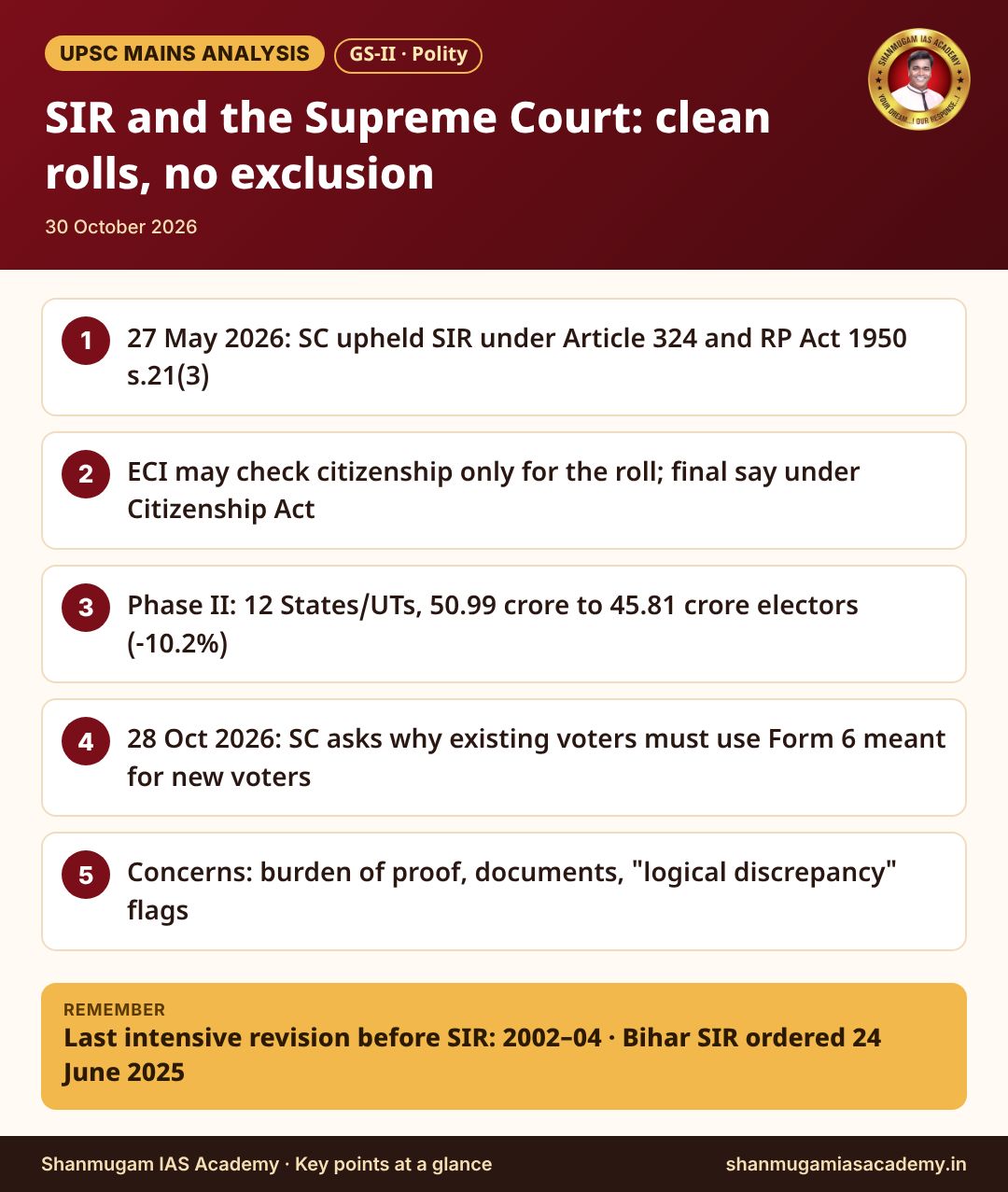
Background: how the SIR unfolded
| Stage | When | What happened |
|---|---|---|
| Bihar (pilot) | Ordered 24 June 2025 | Every elector had to submit an enumeration form; 11 listed documents (Aadhaar added as the 12th on the Supreme Court's direction). About 65 lakh names were dropped at the draft stage; the final roll on 30 September 2025 had about 7.42 crore electors, down from 7.89 crore. |
| Phase II | Announced 27 October 2025 | 12 States/UTs including Tamil Nadu, Kerala, West Bengal, Uttar Pradesh and Puducherry; about 51 crore electors. Final rolls fell from about 50.99 crore to 45.81 crore electors (a drop of 10.2%). |
| Phase III | Announced 14 May 2026 | 16 States and 3 UTs (including Delhi, Karnataka, Maharashtra, Andhra Pradesh, Telangana); about 36.73 crore electors and 3.94 lakh Booth Level Officers. Himachal Pradesh, Jammu and Kashmir and Ladakh to follow later. |
| Delhi | Draft roll 31 August 2026 | About 47.7 lakh of roughly 1.45 crore electors (about one-third) left out of the draft, mostly marked "permanently shifted" or "absent"; lakhs more received "no mapping" or "logical discrepancy" notices. |
The last intensive revision was in 2002–04; the ECI argues that migration, urbanisation, unreported deaths and duplicate entries have since made the rolls unreliable.
The constitutional and legal framework
| Provision | What it says | Relevance to SIR |
|---|---|---|
| Article 324 | Superintendence, direction and control of the preparation of electoral rolls and the conduct of elections vest in the ECI | Source of the ECI's power to order an SIR |
| Article 325 | One general electoral roll for every constituency; no one excluded only on grounds of religion, race, caste or sex | Bars targeted or discriminatory deletion |
| Article 326 | Adult suffrage: every citizen aged 18 or above, not disqualified by law, is entitled to be registered | The right to be on the roll; citizenship is a condition |
| RP Act 1950, s.16 and s.19 | Non-citizens are disqualified; a voter must be 18 on the qualifying date and ordinarily resident | Basis for checking citizenship and residence |
| RP Act 1950, s.21(3) | ECI may at any time, for reasons to be recorded, direct a special revision "in such manner as it may think fit" | The specific legal basis of the SIR |
| RP Act 1950, s.22–24 and s.31 | Correction and inclusion of entries; appeals; false declarations punishable with up to one year's imprisonment | Remedies – and the Form 6 declaration worry |
| CEC and Other ECs Act, 2023, s.18 | Business of the Commission to be transacted unanimously as far as possible, otherwise by majority | Basis of the pleas alleging decisions by the CEC alone |
What the Supreme Court has said so far
- Judgment of 27 May 2026 (petitions led by the Association for Democratic Reforms): the SIR was upheld. The ECI acted within Article 324 and Section 21(3); the exercise has a direct nexus with free and fair elections. Under Section 16, the ECI may inquire into citizenship only to decide inclusion in the roll; a deletion is not a final finding of non-citizenship. Doubtful cases must be referred to the competent authority under the Citizenship Act, 1955 (within four weeks for the Bihar cases), and those found to be citizens must be restored. The presumption in favour of a person already on the roll remains, though it can be rebutted.
- July 2026: while issuing notice on a West Bengal plea, the Bench said exclusion from the roll does not by itself mean loss of citizenship, and noted concerns that deleted voters were losing welfare benefits.
- 22 September 2026 (Delhi): the Court said notices appeared to be issued "almost mechanically", asked the ECI to explain what a "logical discrepancy" is, and said BLOs should help voters; it reportedly also said documents could be submitted by WhatsApp or e-mail.
- 5 October 2026: the Court refused to suspend the Chief Election Commissioner, but issued notice on pleas alleging unilateral SIR decisions, and said it had not approved any modified Form 6.
Why it matters: the dimensions
- Democratic: the right to vote is a statutory right, but registration is its gateway. A voter removed before an election cannot vote, even if restored later.
- Citizenship: the ECI is not the authority to decide citizenship, yet a deletion "for doubtful citizenship" can stigmatise and affect access to documents and welfare.
- Administrative: the 2002–04 rolls were not uniformly digitised, so "mapping" today's voters to them creates errors outside the voter's control.
The Tamil Nadu angle
- Tamil Nadu was in Phase II. Its roll was frozen at about 6.41 crore electors in October 2025; the draft roll (December 2025) had about 5.43 crore.
- After claims and objections, about 27.5 lakh eligible voters were added back, and the final roll of February 2026 had about 5.67 crore electors – a net fall of about 74 lakh.
Concerns and challenges
- Burden of proof: asking every elector to re-prove eligibility reverses the presumption that a person on the roll is a valid voter.
- Documents: the poor, migrant workers, women who moved after marriage and the homeless often lack birth or residence papers.
- Opaque algorithms: "logical discrepancy" flags (such as small age gaps between parent and child or many siblings) are applied by software, without published criteria.
- Form 6 trap: a deleted voter forced to declare that he or she is a new voter risks a false-declaration charge under Section 31.
- Scale and time: in Phase II alone the rolls shrank by over 5 crore names (50.99 crore to 45.81 crore); appeal bodies and BLOs are overloaded, and deadlines are short.
- Institutional credibility: allegations that key decisions were taken by the CEC alone, which the ECI denies, are now before the Court.
Way forward
- Keep the presumption of inclusion: no deletion of an existing elector without individual notice, a hearing and a reasoned order (the Lal Babu Hussein, 1995 standard).
- Publish the rules of the algorithm: notify the criteria for "logical discrepancy" and allow human review before any notice is sent.
- A proper re-entry route: a separate form or declaration for restored voters, so that no one has to falsely call himself a new voter.
- State-led outreach: BLOs to trace "shifted" voters; lists of deleted names in local languages at every booth and online; acceptance of documents by phone or e-mail.
- Keep citizenship and welfare separate: refer doubtful cases to the Citizenship Act authority quickly; no use of roll deletions to deny rations, pensions or passports.
- Continuous, not periodic, cleaning: link death and birth registration to the rolls, use the four qualifying dates every year, and audit deletions independently.
Mains practice question
Answer framework: Introduction – SIR since June 2025; 27 May 2026 judgment · Body – (a) legal basis: Articles 324–326, RP Act 1950 s.16, s.19, s.21(3); (b) justification: migration, deaths, duplicates, last intensive revision 2002–04; (c) concerns: burden of proof, documents, algorithmic flags, Form 6, scale (Phase II 50.99 crore to 45.81 crore; Tamil Nadu example); (d) Court's safeguards: deletion is not a citizenship finding, referral under the Citizenship Act, notice and hearing · Way forward – presumption of inclusion, transparent criteria, re-entry route, outreach · Conclusion – faculty-view line.
Prelims pointers
- Article 324 – ECI; Article 325 – one general roll, no exclusion on religion, race, caste or sex; Article 326 – adult suffrage.
- 61st Constitutional Amendment Act, 1988 – voting age lowered from 21 to 18.
- RP Act 1950, s.21(3) – special revision "for reasons to be recorded"; s.31 – false declaration, up to one year's imprisonment.
- Form 6 – new elector; Form 7 – objection or deletion; Form 8 – shifting of residence or correction of entries.
- Four qualifying dates a year – 1 January, 1 April, 1 July and 1 October (Election Laws (Amendment) Act, 2021).
Every voter list can go wrong in two ways. It can keep names that should not be there – dead, duplicate or ineligible entries (an inclusion error). Or it can drop people who have every right to be there (an "exclusion error"). The SIR was designed to cut the first kind; the Court's recent hearings are about controlling the second. In a democracy the two are not equal: a duplicate name rarely changes an outcome, but a genuine citizen removed before polling day loses a right that cannot be given back for that election. So the test of any revision is not how many names it removes, but how few eligible voters it loses.
- A shift to note: the debate has moved from "can the ECI do an SIR?" (answered yes in May 2026) to "how must it do it?" – procedure, transparency and accountability.
- What to watch next: (1) the ECI's report on late forms and the Form 6 route for Delhi's deleted voters, and the Delhi final roll; (2) the Court's further hearing in November on alleged unilateral decisions and the Form 6 plea; (3) a ruling on the legality of "logical discrepancy" notices; (4) the remaining Phase III final rolls and citizenship referrals under the Citizenship Act.
- Ready-made conclusion line: "A clean electoral roll is measured not by the names it removes but by the eligible citizens it keeps – in a democracy, an exclusion error costs more than an inclusion error."
Sources: Constitution of India (Articles 324–326); Representation of the People Act, 1950; ECI Press Note ECI/PN/086/2026 (14 May 2026); All India Radio News on the Phase II announcement (27 October 2025); reports of the Supreme Court judgment of 27 May 2026 (Business Standard, Supreme Court Observer); Supreme Court hearing reports of July, 22 September, 5 October, 27 October and 28 October 2026 (LiveLaw, LawBeat, The Wire, The News Minute, DT Next, ETV Bharat); Tamil Nadu final roll reports (February 2026). Original analysis by Shanmugam IAS Academy.
Link to this page from your website / blog (HTML code)
SI/POLICE Achievers
-

S. ARUL KUMAR
SI/POLICE SI/POLICE
TNPSC பொதுத்தமிழ் | 9th புதிய தமிழ் புத்தகம் | General Tamil MCQ | Group 4
TNPSC குரூப் 1, 2/2A, 4 – நேரடி வகுப்புகள் · கோவை & மதுரை
2006 முதல் சண்முகம் IAS அகாடமி · Classroom & online coaching in Coimbatore and Madurai
