

Mains Analysis: Kerala's senior citizens law – can India turn elder care from a family duty into a right?
29 October 2026 · English
இந்தப் பகுப்பாய்வைத் தமிழில் படிக்க →
Topics: Social Justice · GS-II · UPSC Mains Analysis
Context
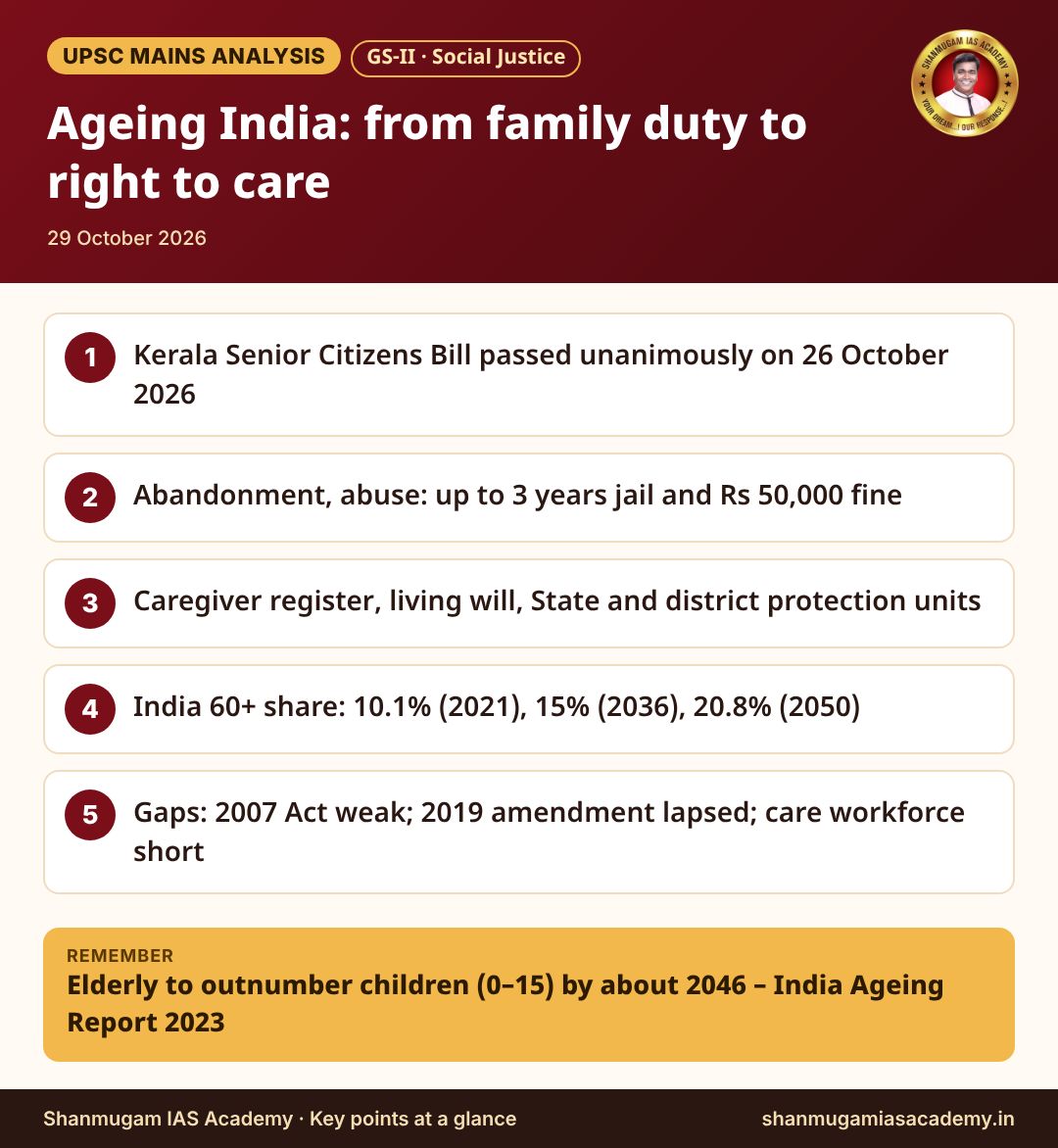
On 26 October 2026, the Kerala Legislative Assembly unanimously passed the Keralam Senior Citizens (Care and Protection of Rights) Bill, 2026. Chief Minister V.D. Satheesan had introduced it on 13 October; it was examined by the Subject Committee and now needs the Governor's assent. It covers persons aged 60 and above. Its key features: up to 3 years' imprisonment and a fine of up to Rs 50,000 for abandonment, cruelty or abuse of a senior citizen and for illegally taking a care-home resident's property; up to 1 year and Rs 25,000 for running an unregistered care centre; a State register of certified caregivers with police verification; a statutory living will on end-of-life care; and a State Senior Citizen Protection Unit with district-level protection forums and units, plus a nodal officer in every police station. Doctors and care centres must report suspected abuse. It is reported as the first comprehensive State law of this kind. The larger question for India: as the country ages fast, can care for the old remain a private family duty, or must it become a public right?
Background: how fast is India ageing?
- India Ageing Report 2023 (IIPS and UNFPA, released 27 September 2023): the share of people aged 60+ was 10.1% in 2021, and is projected to reach 15% by 2036 and 20.8% by 2050 (about 347 million people). The elderly will outnumber children aged 0–15 by about 2046.
- Poor and unequal ageing: more than 40% of the elderly are in the poorest wealth quintile. Women live longer than men after 60, are more often widowed, and have less income and property – the feminisation of ageing.
- LASI Wave 1 (Longitudinal Ageing Study in India, IIPS for the Health Ministry; 72,250 persons aged 45+; released 6 January 2021): about 75% of the elderly have one or more chronic diseases, about 40% have some disability and about 20% have mental-health problems.
- Southern States age first: Kerala had the highest elderly share (about 16.5% in 2021); Tamil Nadu about 13.6% (about 1.04 crore persons).
The existing framework
| Instrument | What it does | Gap |
|---|---|---|
| Article 41 (DPSP) | State to make effective provision for public assistance in old age, within economic capacity | Not enforceable in court |
| Maintenance and Welfare of Parents and Senior Citizens Act, 2007 | Maintenance tribunals; monthly maintenance capped at Rs 10,000; abandonment punishable with up to 3 months or Rs 5,000 fine | Low cap, weak penalty, little awareness |
| MWPSC (Amendment) Bill, 2019 | Introduced 11 December 2019: remove the cap, wider definition of children, 3–6 months jail, registration of care homes | Lapsed on dissolution of the Lok Sabha; amendment still awaited |
| NPHCE (Health Ministry, 2010–11) | Geriatric care from PHC to district; Regional Geriatric Centres; National Centres for Ageing at AIIMS Delhi and Madras Medical College, Chennai | States historically used a small share of funds |
| Atal Vayo Abhyuday Yojana (AVYAY) | Former National Action Plan for Senior Citizens (NAPSrC), renamed April 2021: senior citizen homes (IPSrC), assistive devices (Rashtriya Vayoshri Yojana), State action plans, Elderline | Institutional care still small compared with need |
| Elderline 14567 | National helpline since 1 October 2021; over 29 lakh calls | No financial aid; mainly guidance and referral |
| AB PM-JAY for all 70+ | Cabinet approved 11 September 2024; Ayushman Vay Vandana card from 29 October 2024; Rs 5 lakh a year per family, regardless of income (about 6 crore persons) | Covers hospitalisation, not long-term or home care |
What the Kerala law adds
- From maintenance to rights: the 2007 Act is mainly about money from children; the Kerala law lists rights – affordable home care, safe and accessible public spaces, digital inclusion with non-digital alternatives, free legal aid, and priority shelter for widowed or abandoned women.
- Regulating the care market: care centres must register (valid four years); home-care agencies must have 25% certified caregivers in two years and all in four years; caregivers get minimum wages and protection from exploitation.
- "Ageing in place": one of its guiding principles is home-based care, so that the old can live in their own homes and communities.
- Institutions: protection units and forums at State and district levels; it builds on Kerala's 2025 law that created a State Senior Citizens Commission.
Why it matters: the dimensions
- Social: nuclear families and migration of children leave many parents alone; abuse is often by family members and goes unreported.
- Economic – the care economy: elder care is mostly unpaid work by women. Trained, paid caregivers can create jobs, especially for women, and free family members to work. Under AVYAY, over 35,000 geriatric caregivers have been trained (Ministry figures).
- Health: a rising burden of chronic disease, dementia and disability needs long-term and palliative care, not only hospital insurance.
- Ethical: a living will respects autonomy at the end of life, building on the Supreme Court's Common Cause judgment (2018).
The Tamil Nadu angle
- Tamil Nadu is among the oldest States: about 1.04 crore elderly in 2021, projected to rise further by 2031.
- Chief Minister's Thayumanavar scheme (12 August 2025): doorstep delivery of ration items to about 20.42 lakh persons aged above 70 and to persons with disabilities.
- The State prepared a State Policy for Senior Citizens (2022), and Madras Medical College hosts one of the two National Centres for Ageing.
- Senior citizens' associations have asked the new State government (August 2026) for a Senior Citizens Commission like Kerala's and a higher old-age pension (now about Rs 1,200–1,500 a month under various schemes, as reported).
Challenges
- Implementation: tribunals under the 2007 Act are little used; Kerala's units need staff, funds and trained police.
- Living will safeguards: the opposition in Kerala warned of misuse because the Bill omits the Supreme Court's requirement of two independent witnesses; the government says the Supreme Court's safeguards will be put in the rules.
- Family relations: criminal penalties may deter abuse, but many parents will not prosecute their own children; mediation and support services are needed.
- Workforce and cost: shortage of geriatricians and certified caregivers; care homes are costly; pensions are small and coverage is limited.
- Unequal ageing: rural, poor, widowed and disabled elders face the highest risk, and the digital divide blocks access to services.
Way forward
- Pass a revised national law: reintroduce the MWPSC amendment with care-home registration, caregiver standards and a stronger tribunal system.
- Build a long-term care system: home-based and community care, day-care centres and palliative care linked to NPHCE, PM-JAY and Ayushman Arogya Mandirs.
- Grow a professional care workforce: national geriatric-care certification, minimum wages and social security for caregivers – mostly women.
- Income security: raise and index old-age pensions; expand coverage for widows and informal workers.
- Use the State lab: other States, including Tamil Nadu, can adapt Kerala's model; the Centre can build a common framework from these experiments.
Mains practice question
Answer framework: Introduction – India Ageing Report 2023 data · Body – (a) existing framework: Article 41, 2007 Act, NPHCE, AVYAY, PM-JAY 70+, and gaps; (b) Kerala law: rights, caregiver register, living will, protection units, penalties; (c) dimensions: feminisation, care economy, health; Tamil Nadu example · Way forward – national law, long-term care, workforce, pensions · Conclusion – faculty-view line.
Prelims pointers
- Article 41 – right to public assistance in old age (Directive Principle).
- Maintenance and Welfare of Parents and Senior Citizens Act, 2007 – maintenance cap Rs 10,000 a month.
- Elderline 14567 – launched 1 October 2021; 1 October is the International Day of Older Persons.
- AVYAY – Ministry of Social Justice and Empowerment; formerly NAPSrC. NPHCE – Ministry of Health and Family Welfare.
- LASI – conducted by IIPS, Mumbai; Wave 1 report released 6 January 2021.
India's elder-care debate has so far been about one question: who pays – the children or the State? Kerala's law points to a better question: where and how do the old live well? The answer the world is moving towards is "ageing in place" – helping older people live safely in their own homes and communities, with home care, accessible streets, digital help and trained caregivers, and using institutions only when needed. It is cheaper than institutional care, keeps family bonds, and creates local care jobs.
- A shift to note: from "maintenance" (money from children) to "care and rights" (services, standards, protection). Write "from family duty to public right".
- What to watch next: (1) Governor's assent and the rules on living wills in Kerala, (2) whether the Centre reintroduces the lapsed MWPSC amendment, (3) whether Tamil Nadu sets up a Senior Citizens Commission, (4) uptake of PM-JAY Vay Vandana cards and the next LASI wave.
- Ready-made conclusion line: "India must plan for a society where one in five will be old by 2050 – by enabling ageing in place, so that a longer life is also a life of dignity."
Sources: Reports on the Keralam Senior Citizens (Care and Protection of Rights) Bill, 2026 (October 2026); India Ageing Report 2023 (IIPS–UNFPA); LASI Wave 1 (MoHFW, January 2021); PRS Legislative Research on the MWPSC (Amendment) Bill, 2019 and the Ministry reply on its lapse (December 2025); DGHS page on NPHCE; Ministry of Social Justice and Empowerment / PIB on AVYAY and Elderline (2026); Union Cabinet decision on PM-JAY for 70+ (September 2024); Tamil Nadu State Planning Commission and reports on the Thayumanavar scheme. Original analysis by Shanmugam IAS Academy.
Link to this page from your website / blog (HTML code)
BANK Achievers
-

V. SUGANYA
BANK BANK
TNPSC குரூப் 1, 2/2A, 4 – நேரடி வகுப்புகள் · கோவை & மதுரை
2006 முதல் சண்முகம் IAS அகாடமி · Classroom & online coaching in Coimbatore and Madurai
