

Mains Analysis: Cyclone Arnab – From Relief to Zero-Casualty Cyclone Management
29 October 2026 · English Environment & Ecology
இந்தப் பகுப்பாய்வைத் தமிழில் படிக்க →
Topics: Disaster Management · GS-III · UPSC Mains Analysis
Context
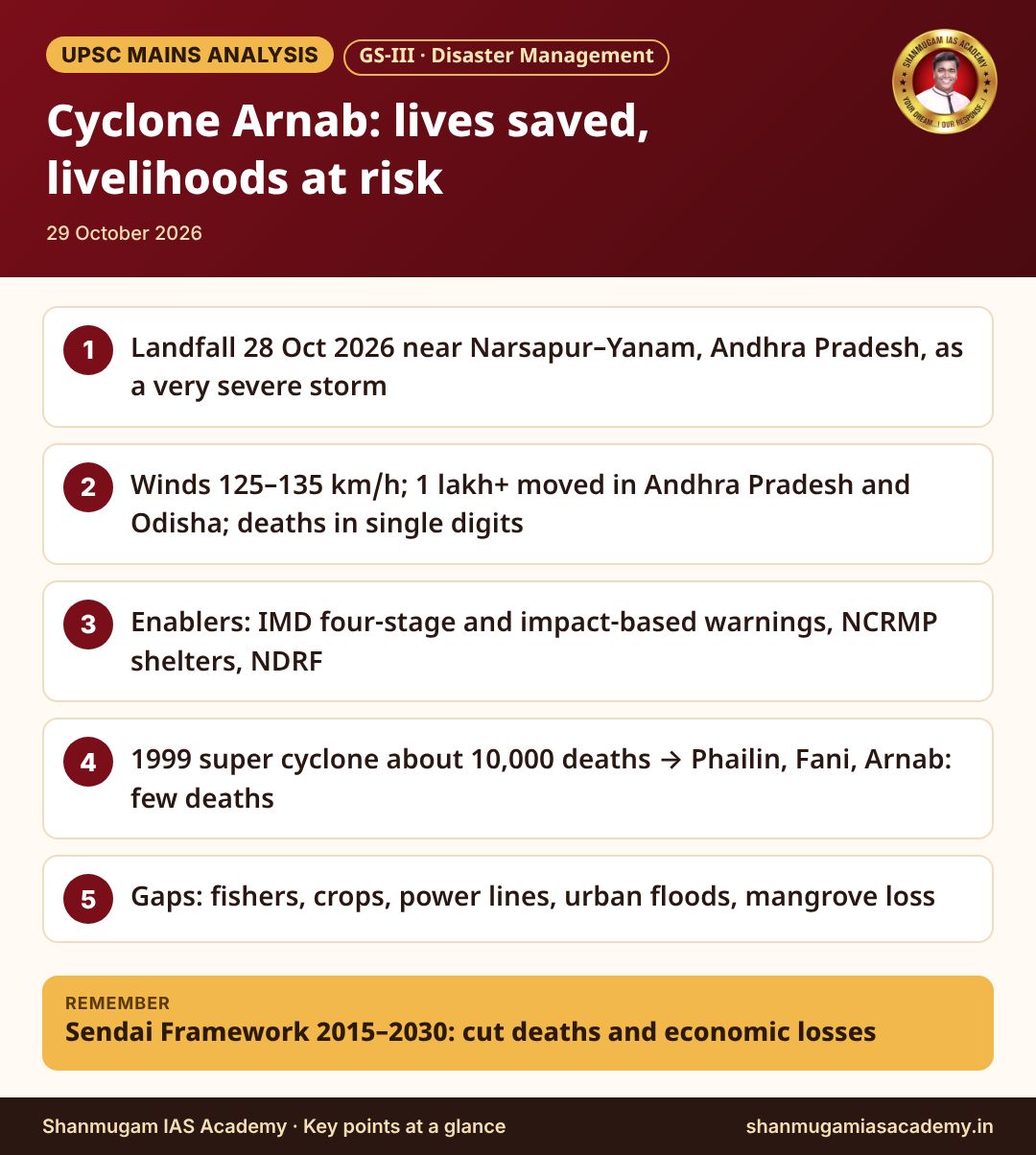
Cyclone Arnab – a name contributed by Bangladesh and commonly linked to the Bengali word for the sea – grew out of a low-pressure area over the Bay of Bengal that formed on 23 October 2026 and became a cyclonic storm on 26 October. According to the India Meteorological Department (IMD), it crossed the Andhra Pradesh–Yanam coast south-west of Yanam, about 20 km east-north-east of Narsapur and about 60 km south-west of Kakinada, in the early hours of 28 October 2026, as a very severe cyclonic storm (VSCS) with sustained winds of 125–135 km/h gusting to 150 km/h, and then weakened over land. More than 1.2 crore people lived in its projected path. Andhra Pradesh moved over 50,000 people from low-lying and coastal areas and Odisha about 48,000; more than 2,000 cyclone shelters were readied in 20 Andhra districts and, according to the NDRF, 39 of its teams were deployed in Andhra Pradesh. The NDRF reported three deaths on landfall day; later reports cited up to five deaths in related incidents such as falling trees and electrocution. Houses, power lines, coconut plantations and standing paddy were damaged. A storm of this strength killing so few people is now normal in India – and that itself is the story.
Background – how India changed
| Cyclone | What happened | Lesson |
|---|---|---|
| Odisha Super Cyclone, Oct 1999 | About 10,000 deaths; weak last-mile warning, few shelters | Odisha set up OSDMA – before the national DM Act |
| Phailin, Oct 2013 (Gopalpur, Odisha) | Nearly 9–10 lakh people evacuated; deaths kept to a few dozen | Mass pre-emptive evacuation works |
| Fani, May 2019 (Odisha) | About 12 lakh evacuated; 64 deaths in India despite an extremely severe storm | Lives saved, but weeks of power and water outages |
| Arnab, Oct 2026 (Andhra Pradesh–Yanam) | VSCS landfall; 1 lakh+ moved in two States; deaths in single digits | Zero-casualty goal near; losses shift to livelihoods |
The system behind low casualties
| Link | What it does |
|---|---|
| IMD four-stage warning | Pre-cyclone watch (72 h) → Cyclone alert, yellow (48 h) → Cyclone warning, orange (24 h) → Post-landfall outlook, red (12 h) |
| Impact-based forecasting | Bulletins say what the wind will do – "total destruction" of thatched houses, poles uprooted – not only wind speed; storm-surge height (1–1.5 m for Arnab) tells who must leave |
| NDMA guidelines | National Guidelines on Management of Cyclones (2008): warning, shelters, coastal zoning, mangroves, community preparedness |
| NCRMP | National Cyclone Risk Mitigation Project (World Bank-aided, from 2011): multipurpose cyclone shelters, evacuation roads, saline embankments, last-mile warning systems (sirens, mass SMS) |
| Response forces | NDRF pre-positioned and airlifted before landfall; State forces (Odisha's ODRAF, SDRFs) |
| Law | Disaster Management Act, 2005 (NDMA–SDMA–DDMA); amended in 2025 (passed March 2025) |
The Disaster Management (Amendment) Act, 2025 lets NDMA and SDMAs prepare plans themselves, requires national and state disaster databases, allows Urban Disaster Management Authorities for state capitals and municipal-corporation cities, gives statutory status to the National Crisis Management Committee and the High Level Committee, and lets States form a State Disaster Response Force. Globally, India follows the Sendai Framework for Disaster Risk Reduction 2015–2030 – four priorities and seven targets, which ask countries to cut not only deaths but also people affected, economic loss and damage to infrastructure.
Why it matters – from relief to risk reduction
- From reactive to proactive: the old model counted bodies and distributed relief; the new one acts 72 hours before landfall.
- Odisha model: a dedicated agency, shelters managed by trained village committees, a "zero-casualty" political goal and repeated drills made evacuation a habit – and other States copied it.
- Federal teamwork: IMD warns, NDMA and MHA coordinate, States evacuate, districts run shelters, NDRF fills gaps.
- Global credibility: India's cyclone record supports its leadership in the Coalition for Disaster Resilient Infrastructure (CDRI).
The Tamil Nadu angle
- Gaja (November 2018): crossed near Vedaranyam (Nagapattinam); lakhs were evacuated, but the coconut, banana and fishing economy of the delta was flattened – a classic "lives saved, livelihoods lost" case.
- Michaung (December 2023): crossed the Andhra coast near Bapatla, yet its slow movement and heavy rain flooded Chennai, with at least 17 deaths reported – urban flooding, not wind, was the killer.
- Tools: TNSDMA's TNSMART web-GIS platform and the TN-Alert app give impact-based, location-wise warnings; Pichavaram's mangroves remind us of nature as a shield.
Challenges – what "zero casualty" hides
- Livelihood losses: fishers lose days at sea, boats and nets; farmers lose paddy at harvest stage and coconut trees that take years to regrow. Relief norms under SDRF/NDRF pay little for this.
- Power and communication: uprooted poles cut electricity and mobile networks for days – Fani showed that restoration, not evacuation, becomes the main public grievance.
- Urban flooding: cities like Chennai and Visakhapatnam face rain-driven floods that wind-focused cyclone plans do not cover.
- Indirect deaths: most Arnab deaths came from falling trees, live wires and wall collapse – hazards after the storm, not the surge.
- Ecosystem loss: mangroves and coastal dunes – natural buffers – are lost to aquaculture, ports and construction.
- Warning fatigue: some residents ignore repeated warnings, especially when a storm weakens before landfall.
Way forward
- From zero casualty to minimum loss: track economic loss and recovery time as Sendai asks, not just deaths.
- Underground and hardened power lines in high-risk coastal belts; pre-staged restoration crews and materials.
- Livelihood protection: parametric insurance for fishers and coconut growers; faster crop-loss assessment by drones and satellites.
- Urban DM authorities under the 2025 amendment to plan for drainage, lakes and flood-plains in coastal cities.
- Nature-based defences: mangrove and shelter-belt plantation (MISHTI-type programmes) and strict Coastal Regulation Zone enforcement.
- Last-mile messaging in local languages through cell-broadcast and the Common Alerting Protocol, with community volunteers (Aapda Mitra).
Mains practice question
Answer framework: Introduction – Arnab (28 October 2026, VSCS, deaths in single digits) vs 1999 super cyclone · Body – (a) enablers: IMD four-stage and impact-based warnings, NDMA guidelines, NCRMP shelters, NDRF/SDRF, DM Act 2005 and 2025 amendment, Odisha model; (b) gaps: livelihoods, power, urban floods (Michaung), indirect deaths, mangrove loss · Way forward – Sendai targets, hardened grids, parametric insurance, urban DM authorities, nature-based solutions · Conclusion – faculty-view line.
Prelims pointers
- IMD scale (sustained wind): Depression 31–49 km/h; Deep Depression 50–61; Cyclonic Storm 62–88; Severe 89–117; Very Severe 118–166; Extremely Severe 167–221; Super Cyclonic Storm 222 and above.
- North Indian Ocean names: list of 169 names (13 each from 13 countries) adopted in 2020 by the WMO/ESCAP Panel on Tropical Cyclones; "Arnab" was proposed by Bangladesh.
- IMD's Regional Specialised Meteorological Centre (RSMC), New Delhi, issues advisories for the North Indian Ocean.
- Sendai Framework: adopted 2015 in Sendai, Japan; succeeds the Hyogo Framework (2005–2015).
- NCRMP (World Bank-aided): Phase I (2011) – Andhra Pradesh and Odisha; Phase II (approved 2015) – west-coast States such as Gujarat, Maharashtra and Kerala, plus West Bengal.
Learn the term "Build Back Better": a Sendai Framework idea (Priority 4) that recovery should not rebuild the same weak house, pole or embankment, but a stronger and safer one, so that the next disaster causes less loss. India has mastered evacuation; its next frontier is recovery. Use the term to move your answer beyond "deaths were low" to "how quickly and how well did people recover".
- What to watch next: (1) the central team's damage assessment and NDRF assistance to Andhra Pradesh; (2) how long power and communication restoration takes in Konaseema and West Godavari; (3) whether States notify Urban Disaster Management Authorities under the 2025 amendment; (4) the north-east monsoon season (October–December), the main cyclone season for the Tamil Nadu coast.
- Tamil Nadu angle: compare Arnab with Gaja (2018) and Michaung (2023) in TNPSC Group 1 and UPSC answers.
- Ready-made conclusion line: "India has learnt to save lives from cyclones; to Build Back Better it must now save livelihoods, power lines and mangroves with the same urgency."
Sources: IMD national bulletins and RSMC New Delhi (four-stage warning, cyclone scale); NDMA cyclone guidelines; OSDMA (NCRMP); PRS Legislative Research (Disaster Management (Amendment) Bill, 2024); UNDRR (Sendai Framework); TNSDMA; reports by ThePrint/PTI, ANI, Euronews/AP, ABC/Reuters, Al Jazeera, The News Minute, Deccan Herald. Original analysis by Shanmugam IAS Academy.
Link to this page from your website / blog (HTML code)
TNPSC Achievers
-

MOHAMMAD ALI
TNPSC TNPSC
TNPSC குரூப் 1, 2/2A, 4 – நேரடி வகுப்புகள் · கோவை & மதுரை
2006 முதல் சண்முகம் IAS அகாடமி · Classroom & online coaching in Coimbatore and Madurai
