

UNEP recognition: India's Ganges River Dolphin Recovery Programme cited among the UN World Restoration Flagships
30 October 2026 · English Environment & Ecology
Topics: States, Tax, Environment, Culture & Awards · 30 October 2026 Current Affairs (UPSC / TNPSC / SSC / RRB)
News
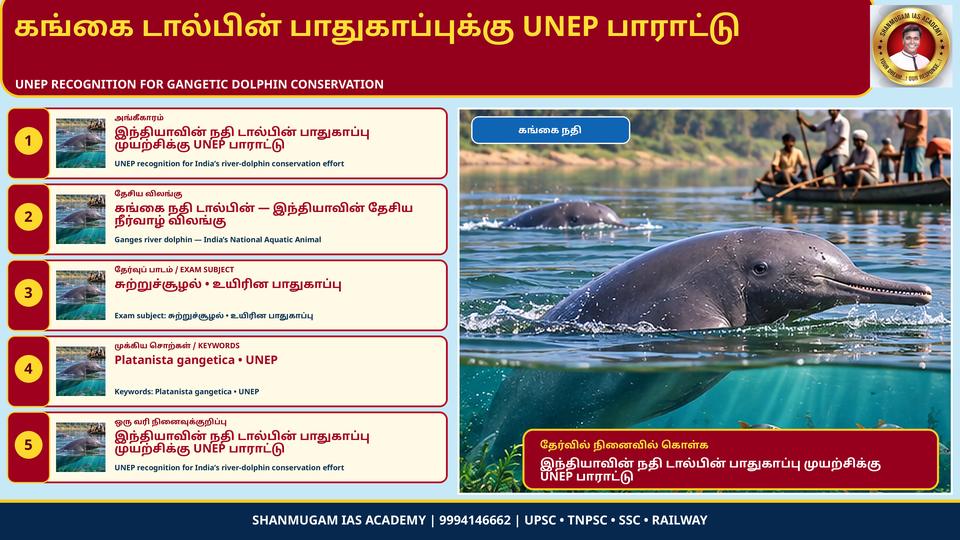
The report 'Nature's Comeback – Scaling Ecosystem Restoration for People and Planet', released in October 2026 by the UN Environment Programme (UNEP) with the Food and Agriculture Organization (FAO) and the Secretariat of the Convention on Biological Diversity (CBD), cited India's Ganges River Dolphin Recovery Programme as one of 35 'UN World Restoration Flagships'. It was held up as a model that links species protection, river-ecosystem restoration and local livelihoods. The report comes at the mid-point of the UN Decade on Ecosystem Restoration (2021–2030) and warns that restoration is not moving fast enough to meet the 2030 goals.
Key facts
| Recognition | UNEP–FAO–CBD 'Nature's Comeback' report (Oct 2026) – one of 35 World Restoration Flagships |
| Implementation | Union Environment, Forest & Climate Change Ministry – 'Project Dolphin'; Comprehensive Action Plan for dolphins 2022–2047 |
| Species | Ganges river dolphin – Platanista gangetica; 'susu'; IUCN: Endangered |
| Legal protection | Wildlife (Protection) Act 1972 – Schedule I; CITES – Appendix I |
| Status | India's National Aquatic Animal (2009); State aquatic animal of Assam; 5 Oct – National Dolphin Day |
| First estimate | 3 Mar 2025 – 6,327 river dolphins (8 States, 28 rivers); Uttar Pradesh highest, then Bihar, West Bengal, Assam |
Background
- Biology: the Ganges dolphin is a freshwater dolphin with very poor eyesight – it finds prey in muddy water by ultrasonic clicks and echoes (echolocation). Being air-breathing, it surfaces every 30–120 seconds through a blowhole on top of its head; its breathing sound gives the name 'susu'. It is an indicator species of river health.
- Geography: found in the Ganges–Brahmaputra–Meghna and Karnaphuli–Sangu river systems of India, Nepal and Bangladesh. The Vikramshila Gangetic Dolphin Sanctuary (1991) on the Ganga in Bhagalpur district, Bihar, was set up for it. Threats: dams and barrages, low flows, pollution and entanglement in fishing nets.
- Policy history: declared National Aquatic Animal in 2009; the PM announced 'Project Dolphin' on 15 Aug 2020. The first river-dolphin estimation report was released on 3 Mar 2025 at the National Board for Wildlife meeting at Sasan Gir, Gujarat. 'Namami Gange' was named a World Restoration Flagship at CBD COP15 in Montreal in Dec 2022 (among the first 10).
- Global context: the UN Decade on Ecosystem Restoration (2021–2030) was proclaimed by the UN General Assembly and is led by UNEP and FAO. Countries have pledged to restore about 1 billion hectares of degraded land. Target 2 of the Kunming–Montreal Global Biodiversity Framework: restore at least 30% of degraded ecosystems by 2030.
Tamil Nadu link: the Ganges dolphin does not occur in Tamil Nadu's rivers. But Tamil Nadu leads in marine-mammal protection – India's first Dugong Conservation Reserve was notified in Palk Bay in 2022, and dolphins are also seen in the Gulf of Mannar Marine National Park. (Tamil Nadu ACS Supriya Sahu won UNEP's 'Champions of the Earth' 2025 – 13.10.2026 set.)
Source: LexisNexis (UNEP report, 26 Oct 2026); News on AIR (3 Mar 2025); Business Today (Dec 2022)
Join our UPSC classroom or online batch: UPSC coaching in Coimbatore · Fees · Call 99941 46662.
Link to this page from your website / blog (HTML code)
TNPSC Achievers
-

VENKATASALAM
TNPSC TNPSC
TNPSC பொதுத்தமிழ் | 9th புதிய தமிழ் புத்தகம் | General Tamil MCQ | Group 4
TNPSC குரூப் 1, 2/2A, 4 – நேரடி வகுப்புகள் · கோவை & மதுரை
2006 முதல் சண்முகம் IAS அகாடமி · Classroom & online coaching in Coimbatore and Madurai
