

Mains Analysis: Social Security Board for gig and unorganised workers – will a new board deliver real protection?
31 October 2026 · English
இந்தப் பகுப்பாய்வைத் தமிழில் படிக்க →
Topics: Social Justice · GS-II · UPSC Mains Analysis
Context
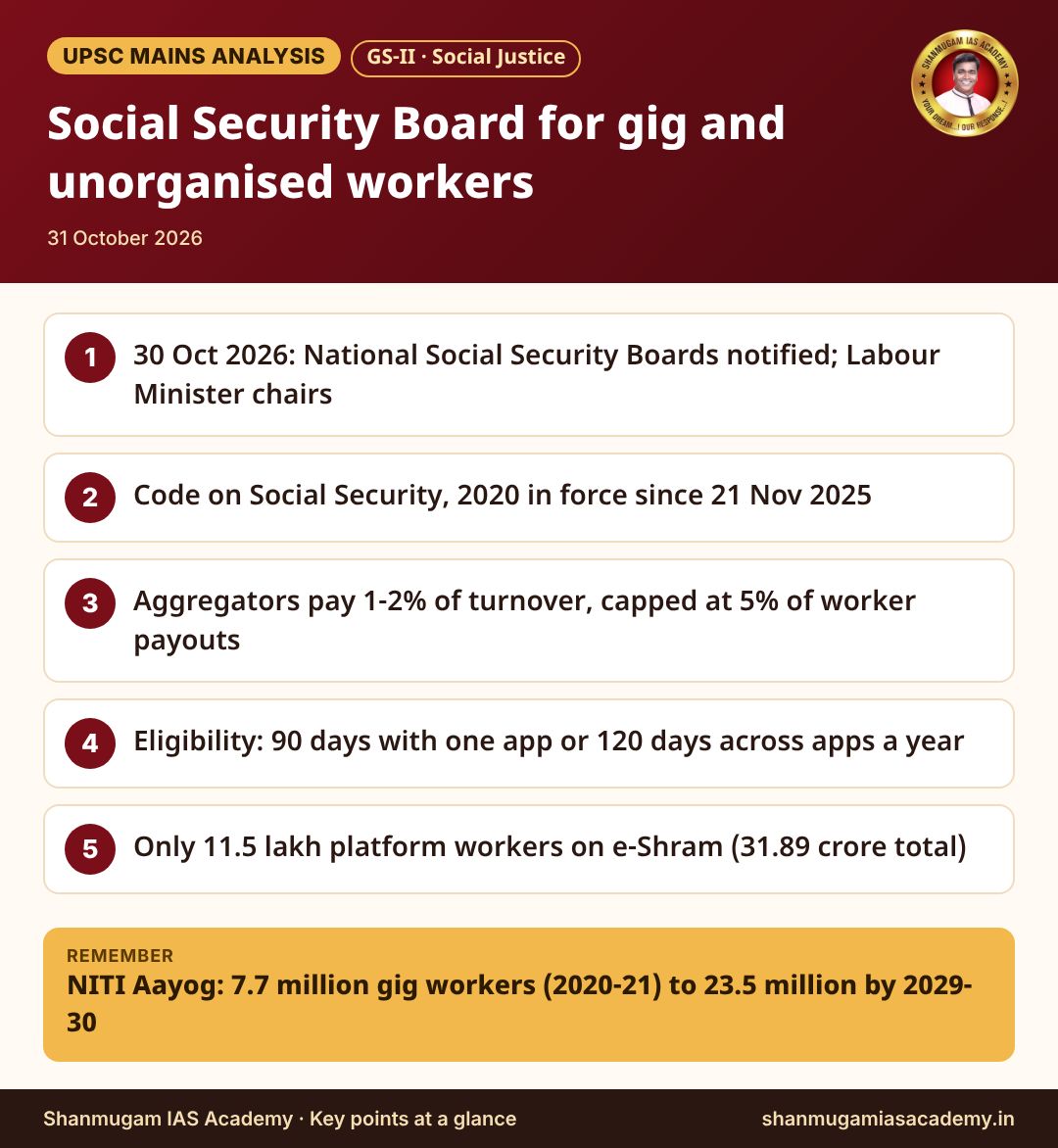
On 30 October 2026, the Ministry of Labour and Employment announced that it had notified National Social Security Boards – one for unorganised workers and one for gig and platform workers – under the Code on Social Security, 2020. Each Board is chaired by the Union Labour Minister and includes representatives of the Central and State governments, aggregator companies, employers, civil society, trade unions and associations of gig and platform workers. The Boards will recommend social security schemes, advise the Centre on administering the Code, monitor Central welfare schemes, review record-keeping by States and examine spending from the social security fund. Each must meet at least three times a year. The step comes almost a year after the four Labour Codes came into force, and the question for Mains is simple: can an advisory Board turn legal recognition of gig and informal workers into actual benefits?
Background: from exclusion to recognition
- Code on Social Security, 2020: merges nine older social security laws (including the EPF, ESI, Maternity Benefit and Unorganised Workers' Social Security Acts). With the other three Labour Codes, it came into force on 21 November 2025. It is the first Central law to define "gig worker", "platform worker" and "aggregator".
- A separate category, not "employees": gig and platform workers are covered under their own chapter, so they get notified welfare schemes (life and disability cover, accident insurance, health and maternity benefits, old-age protection, crèches) – not PF, ESI or gratuity as of right.
- Who pays: aggregators listed in the Code's Seventh Schedule contribute 1–2% of annual turnover, capped at 5% of the amount paid or payable to gig and platform workers, into a Social Security Fund; the Centre, States and CSR money can also fund schemes (PIB, December 2025).
- Rules: draft rules came in December 2025; the Social Security (Central) Rules, 2026 were notified on 8 May 2026. To be eligible, a worker must have worked at least 90 days with one aggregator, or 120 days across several, in the previous financial year; any day with any income counts as a day. Workers aged 16 and above self-register with Aadhaar; aggregators must upload their workers' details.
- e-Shram: launched on 26 August 2021 as the national database of unorganised workers. As on 18 August 2026 it had 31.89 crore registrations (54.28% women) but only about 11.5 lakh platform workers. An aggregator module was added on 12 December 2024.
- Health cover: the Union Budget 2025-26 announced identity cards, e-Shram registration and Ayushman Bharat PM-JAY health cover for gig workers – estimated then at nearly one crore.
- Size of the workforce: NITI Aayog (June 2022) estimated 7.7 million gig workers in 2020-21, rising to 23.5 million by 2029-30.
Core analysis: Centre and States – who is doing what
| Law / body | Status | How it is funded | What to note |
|---|---|---|---|
| Code on Social Security, 2020 (Centre) | In force 21 Nov 2025; Rules 8 May 2026; Boards notified 30 Oct 2026 | 1–2% of aggregator turnover, capped at 5% of payouts to workers | Board only recommends; benefits depend on schemes the Centre notifies |
| Rajasthan Platform Based Gig Workers (Registration and Welfare) Act, 2023 | First State law (July 2023) | Welfare fee on platform transactions | Set the model for later State laws |
| Karnataka Platform Based Gig Workers (Social Security and Welfare) Act, 2025 | Welfare fee notified Feb 2026 | 1% of each payout to a worker (Act allows 1–5%), with per-trip caps | IAMAI, Swiggy, Zepto and others challenged it in the High Court (2026) citing overlap with the Central Code; no stay, but fee to be deposited |
| Telangana Platform Based Gig Workers (Registration, Social Security and Welfare) Act, 2026 | Passed 30 Mar 2026; assent 25 Apr 2026 | Welfare fund fee at rates the State notifies (1–2% of transactions reported) | Pay and deduction transparency; limits on arbitrary use of algorithms |
| Jharkhand and Bihar Acts, 2025 | Enacted 2025 | Welfare fund / fee | Registration and welfare boards |
| Tamil Nadu | Manual Workers Act, 1982 extended to platform workers (Nov 2023); Gig Workers Welfare Board from Dec 2023 | State welfare fund | State-paid accident insurance Rs 5 lakh (2025), doubled to Rs 10 lakh (Sep 2026); e-scooter subsidy Rs 20,000 (Budget 2025-26) |
Why it matters: the dimensions
- Social justice: most Indian workers are informal. India's social protection coverage, by the ILO's count, rose from 19% in 2015 to 64.3% in 2025 (over 94 crore people) – but being in one scheme is not the same as having income security in old age, sickness or injury.
- Economic: platforms create quick entry-level jobs, especially for young people and migrants. Social security makes such work sustainable and productive rather than a low-paid trap.
- Federal: the Code (a Concurrent List subject) sits alongside several State laws with their own fees and boards. Without coordination, aggregators may pay twice and workers may fall between two systems.
- Gender: women are 54% of e-Shram registrants; maternity benefit and crèche facilities under the Code matter most to them.
- Global standards: on 12 June 2026, the 114th International Labour Conference adopted ILO Convention No. 193 on decent work in the platform economy (406 for, 8 against, 36 abstentions). The Indian government delegate abstained. The Convention asks States to extend social protection and occupational safety to platform workers and to regulate algorithmic management.
Challenges and gaps
- Advisory body, no scheme yet: the Board recommends and monitors; the Code's benefits flow only from schemes the Centre notifies. Reports on the Rules in May 2026 noted that no scheme for gig workers had yet been notified under the relevant section.
- Eligibility thresholds: the 90/120-day rule may exclude part-time, seasonal and new workers – often women and students – who most need cover.
- Low registration: 11.5 lakh platform workers on e-Shram against NITI Aayog's 7.7 million estimate for 2020-21. In Tamil Nadu, a 2024 press report found only one gig worker enrolled with the new board more than 100 days after its launch.
- Not "employees": the Code does not give gig workers minimum wages, written contracts, working-hour limits or PF as of right; unions say social security without these is only a partial floor.
- Centre–State overlap: parallel fees (Central contribution and State welfare fees) and litigation such as the Karnataka challenge can delay money reaching workers.
- Data and algorithms: the fund depends on aggregators reporting turnover and payouts correctly; there is no independent audit of platform data or of algorithmic deactivation.
Way forward
- Notify schemes with timelines: start with accident and health cover (PM-JAY already announced), then maternity and old-age pension, each with a date and a budget from the Social Security Fund.
- One worker, one account: use the e-Shram Universal Account Number so that contributions and benefits follow the worker across platforms and States.
- Harmonise Centre and States: let State fees be set off against the Central contribution, or route both through one fund, through the Board where State governments are represented.
- Review eligibility: pro-rate benefits for workers below 90/120 days instead of excluding them altogether.
- Transparency and grievance: publish the Fund's collections and spending; set up helplines and facilitation centres under the Code; require platforms to explain deactivation and pay deductions – a direction also set by ILO C193.
- Drive registration: camps at delivery hubs and taxi stands, help in Tamil and other regional languages, and aggregator-led auto-enrolment.
Mains practice question
Answer framework: Introduction – growth of the gig economy (NITI Aayog: 7.7 million to 23.5 million) and the Code in force from 21 November 2025 · Body – (a) features: definitions, aggregator contribution of 1–2% of turnover capped at 5% of payouts, Social Security Fund, e-Shram, PM-JAY; (b) the Board (October 2026) – composition and functions; (c) gaps: no scheme yet, 90/120-day rule, low registration, not "employees", Centre–State overlap; (d) State models – Rajasthan, Karnataka, Telangana, Tamil Nadu · Way forward – notify schemes, portable UAN-linked benefits, harmonised funding, ILO C193 standards · Conclusion – faculty-view line.
Prelims pointers
- Code on Social Security, 2020 – consolidates 9 laws; in force with the other three Labour Codes from 21 November 2025.
- Aggregator contribution – 1–2% of annual turnover, not more than 5% of the amount paid or payable to gig and platform workers.
- Social Security (Central) Rules, 2026 – notified 8 May 2026; eligibility 90 days (one aggregator) or 120 days (multiple) in a financial year.
- e-Shram portal – launched 26 August 2021; 31.89 crore registrations as on 18 August 2026.
- ILO Convention No. 193 (decent work in the platform economy) – adopted 12 June 2026 at the 114th International Labour Conference.
The gig worker's life is defined by movement – between apps, between cities, in and out of work. A safety net tied to one employer cannot catch such a worker. The real test of the new Board is whether it builds "portable social security": contributions and benefits that sit in the worker's own account and follow her across platforms, employers and States. e-Shram's Universal Account Number, the Social Security Fund and the aggregator contribution are the building blocks; the Board must now join them into actual schemes.
- A shift to note: from "employer-linked" to "worker-linked" social security. Write: "protect the worker, not the job".
- What to watch next: (1) the Board's first meeting and the first schemes notified for gig workers, (2) collection of aggregator contributions into the Social Security Fund and how much is spent, (3) the Karnataka High Court's ruling on Centre–State overlap, (4) whether India moves towards ILO Convention No. 193 standards, and (5) platform-worker registrations on e-Shram in Tamil Nadu and across India.
- Ready-made conclusion line: "In a world where work moves from app to app, social security must move with the worker – portability, not paperwork, is the measure of the new Code."
Sources: Code on Social Security, 2020 (India Code); PIB releases on the Labour Codes (21 November 2025), on gig and platform workers (9 December 2025, 29 January 2026) and the e-Shram factsheet (25 August 2026); PRS Legislative Research on the Social Security (Central) Rules, 2026; Union Budget 2025-26 release (Ministry of Labour); reports of 30 October 2026 on the Board (The Tribune, Business Today, ETV Bharat, Inc42); ILO Convention No. 193 reports (Public Services International, National Law Review); Karnataka welfare fee and High Court reports (The News Minute, SCC Online, Bar and Bench, LiveLaw); Telangana Bill and Act (The South First, PRS); Tamil Nadu – State Planning Commission study (2026), DT Next, Outlook and HR Katha reports. Original analysis by Shanmugam IAS Academy.
Link to this page from your website / blog (HTML code)
BANK Achievers
-

MRS. GAYATHRI
BANK BANK
TNPSC பொதுத்தமிழ் | 9th புதிய தமிழ் புத்தகம் | General Tamil MCQ | Group 4
TNPSC குரூப் 1, 2/2A, 4 – நேரடி வகுப்புகள் · கோவை & மதுரை
2006 முதல் சண்முகம் IAS அகாடமி · Classroom & online coaching in Coimbatore and Madurai
