

Mains Analysis: Digital arrest scams – can making banks pay stop a crime that runs on fear?
31 October 2026 · English Science & Technology
இந்தப் பகுப்பாய்வைத் தமிழில் படிக்க →
Topics: Internal Security · GS-III · UPSC Mains Analysis
Context
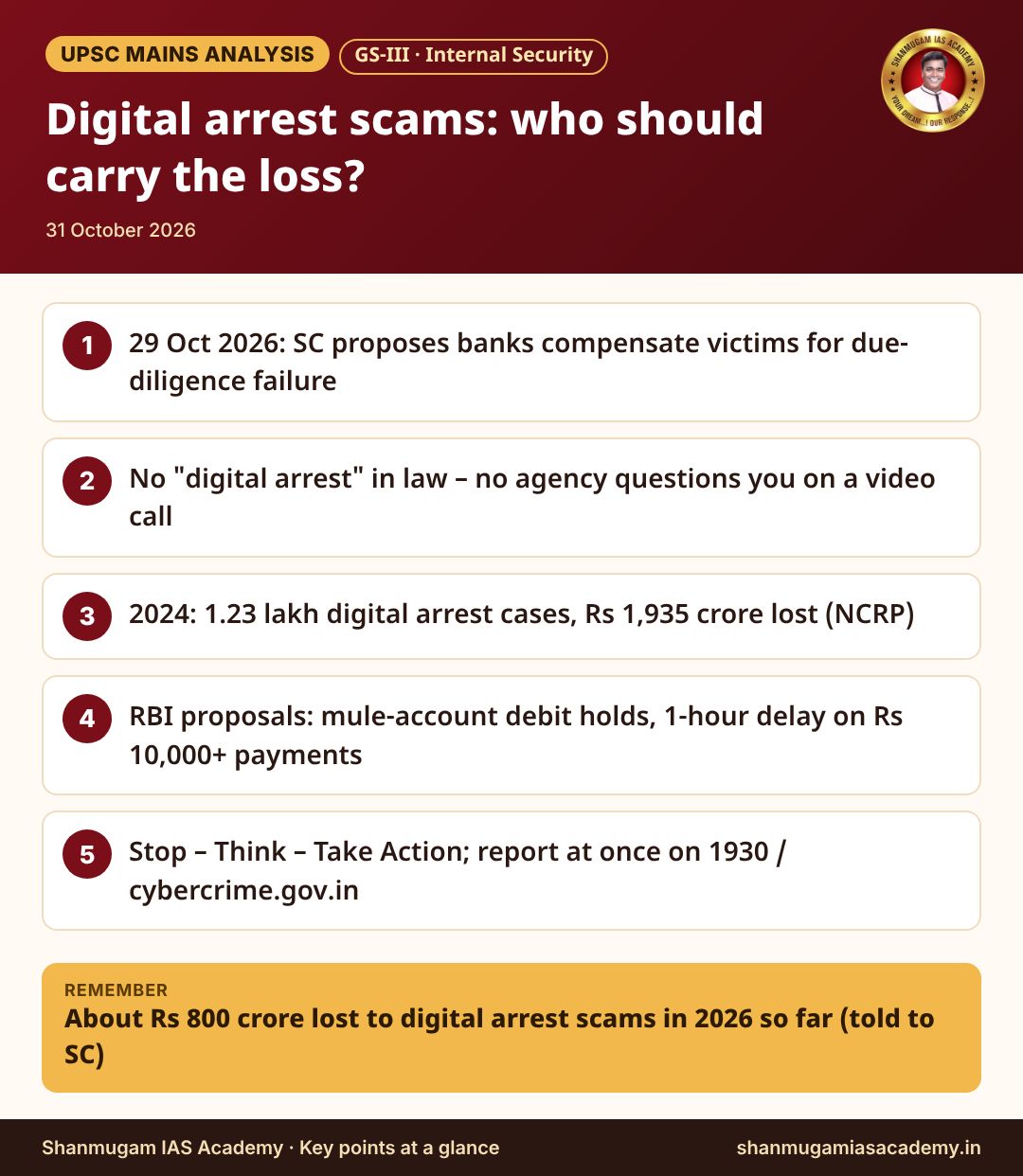
On 29 October 2026, a Supreme Court bench of Chief Justice Surya Kant, Justice Joymalya Bagchi and Justice V. Mohana, hearing its suo motu case on "digital arrest" scams, said it was proposing to direct that banks compensate victims – at least the amount lost – where the fraud succeeded because the bank failed in due diligence. The bench said the victim's account should see "zero debit", that unusual transactions should be held and verified before release, and that it would examine the RBI's draft Know Your Customer (KYC) Amendment Directions, 2026 before passing final orders. The Attorney General, R. Venkataramani, opposed court-imposed penalties and said the RBI's new measures would be operational by December 2026. About Rs 800 crore has been lost to digital arrest scams so far this year, the Court was told. The policy question: when a crime runs on fear and the victim himself presses "pay", who should carry the loss – the citizen, the bank, the platform or the State?
Background: what a "digital arrest" is
- Modus operandi: a caller poses as police, CBI, ED, customs, TRAI or even a court; claims the victim's Aadhaar, SIM or parcel is linked to drugs or money laundering; keeps the victim on a video call for hours or days ("you are under digital arrest, do not tell anyone"); shows fake uniforms, police-station backdrops and forged court orders; and makes the victim transfer savings to "verify" them. The money is moved at once through layers of mule accounts.
- No such thing in law: Indian criminal law has no "digital arrest". The PM said in Mann Ki Baat (115th episode, 27 October 2024) that no investigating agency ever questions anyone by phone or video call, and gave three steps – "Ruko – Socho – Action lo" (Stop – Think – Take Action).
- Scale: the MHA told the Rajya Sabha (12 March 2025) that the National Cyber Crime Reporting Portal (NCRP) recorded 39,925 digital arrest and related cases with Rs 91.14 crore lost in 2022, and 1,23,672 cases with Rs 1,935.51 crore lost in 2024. The Centre later told the Supreme Court that over Rs 3,000 crore had been extorted, mostly from elderly people.
- The wider fraud wave: NCRP data cited in an RBI discussion paper (April 2026) show cyber-fraud reports rising from about 2.6 lakh (2021) to about 28 lakh (2025), and the amount from Rs 551 crore to Rs 22,931 crore. I4C data reported in 2026 placed Tamil Nadu third in cyber-fraud losses, after Maharashtra and Karnataka.
- Existing machinery: NCRP (cybercrime.gov.in) and helpline 1930; the Citizen Financial Cyber Fraud Reporting and Management System (2021) to freeze money quickly – over Rs 4,386 crore saved by February 2025 (PIB); I4C, an attached office of the MHA; over 7.81 lakh SIM cards and 83,668 WhatsApp accounts blocked by February 2025; DoT's Sanchar Saathi / Chakshu for reporting suspected fraud calls; and the RBI Innovation Hub's MuleHunter.AI (announced December 2024) to detect mule accounts.
The Supreme Court's suo motu case – a timeline
| Date | Step | Significance |
|---|---|---|
| 17 Oct 2025 | Suo motu cognisance on the complaint of a senior-citizen couple from Ambala who lost Rs 1.05 crore to callers posing as CBI, ED and court officials (forged court orders shown on video) | Court treats it as an attack on public faith in courts and agencies |
| 1 Dec 2025 | CBI given a pan-India probe, with a free hand to examine the role of bankers; RBI asked why AI/ML is not used to catch mule accounts; States asked to give consent; Interpol help sought | Shift from scattered State FIRs to a national, follow-the-money investigation |
| 9 Feb 2026 | Court calls the siphoning of over Rs 54,000 crore through digital frauds "robbery and dacoity"; Centre asked to frame an SOP with RBI, banks and DoT; joint meeting on victim compensation | Compensation enters the agenda |
| 28 Jul 2026 | Court suggests defining "digital arrest" as a standalone offence with harsher punishment; Solicitor General says a draft law on digital arrests and deepfakes is being prepared | Legislative gap recognised |
| 4 Aug 2026 | RBI to adopt an SOP on temporary debit holds within four weeks, with grievance redressal and money-restoration modules; States to notify State Cyber Crime Coordination Centres and adopt e-Zero FIR | Victim-side remedies built; 36,290 cases, Rs 18.05 crore restored so far |
| Sep 2026 | RBI issues draft KYC Amendment Directions, 2026: SOP for suspected mule accounts (transactions of Rs 1,000 or more flagged, debit hold up to 60 days, effective 1 April 2027) | Prevention moves into banking regulation |
| 29 Oct 2026 | Bench proposes bank compensation for due-diligence failure, "zero debit" for victims, hold-and-verify for unusual transactions; States to report FIRs | From "awareness" to "liability" |
Core analysis: why bank measures are necessary but not enough
| Layer | What exists / is proposed | Gap |
|---|---|---|
| Customer liability | RBI 2017 circular: zero liability for unauthorised electronic transactions caused by bank negligence or third-party breach reported promptly | Digital arrest victims "authorise" the payment under fear, so most fall outside it |
| Payment friction | RBI discussion paper (Apr 2026): one-hour delay on authorised push payments of Rs 10,000 or more, cancellable; trusted-person check for elderly; customer "kill switch" | Victims under coercion may still confirm; delays affect genuine payments |
| Mule accounts | MuleHunter.AI; draft KYC Amendment Directions 2026 – flag, hold up to 60 days, STRs where required under AML rules | Mule accounts are rented or bought; KYC is done but the account is sold later |
| Telecom and platforms | SIM and IMEI blocking, Chakshu, spoofed-call blocking; WhatsApp banned about 9,400 scam-linked accounts from January 2026 (I4C status report to SC) | Calls come over internet apps and from compounds abroad; blocking is after the event |
| Policing | 1930/NCRP, I4C, CBI probe, e-Zero FIR, State coordination centres | Inter-State and cross-border trails; low recovery; few convictions of the masterminds |
| Law | BNS: cheating by personation, extortion, personating a public servant, organised crime; IT Act s.66C/66D | No defined offence of "digital arrest"; draft law still awaited |
Dimensions
- Internal security: the scams are run by organised networks, often from scam compounds abroad that use trafficked workers. Proceeds fund other crime – a classic convergence of cyber crime, money laundering and human trafficking.
- Economic and financial: fear of fraud slows digital payments and hurts trust in UPI and online banking – the backbone of India's Digital Public Infrastructure.
- Social: senior citizens, retired officials and doctors are prime targets because they have savings and respect authority; shame stops many from reporting.
- Governance and federal: police and public order are State subjects, but the crime crosses States and borders – hence the CBI, I4C and Court-driven coordination.
- Rights: holding transactions and auto-reporting to police protect victims but can hurt genuine customers and raise privacy questions under the DPDP Act.
Challenges
- The "authorised" payment trap: the victim himself presses "pay", so banks argue they followed instructions – the core reason the Court is moving towards strict liability.
- Speed of money: funds pass through several layers of accounts and wallets within minutes; the "golden hour" after the fraud is usually lost.
- Cross-border havens: callers sit outside Indian jurisdiction; extradition and mutual legal assistance are slow.
- Insider complicity: the CBI has been asked to probe bank staff who open or ignore mule accounts.
- Moral hazard vs fairness: full bank liability may make customers careless and raise costs; no liability leaves the most vulnerable to bear it all.
- False positives: holds of up to 60 days can freeze genuine accounts, small traders and gig workers, with no compensation for wrongful holds.
Way forward
- Shared-liability framework: a clear rule on who pays what – bank, receiving bank (which hosted the mule account), platform and telecom – with time-bound refunds, as the Court's August 2026 order asked the committee to examine.
- Risk-based friction: cooling-off periods and trusted-person checks for unusual, high-value transfers from accounts of senior citizens, not blanket delays for everyone.
- Hit the receiving end: stronger checks when an account suddenly receives large credits; liability on the bank that opened the mule account.
- Define the offence: a specific offence of impersonating law enforcement to extort, with asset freezing on prima facie evidence.
- Platform duty: verified "government agency" labels, rapid takedown of impersonating accounts and data-sharing with I4C under law.
- International action: Interpol notices, joint operations with neighbouring countries hosting scam compounds, and rescue of trafficked workers.
- Awareness that sticks: repeat the simple rule – no agency arrests on video, no agency asks for money to "verify" – through banks, post offices, pension offices and local bodies; report at once on 1930.
Mains practice question
Answer framework: Introduction – what digital arrest is; 2024 NCRP data (1.23 lakh cases, Rs 1,935 crore) · Body – (a) modus operandi and why victims "authorise" payments; (b) measures: NCRP/1930, I4C, blocking of SIMs and accounts, Chakshu, MuleHunter.AI, RBI drafts, CBI probe, e-Zero FIR; (c) Supreme Court suo motu case and the bank-liability proposal – arguments for (due diligence, deep pockets, incentive to prevent) and against (moral hazard, cost, false holds); (d) remaining gaps – cross-border havens, no defined offence · Way forward – shared liability, risk-based friction, receiving-bank checks, international action · Conclusion – faculty-view line.
Prelims pointers
- National Cyber Crime Helpline: 1930; portal: cybercrime.gov.in (NCRP).
- I4C (Indian Cyber Crime Coordination Centre) – an attached office of the Ministry of Home Affairs.
- Chakshu – facility on DoT's Sanchar Saathi portal to report suspected fraud calls and messages.
- MuleHunter.AI – AI model for detecting mule accounts, developed by the Reserve Bank Innovation Hub (announced December 2024).
- Supreme Court suo motu case: In Re: Victims of Digital Arrest Related to Forged Documents, SMW (Crl.) 3/2025.
The real story of this case is a shift in who carries the risk. For years the message was "be aware" – the loss stayed with the victim. The Court is now moving towards "authorised push payment (APP) fraud" being treated as a shared risk: if the victim pressed "pay" under coercion, but the bank ignored obvious red flags, the bank must pay. The UK took this route in 2024 with mandatory reimbursement. Expect India to build a middle path – liability linked to due diligence, plus friction aimed only at risky transfers.
- A shift to note: from "awareness and blocking" to "liability and prevention by design". Write: "make the system, not the scared citizen, carry the risk".
- What to watch next: (1) the Court's final directions on compensation and hold-and-verify, (2) the RBI's KYC Amendment Directions, 2026 and measures promised by December 2026, (3) the mule-account SOP from 1 April 2027 (as drafted), (4) a Bill defining digital arrest and deepfake impersonation, (5) how auto-reporting to police is squared with the DPDP Act.
- Ready-made conclusion line: "Fear travels faster than money – India must make money travel slower than fear, and make those who could have stopped it share the loss."
Sources: PIB (MHA), "Steps taken to address the issue of digital arrest scams", 12 March 2025; Rajya Sabha reply reported by PTI; Reserve Bank of India – draft KYC Amendment Directions, 2026 and the April 2026 discussion paper on digital payment safeguards (as reported by All India Radio and MediaNama); reports on the Supreme Court hearings of 27 October 2025, 1 December 2025, 9 February, 28 July, 4 August and 29 October 2026 (LiveLaw, Bar and Bench, The Leaflet, ETV Bharat, Verdictum, DT Next, Deccan Chronicle, ThePrint, Outlook Money, The Week, NewsGram, MediaNama); I4C data reported by IANS (January 2026) and Outlook Money (July 2026); Mann Ki Baat, 27 October 2024. Original analysis by Shanmugam IAS Academy.
Link to this page from your website / blog (HTML code)
BANK Achievers
-

SUJJI
BANK BANK
TNPSC பொதுத்தமிழ் | 9th புதிய தமிழ் புத்தகம் | General Tamil MCQ | Group 4
TNPSC குரூப் 1, 2/2A, 4 – நேரடி வகுப்புகள் · கோவை & மதுரை
2006 முதல் சண்முகம் IAS அகாடமி · Classroom & online coaching in Coimbatore and Madurai
