

GSLV-F18 successfully launches NVS-03 navigation satellite – a boost to restoring NavIC
1 November 2026 · English Science & Technology
Topics: Science, Sports, Defence & International · 1 November 2026 Current Affairs (UPSC / TNPSC / SSC / RRB)
News
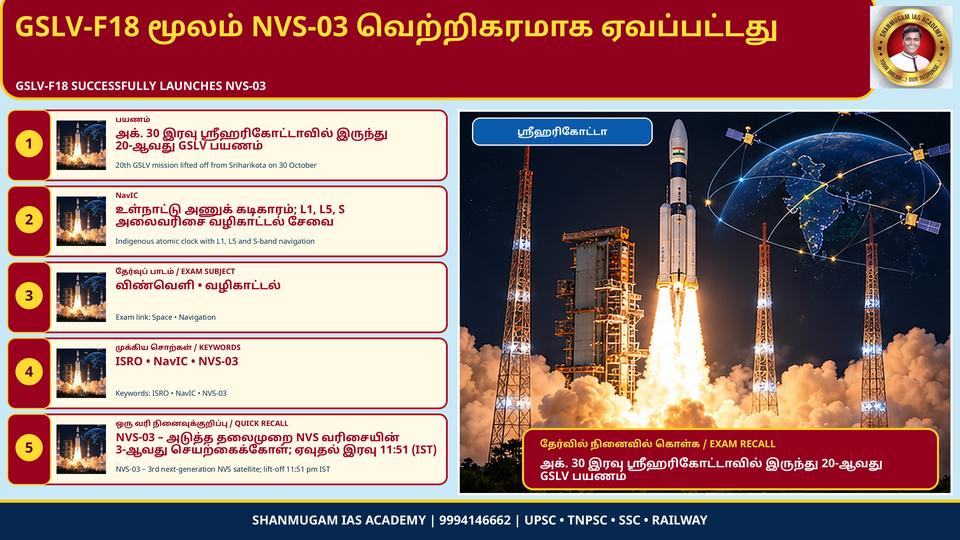
ISRO's GSLV-F18 lifted off from the Second Launch Pad of Satish Dhawan Space Centre, Sriharikota, at 11:51 pm IST on 30 October 2026 and successfully placed the NVS-03 navigation satellite in the intended Geosynchronous Transfer Orbit (GTO). It was the 20th flight of the GSLV. NVS-03, the third satellite of the next-generation NVS series, carries an indigenous atomic clock along with procured atomic clocks and adds the L1 signal to the existing L5 and S-band signals. The first orbit-raising burn was carried out on 31 October; ISRO Chairman V. Narayanan was reported as saying that NavIC now has the minimum number of satellites needed to restore its services.
Key facts
| Launch | 30 Oct 2026, 11:51 pm IST – Second Launch Pad, Satish Dhawan Space Centre, Sriharikota (Andhra Pradesh) |
| Rocket | GSLV-F18 – 20th flight of GSLV; about 50 m tall, about 420 t at lift-off; 3 stages (S139 + 4 L40H strap-ons, GL40HT, cryogenic CUS15) |
| Satellite | NVS-03 – 3rd of the next-generation NVS series; payload about 2,250 kg |
| Orbit | GTO (planned 170 km × 37,023 km, inclination 20.75°); to be raised to geosynchronous orbit (GSO) |
| Signals | New L1 + L5 + S-band; indigenous atomic clock + procured atomic clocks |
| Coverage | Indian landmass and about 1,500 km beyond its boundary |
| NavIC status | As of July 2026 only 3 satellites (IRNSS-1B, IRNSS-1I, NVS-01) were working; at least 4 are needed for standalone positioning |
Background – NavIC and GSLV
- NavIC (IRNSS – Indian Regional Navigation Satellite System): approved in 2006; first satellite IRNSS-1A launched on 1 July 2013 by PSLV-C22. Design – 7 satellites: 3 geostationary (32.5°E, 83°E, 131.5°E) + 4 inclined geosynchronous (55°E, 111.75°E).
- Atomic-clock problem: all three rubidium atomic clocks of IRNSS-1A failed in 2016. Its replacement IRNSS-1H did not reach orbit on 31 Aug 2017 because the heat shield of PSLV-C39 failed to separate.
- NVS-01: launched on 29 May 2023 by GSLV-F12 – the first NavIC satellite with an indigenous atomic clock (replaced IRNSS-1G).
- NVS-02: launched on 29 Jan 2025 by GSLV-F15 – ISRO's 100th launch from Sriharikota. Its oxidiser valves did not open, so it could not be raised to its orbit. With NVS-03, the NavIC series has 12 satellites (IRNSS-1A to 1I = 9, plus NVS-01, 02, 03).
- GSLV (Mk II): a three-stage rocket whose third stage is an indigenous cryogenic stage (liquid hydrogen + liquid oxygen); can carry about 2,250 kg to GTO. Heavier satellites go on LVM3.
- Navigation systems of the world: GPS (USA), GLONASS (Russia), Galileo (European Union), BeiDou (China) – global; NavIC (India), QZSS (Japan) – regional.
Tamil Nadu link: Tamil Nadu link: GSLV's cryogenic engine (CE-7.5) is tested at the ISRO Propulsion Complex (IPRC), Mahendragiri, Tirunelveli district; GSLV's second stage (GS2) and L40 strap-on stages are also integrated there. (The launch site, Sriharikota, is in Andhra Pradesh.)
Source: ISRO – GSLV-F18/NVS-03 mission page and mission brochure (27–28 Oct 2026); India TV News (30 Oct 2026); Starlust (31 Oct 2026); Wikipedia (NavIC, NVS-02, ISRO Propulsion Complex)
Join our UPSC classroom or online batch: UPSC coaching in Coimbatore · Fees · Call 99941 46662.
Link to this page from your website / blog (HTML code)
TNPSC Achievers
-

NEUTON
TNPSC TNPSC
Today Current Affairs in Tamil | 02 நவம்பர் 2026 | TNPSC Group 4 முக்கிய வினாக்கள்
TNPSC குரூப் 1, 2/2A, 4 – நேரடி வகுப்புகள் · கோவை & மதுரை
2006 முதல் சண்முகம் IAS அகாடமி · Classroom & online coaching in Coimbatore and Madurai
