

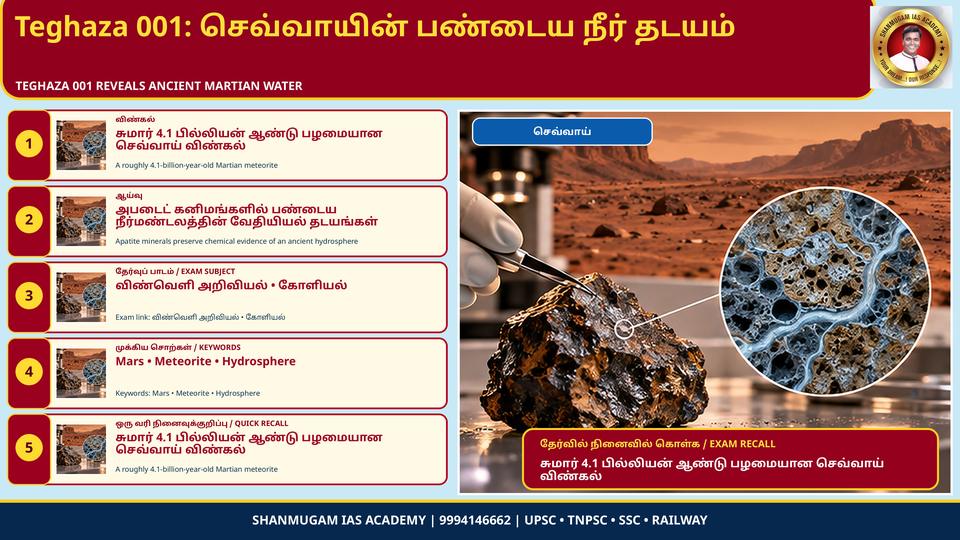
Over-4.1-billion-year-old Martian meteorite 'Teghaza 001' reveals Mars' ancient water history
1 November 2026 · English History, Art & Culture
Topics: Science, Sports, Defence & International · 1 November 2026 Current Affairs (UPSC / TNPSC / SSC / RRB)
News
A team led by Yang Liu of NASA's Jet Propulsion Laboratory (JPL) published a study of the Martian meteorite 'Teghaza 001' in the journal Science on 29 Oct 2026. The roughly 800-gram rock was found in the Sahara in 2022 and is named after the Teghaza salt plain in Mali. Martian subsurface water altered the rock about 4.1 billion years ago, so it formed even earlier – one of the oldest Martian meteorites known. Its oxygen isotopes, texture and chemistry point to a dynamic water cycle on early Mars. A companion study in Science Advances (June 2026), using the hydrogen–deuterium ratio, showed that Mars was already losing its early atmosphere and water to space by 4.1 billion years ago.
Key facts
| Meteorite | Teghaza 001 – ~800 g; Sahara, 2022; named after Teghaza salt plain, Mali |
| Age | Altered by water ~4.1 billion years ago; formed earlier |
| Study | Science (JPL release 29 Oct 2026) – lead author Yang Liu (NASA JPL); co-authors Lee Saper (NASA Ames), François Tissot (Caltech) |
| Method | Uranium–lead dating of zircon (~4.11 billion years); a less precise rubidium–strontium analysis gave ~4.24 billion years |
| Water study | Science Advances, June 2026 – H/D ratio: early atmospheric loss |
| Type | Gabbro (coarse-grained igneous rock); unusually heavy oxygen isotopes |
Background
- Science: deuterium ('heavy hydrogen') is a hydrogen isotope with one proton and one neutron. Lighter hydrogen escapes to space more easily, so the remaining water becomes enriched in deuterium – a tool to measure a planet's water loss. Once the magnetic field faded, the solar wind stripped the atmosphere.
- Mars: fourth planet from the Sun; called the 'Red Planet' due to iron oxide on its surface; Olympus Mons is the tallest volcano in the Solar System; two moons, Phobos and Deimos. NASA's Perseverance rover is collecting samples in Jezero crater, an ancient lake bed.
- Martian meteorites: rocks blasted off Mars by impacts that later fell on Earth; most are young 'shergottites'. Famous ones include 'Black Beauty' (NWA 7034) and ALH84001, which sparked a 1996 debate on possible life traces; ALH84001 is similar in age to Teghaza 001.
- Geography: the Sahara is the world's largest hot desert; Teghaza in northern Mali was a major rock-salt mining centre of medieval trans-Saharan trade.
Tamil Nadu link: the Programme Director of India's Mars Orbiter Mission (Mangalyaan – launched 5 Nov 2013; entered Mars orbit 24 Sep 2014) was Mylswamy Annadurai of Kodhavadi, Coimbatore district. Also, 'melanterite', a mineral that helps explain wet phases on Mars, was found at Neyveli.
Source: NASA JPL release, 29 Oct 2026; New Space Economy, 30 Oct 2026; Business Standard, 31 Oct 2026; Live Science, 13 Aug 2026 (Science Advances study); EarthSky
Join our UPSC classroom or online batch: UPSC coaching in Coimbatore · Fees · Call 99941 46662.
Link to this page from your website / blog (HTML code)
TNPSC Achievers
-

R. SASIKALA
TNPSC TNPSC
Today Current Affairs in Tamil | 02 நவம்பர் 2026 | TNPSC Group 4 முக்கிய வினாக்கள்
TNPSC குரூப் 1, 2/2A, 4 – நேரடி வகுப்புகள் · கோவை & மதுரை
2006 முதல் சண்முகம் IAS அகாடமி · Classroom & online coaching in Coimbatore and Madurai
