

Google's Project Suncatcher satellite sends back its first AI response from space
1 November 2026 · English Science & Technology
Topics: Science, Sports, Defence & International · 1 November 2026 Current Affairs (UPSC / TNPSC / SSC / RRB)
News
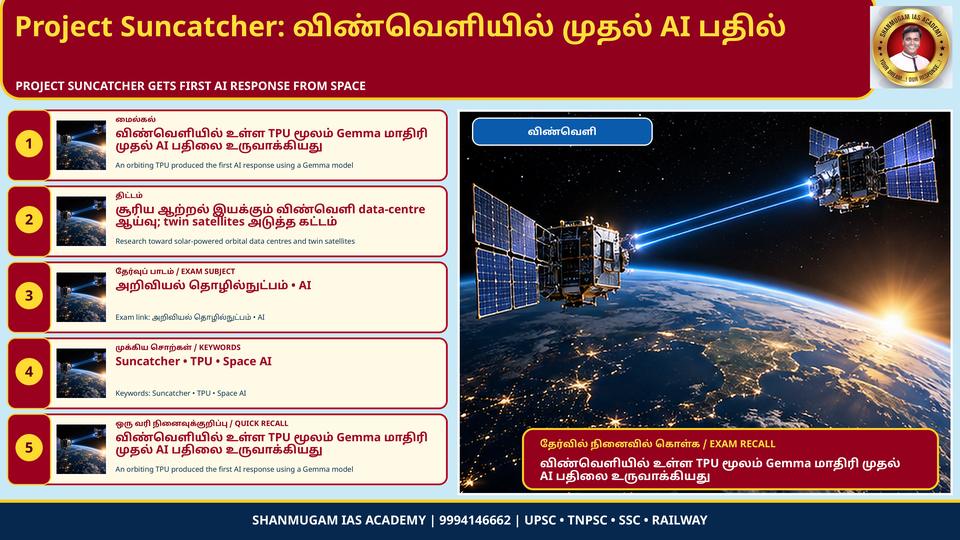
Google senior director Travis Beals announced on 30 Oct 2026 that the Project Suncatcher prototype satellite – launched on 1 Oct 2026 on SpaceX's 'Transporter-18' rideshare – has sent back its first AI response from orbit. To a prompt uplinked during a ground-station pass, the open 'Gemma 4' AI model running on a data-centre-class Google TPU aboard the satellite replied with a haiku ('Blue marble below / Data streams in silent grace / Starlight feeds my core'), received as the satellite flew over Svalbard, Norway. The satellite was built with Planet (Planet Labs) and carries four TPUs.
Key facts
| Project | Project Suncatcher – Google research moonshot for solar-powered AI compute in space (announced Nov 2025) |
| Launch | 1 Oct 2026 – SpaceX Transporter-18 rideshare; partner: Planet (Planet Labs PBC) |
| Hardware | 4 TPUs; due to power and heat limits only one TPU runs at a time, in short sessions; up to about 1 kW of power |
| AI model | Gemma 4 – Google's open-weight model family |
| First reply | Announced 30 Oct 2026; a haiku – received over Svalbard (Norway) |
| Next | Two linked satellites planned for 2027 |
Background
- Why space? AI data centres need huge power and cooling water. In space sunlight is nearly continuous, and Google says solar panels in a 'dawn–dusk sun-synchronous orbit' can be several times more productive than on Earth. The goal is clusters of satellites, each with dozens of TPUs, linked by lasers to form a 'space data centre'. The present prototype uses batteries in a standard (not sun-synchronous) orbit.
- Science: TPU – Tensor Processing Unit; a special chip (ASIC) designed by Google for machine learning. Sun-synchronous orbit – a near-polar orbit in which a satellite passes over each place at the same local solar time – ideal for Earth-observation satellites.
- Heat challenge: in the vacuum of space there is no air, so no convection; heat can leave only by radiation. That is why the prototype runs one TPU for only minutes at a time. The first aim is to test whether TPUs survive space radiation and thermal extremes.
Tamil Nadu link: no direct link. Related facts: Sundar Pichai, CEO of Google and Alphabet, was born in Madurai and grew up in Chennai. India's second spaceport (for SSLV) is coming up at Kulasekarapattinam, Thoothukudi district.
Source: Google blog via PPC Land, The Next Web (30 Oct – 1 Nov 2026); NPR / WUNC (1 Oct 2026); Satellite Today (Nov 2025)
Join our UPSC classroom or online batch: UPSC coaching in Coimbatore · Fees · Call 99941 46662.
Link to this page from your website / blog (HTML code)
TNPSC Achievers
-

R. KEERTHANA
TNPSC TNPSC
Today Current Affairs in Tamil | 02 நவம்பர் 2026 | TNPSC Group 4 முக்கிய வினாக்கள்
TNPSC குரூப் 1, 2/2A, 4 – நேரடி வகுப்புகள் · கோவை & மதுரை
2006 முதல் சண்முகம் IAS அகாடமி · Classroom & online coaching in Coimbatore and Madurai
