

India–Bangladesh Ganga Waters Treaty (1996, Farakka) expires on 12 Dec 2026 – Bangladesh seeks a new pact
1 November 2026 · English International
Topics: Science, Sports, Defence & International · 1 November 2026 Current Affairs (UPSC / TNPSC / SSC / RRB)
News
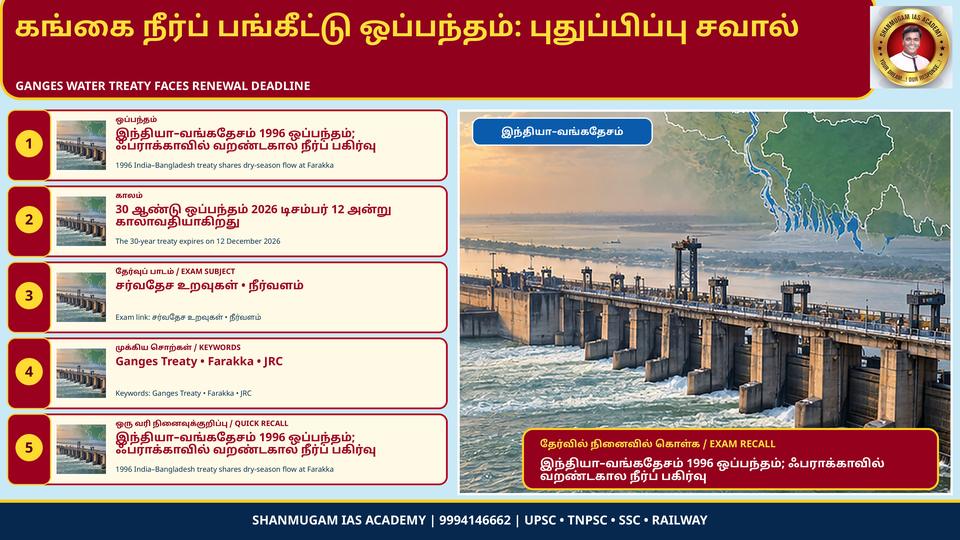
The 30-year 'Ganga Waters Treaty', signed by India and Bangladesh on 12 Dec 1996 to share the Ganga's dry-season flow at the Farakka Barrage, expires on 12 Dec 2026. On 8 Oct 2026 Bangladesh Water Resources Minister Shahiduddin Chowdhury Anee said Dhaka wants a new treaty before expiry, with a 'guarantee clause' (assured minimum share) like the one in the 1977 agreement. Bangladesh sent its request for talks on 8 June 2026. MEA spokesperson Randhir Jaiswal has said all river talks take place within the Joint Rivers Commission (JRC) and that technical-level discussions are under way. Bihar's ruling JD(U) and Deputy CM (Aug 2026) oppose renewal in its present form, blaming the Farakka Barrage for floods and siltation.
Key facts
| Treaty | 12 Dec 1996 – PMs H.D. Deve Gowda (India) and Sheikh Hasina (Bangladesh); 30 years |
| Lean season | 1 Jan – 31 May; 10-day periods; based on 1949–88 flow data |
| Formula | Below 70,000 cusecs – equal shares; above 75,000 – India 40,000, rest to Bangladesh; 35,000 cusecs guaranteed alternately 11 Mar – 10 May |
| Farakka | Murshidabad district, West Bengal; operational 1975; diverts water into the Hooghly for Kolkata port |
| Rivers | The two countries share 54 rivers; only the Ganga has a long-term treaty |
| Bangladesh | PM Tarique Rahman (since Feb 2026) |
Background
- History: a 5-year agreement on Farakka water was signed on 5 Nov 1977 (Ziaur Rahman era in Bangladesh); it had a 'guarantee clause' that Bangladesh's share would not fall below 80% of the schedule in low flow; a 1982 MoU removed it. The 1996 treaty has no guarantee or arbitration clause – only immediate consultations if flow falls below 50,000 cusecs (Article II(iii)).
- Geography: the Ganga rises as the Bhagirathi at the Gangotri glacier (Gaumukh), Uttarakhand, and joins the Alaknanda at Devprayag. Below Farakka it splits – one branch flows as the Bhagirathi–Hooghly in West Bengal; the main stream enters Bangladesh as the 'Padma', joins the Jamuna (Brahmaputra) near Goalundo and then the Meghna before reaching the Bay of Bengal.
- Constitution: Article 253 empowers Parliament to make laws on any subject, including State List subjects, to implement international treaties. Water – State List Entry 17; regulation of inter-State rivers – Union List Entry 56. Article 51(c) – respect for treaty obligations (Directive Principle). Water disputes – Article 262 and the Inter-State River Water Disputes Act, 1956.
- Relations: the India–Bangladesh Joint Rivers Commission (JRC) was set up in 1972. The Teesta water-sharing pact has been pending since 2011. Sheikh Hasina was ousted in August 2024 and came to India; after an interim government led by Muhammad Yunus, Tarique Rahman became PM in Feb 2026.
Tamil Nadu link: Tamil Nadu's key inter-State river issue is the Cauvery. The Cauvery Water Disputes Tribunal (1990) gave its final award on 5 Feb 2007; under the Supreme Court verdict of 16 Feb 2018, Karnataka must release 177.25 TMC ft a year to Tamil Nadu, measured at Biligundlu; the Cauvery Water Management Authority (CWMA) and Cauvery Water Regulation Committee (CWRC) were set up in 2018 to implement it.
Source: UNI (8 Oct 2026); Prothom Alo (29 Sep); ISAS (NUS) Brief 1428 (12 Oct); ThePrint (4 Aug)
Join our UPSC classroom or online batch: UPSC coaching in Coimbatore · Fees · Call 99941 46662.
Link to this page from your website / blog (HTML code)
BANK Achievers
-

JEEVA
BANK BANK
Today Current Affairs in Tamil | 02 நவம்பர் 2026 | TNPSC Group 4 முக்கிய வினாக்கள்
TNPSC குரூப் 1, 2/2A, 4 – நேரடி வகுப்புகள் · கோவை & மதுரை
2006 முதல் சண்முகம் IAS அகாடமி · Classroom & online coaching in Coimbatore and Madurai
