

'Super' El Niño heat could cause about 55,000 additional deaths in India in Oct 2026 – Mar 2027: University of Chicago's Climate Impact Lab
1 November 2026 · English Infrastructure & Energy
Topics: Weather, States, Archaeology & Infrastructure · 1 November 2026 Current Affairs (UPSC / TNPSC / SSC / RRB)
News
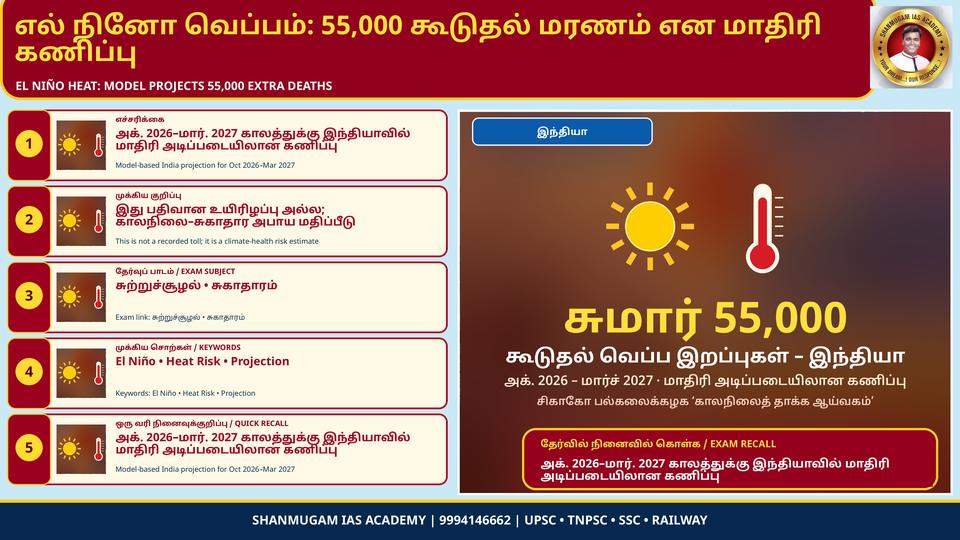
According to a revised projection released on 28–29 Oct 2026 by the new 'El Niño Heat Mortality Tracker' of the University of Chicago's Climate Impact Lab (USA), India could see about 55,000 heat-related deaths above a normal year in Oct 2026 – Mar 2027, most of them in March. Nigeria (about 56,000) is first, India second. Globally, about 8.57 lakh additional deaths are projected for June 2026 – March 2027. The September report's India estimate of 15,800 rose because March was added and August–September were warmer than forecast. These are model-based estimates, not confirmed death counts.
Key facts
| By | Climate Impact Lab, University of Chicago – 'El Niño Heat Mortality Tracker' (monthly estimates for about 3,700 sub-national regions) |
| India | Oct 2026 – Mar 2027: about 55,000 additional deaths (Sept report: 15,800, Sept–Feb) |
| Other countries | Nigeria ~56,000; Indonesia ~29,000; Brazil ~19,000 |
| World | June 2026 – Mar 2027: ~857,000 (Sept projection 451,000, to Feb) |
| Climate context | Copernicus: Aug 2026 – warmest August on record; Sept 2026 – second-warmest September (1.63°C above pre-industrial) |
| El Niño | Began June 2026; expected to peak around Dec 2026 |
Background
- Method: it uses the link between daily temperature and all-cause mortality, adjusted for local climate, vulnerability and adaptive capacity, to estimate deaths above a historical baseline. The Lab's co-founder is economist Michael Greenstone.
- Science: body temperature is regulated by the brain's hypothalamus; the body cools by evaporation of sweat. High humidity slows evaporation and raises the risk of heatstroke. Heat hits heart and kidney patients, the elderly and outdoor workers hardest.
- Policy: South Asia's first Heat Action Plan – Ahmedabad, 2013. IMD definition: heat-wave criteria apply only once the maximum temperature reaches at least 40°C in the plains or 30°C in hilly areas. Heat wave is not among the 12 nationally notified disasters; States may declare it a 'State-specific disaster' and use up to 10% of SDRF funds.
- The Copernicus Climate Change Service (C3S) is part of 'Copernicus', the European Union's Earth-observation programme; ECMWF runs it on behalf of the European Commission.
Tamil Nadu link: in 2024 the Tamil Nadu government declared heat wave a 'State-specific disaster', with ₹4 lakh relief to the families of heat victims. The Climate Impact Lab's September report (Sept 2026 – Feb 2027) projected about 1,640 additional deaths in Tamil Nadu.
Source: Down To Earth, Business Today, 29 Oct 2026; Climate Fact Checks, 31 Oct 2026; The South First, 26 Sept 2026; Al Jazeera, 23 Sept 2026; Scroll (2024)
Join our UPSC classroom or online batch: UPSC coaching in Coimbatore · Fees · Call 99941 46662.
Link to this page from your website / blog (HTML code)
TET Achievers
-

RAJARAJESHWARI
TNTET TNTET
Today Current Affairs in Tamil | 02 நவம்பர் 2026 | TNPSC Group 4 முக்கிய வினாக்கள்
TNPSC குரூப் 1, 2/2A, 4 – நேரடி வகுப்புகள் · கோவை & மதுரை
2006 முதல் சண்முகம் IAS அகாடமி · Classroom & online coaching in Coimbatore and Madurai
