

Mains Analysis: After GSLV-F18 – does ISRO have the capacity to match its mandate?
2 November 2026 · English Science & Technology
இந்தப் பகுப்பாய்வைத் தமிழில் படிக்க →
Topics: Science & Technology · GS-III · UPSC Mains Analysis
Context
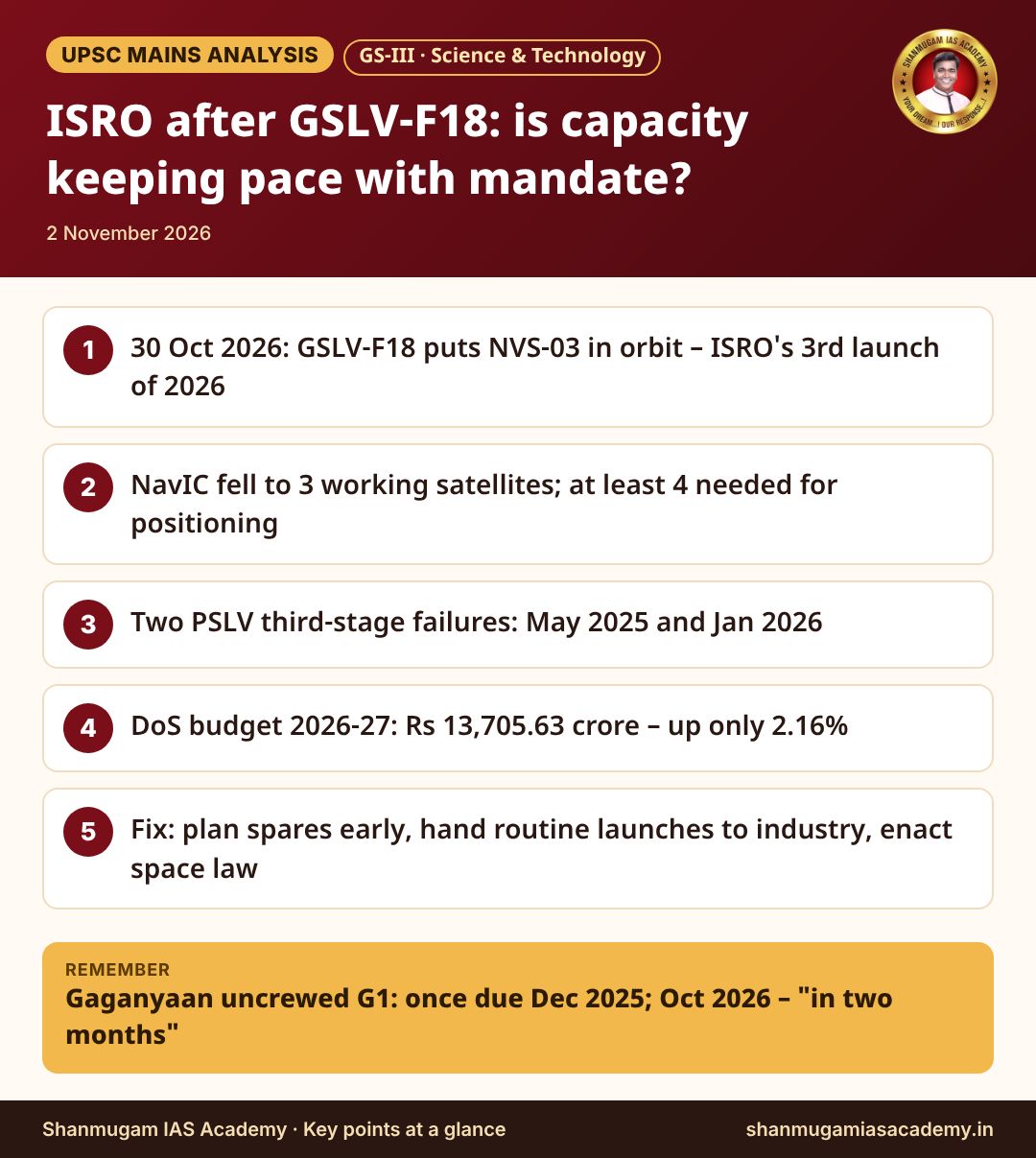
At 11:51 pm on 30 October 2026, ISRO's GSLV-F18 lifted off from the Second Launch Pad at Sriharikota and placed the navigation satellite NVS-03 in its planned geosynchronous transfer orbit. It was the 20th flight of the GSLV and only ISRO's third launch of 2026. The satellite matters more than most: India's own navigation system, NavIC, had fallen to three working satellites – one short of the four needed to fix a position – after an atomic clock on IRNSS-1F stopped in March 2026. The success is welcome, but it raises a bigger question for the exam: is ISRO's capacity – people, rockets, launch pads, money and industrial partners – keeping pace with a mandate that now runs from navigation and earth observation to human spaceflight and a space station?
Background: NavIC – a system that kept losing satellites
- Design: NavIC (IRNSS), approved in 2006, is a regional system of seven satellites – three geostationary and four inclined geosynchronous – covering India and about 1,500 km beyond its boundary. The first satellite, IRNSS-1A, was launched in July 2013.
- The clock problem: each satellite needs precise atomic clocks. All three clocks on IRNSS-1A failed in 2016; its replacement IRNSS-1H was lost in August 2017 when the PSLV-C39 heat shield did not separate.
- Second generation: NVS-01 (May 2023, GSLV-F12) was the first NavIC satellite with an indigenous atomic clock. NVS-02 (January 2025, GSLV-F15) reached transfer orbit but its oxidiser valves did not open, so it could not be raised to its working orbit.
- Outage: in July 2026 the Minister of State for Space told Parliament that only IRNSS-1B, IRNSS-1I and NVS-01 were providing positioning, navigation and timing services; at least four are needed for basic positioning, so NavIC could not give standalone positions, though its timing service continued. NVS-04 and NVS-05 were said to be in an advanced stage.
- NVS-03: carries an Indian atomic clock along with procured clocks and adds the L1 signal – the band used by GPS – to the existing L5 and S-band, which makes NavIC easier to build into ordinary phones and devices.
Launch record, January 2025 – October 2026
| Date | Mission | Outcome |
|---|---|---|
| 29 Jan 2025 | GSLV-F15 / NVS-02 (100th launch from Sriharikota) | Rocket worked; satellite stranded in transfer orbit |
| 18 May 2025 | PSLV-C61 / EOS-09 | Failed – third-stage (PS3) anomaly |
| 30 Jul 2025 | GSLV-F16 / NISAR | Success |
| 2 Nov 2025 | LVM3-M5 / CMS-03 | Success |
| 24 Dec 2025 | LVM3-M6 / BlueBird Block-2 (commercial) | Success |
| 12 Jan 2026 | PSLV-C62 / EOS-N1 + 15 co-passengers | Failed – third stage again; 16 satellites lost |
| 4 Sep 2026 | GSLV-F17 / EOS-05 | Success |
| 30 Oct 2026 | GSLV-F18 / NVS-03 | Success |
Eight ISRO launches in 22 months, and three of the first six did not deliver a working satellite to its intended orbit. PSLV – the workhorse – has not flown since January. The report on the 2025 PSLV failure was sent to the Prime Minister's Office but, as reported, has not been made public. The private sector added one flight: Skyroot's Vikram-1 reached orbit on 18 July 2026, India's first private orbital launch, using ISRO's pad and test facilities.
Core analysis: mandate versus capacity
| Area | Mandate / target | Status (Oct 2026) | Gap |
|---|---|---|---|
| Navigation | Seven-satellite NavIC; L1 for mass use | Three working before NVS-03; NVS-04, 05 pending | Replacements came years late; no spare in orbit |
| Launch cadence | Rising demand: NavIC, earth observation, Gaganyaan, commercial | Five launches in 2025, three by ISRO in 2026 | Two PSLV failures; slow return to flight |
| Human spaceflight | Gaganyaan; Rs 20,193 crore programme (2024); eight missions by Dec 2028 | Uncrewed G1, once due in Dec 2025; in Oct 2026 the ISRO chief said "in two months" | Crewed flight (2027) depends on three uncrewed flights |
| Space station | BAS-1 module by Dec 2028; full BAS by 2035 | Design and studies stage | Timeline rests on Gaganyaan and LVM3 slots |
| Infrastructure | Third Launch Pad (Rs 3,984.86 crore, 48 months); NGLV (Rs 8,240 crore, 30 t to LEO) | Only two pads; GSLV and LVM3 share one | Pad congestion until new pads are ready |
| Budget | Department of Space: Rs 13,705.63 crore (2026-27) | Up only 2.16% on 2025-26 BE (Rs 13,416.20 crore) | Flat in real terms while the mission list grows |
| People | About 14,600 employees (reported) | 100+ resignations from key projects reported; DoS tightened exit rules (July 2026) | Vacancies of nearly 30% of sanctioned posts reported |
| Industry | Space Policy 2023: ISRO to exit routine manufacturing | SSLV technology to HAL (Rs 511 crore); HAL–L&T PSLVs | First industry PSLV reportedly slipped to March 2027 |
Why it matters
- Strategic: satellite navigation is now critical infrastructure for defence, power grids, telecom timing and banking. Depending on foreign systems in a crisis is a risk; a sovereign system is useful only if it stays working.
- Economic: the government places India's space economy at about $8.4 billion, with a target of $44 billion by 2033 and nearly 400 space start-ups (PIB, January 2026). That target needs reliable, frequent and affordable launches.
- Institutional: the Indian Space Policy 2023 splits roles – ISRO for research and new technology, IN-SPACe (2020) to promote and authorise private activity, NSIL to commercialise ISRO-built systems. Delays at ISRO now slow the whole ecosystem.
- Credibility: foreign customers, co-passenger start-ups and partners judge India by launch reliability; two PSLV failures in eight months hurt.
- Tamil Nadu link: GSLV's cryogenic engine is tested at the ISRO Propulsion Complex, Mahendragiri (Tirunelveli), and the new SSLV spaceport at Kulasekarapattinam (Thoothukudi) is targeted for commissioning in 2026-27.
Challenges
- Replacement lag: NavIC satellites were built for about ten years of life, yet replacements arrived late and one (NVS-02) failed – the system had no spare margin.
- Single points of failure: PSLV shares stages and parts with other rockets; one solid-motor problem grounds the busiest launcher.
- Too many priorities, flat money: Gaganyaan, BAS, NGLV, Chandrayaan-4 and operational satellites compete for the same engineers, budget and pads.
- Talent drain: private space firms now hire ISRO-trained engineers; tightening exit rules treats the symptom, not pay, career paths or workload.
- Slow hand-over to industry: industry-built PSLVs and SSLVs are not yet flying regularly, so ISRO still does routine production.
- Legal gap: the Space Activities Bill, drafted since 2017 and re-drafted in 2025, is still not law – liability, licensing and insurance rest on policy, not statute.
- Transparency: failure reports that are not published make it hard for Parliament and partners to judge whether fixes are sound.
Way forward
- Constellation planning: build and store NavIC spares in advance; launch replacements before satellites reach end of life, not after.
- Publish failure reports (with security edits) and fix a firm PSLV return-to-flight plan.
- Real hand-over: let NSIL and industry run PSLV, SSLV and routine satellites on fixed-price contracts, so ISRO focuses on Gaganyaan, NGLV and science.
- Enact the Space Activities Law to give IN-SPACe statutory powers, clear liability and quicker licences.
- Money with milestones: multi-year funding for flagship missions, linked to published milestones reviewed by Parliament.
- People: fill vacancies faster, add technical career tracks and allow two-way movement between ISRO and industry instead of blocking exits.
- Infrastructure: complete the Third Launch Pad and Kulasekarapattinam on time to remove pad congestion.
Mains practice question
Answer framework: Introduction – GSLV-F18/NVS-03 (30 Oct 2026) and NavIC at three working satellites · Body – (a) mandate: navigation, earth observation, Gaganyaan, BAS, NGLV; (b) capacity gaps: launch record 2025–26, PSLV failures, replacement lag, flat budget (Rs 13,705.63 crore), talent drain, two launch pads; (c) role of private sector: Space Policy 2023, IN-SPACe, NSIL, FDI rules (2024), Vikram-1, SSLV transfer to HAL; (d) reforms: Space Activities law, published failure reports, milestone funding · Conclusion – faculty-view line.
Prelims pointers
- NavIC signals: L5 and S-band; NVS series adds L1. Coverage: India + about 1,500 km.
- NVS-01 (2023) – first NavIC satellite with an indigenous atomic clock.
- FDI in space (2024): satellites up to 74%, launch vehicles and spaceports up to 49%, components up to 100% under the automatic route.
- IN-SPACe – space regulator and promoter (2020); NSIL – public sector undertaking under the Department of Space.
- Vikram-1 (Skyroot Aerospace) – first private orbital launch from India, 18 July 2026.
The lesson of NavIC is not that India cannot build satellites – it can. It is that a space power is judged by "assured access to space": the ability to put the right satellite in orbit when it is needed, with a backup rocket, a spare satellite and a free launch pad. India built firsts but not enough depth. The next five years will test whether ISRO becomes a research agency that lets industry run routine launches.
- Concept to use: "assured access to space" – in any answer on ISRO, NavIC, defence space or private launchers.
- What to watch next: (1) NVS-03 reaching its slot and NavIC positioning restored, then NVS-04 and NVS-05; (2) PSLV return to flight and the first industry-built PSLV; (3) Gaganyaan G1 and the 2027 crewed target; (4) the Space Activities Bill in Parliament.
- Ready-made conclusion line: "Firsts make headlines; replacements make a space power – India must plan its satellites, rockets and people for continuity, not just for launch day."
Sources: ISRO – GSLV-F18/NVS-03 mission page and brochure; ISRO launch-missions list; ISRO and PIB releases on the Third Launch Pad (16 Jan 2025), NGLV (18 Sep 2024), Gaganyaan/BAS (18 Sep 2024) and the IN-SPACe venture fund (24 Oct 2024); Indian Space Policy 2023 (Business Standard); reports on NavIC and the July 2026 Parliament reply (The Week, Swarajya, ETV Bharat, WION); PSLV-C62 (NASASpaceflight, The Week, Business Today); Vikram-1 (ISRO, Al Jazeera); Gaganyaan timelines (All India Radio, ETV Bharat, UNI, Starlust); Budget 2026-27 (Business Today, ETV Bharat); staffing (Business Today, Swarajya, People Matters); FDI rules (EY). Original analysis by Shanmugam IAS Academy.
Link to this page from your website / blog (HTML code)
BANK Achievers
-

Kousik
BANKING BANKING
அறிவோம் அரசியலமைப்பு | MAKING OF CONSTITUTION | UPSC Polity தமிழில் | NITHISH KUMAR
TNPSC குரூப் 1, 2/2A, 4 – நேரடி வகுப்புகள் · கோவை & மதுரை
2006 முதல் சண்முகம் IAS அகாடமி · Classroom & online coaching in Coimbatore and Madurai
