

Mains Analysis: The U.S. embargo on Cuba – a shrinking UN majority, secondary sanctions and what it means for India's strategic autonomy
2 November 2026 · English International
இந்தப் பகுப்பாய்வைத் தமிழில் படிக்க →
Topics: International Relations · GS-II · UPSC Mains Analysis
Context
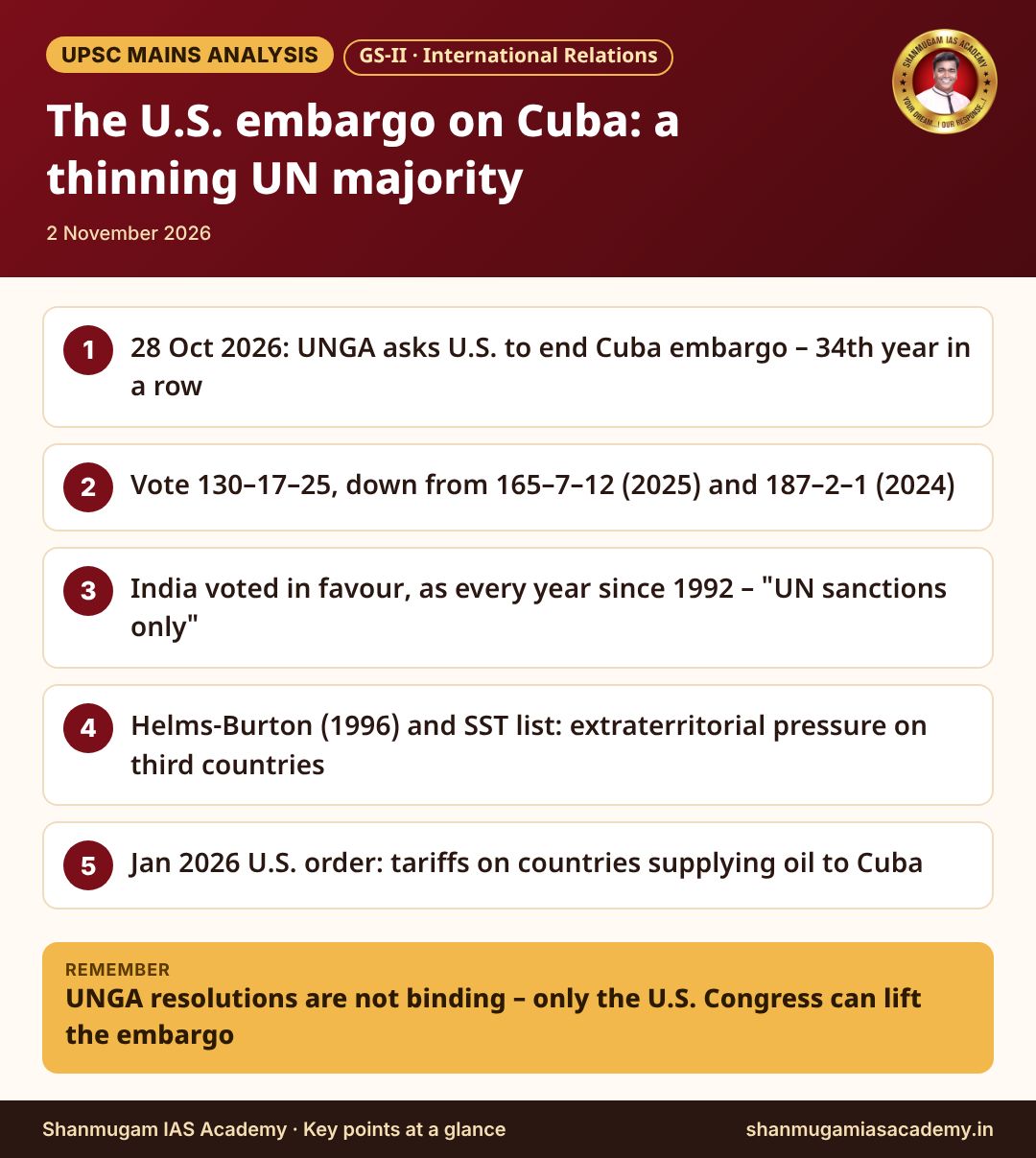
On 28 October 2026 the UN General Assembly adopted, for the 34th consecutive year, the resolution on the "Necessity of ending the economic, commercial and financial embargo imposed by the United States of America against Cuba". The vote was 130 in favour, 17 against and 25 abstentions – down from 165–7–12 in 2025 and 187–2–1 in 2024. Besides the United States, several Latin American states – among them Argentina, Paraguay, Colombia, Ecuador and Costa Rica – voted against, while Germany and Italy, long-time supporters, abstained. Venezuela, whose vote is suspended over unpaid UN dues, did not vote. The support was reported as the weakest in decades and followed an active U.S. campaign to persuade governments to change their votes. India voted in favour, as it has every year since the resolution was first adopted in 1992; its representative reiterated the Assembly's call on states to repeal or invalidate laws and measures with "extraterritorial effects". The question for an Indian student: the resolution still passed easily, so why does a shrinking majority matter – and what does it tell India about unilateral sanctions, which have hit Indian interests too?
Background: how the embargo was built
| Year | Measure | What it does |
|---|---|---|
| 1962–63 | President Kennedy proclaims a trade embargo (February 1962); Cuban Assets Control Regulations issued under the Trading with the Enemy Act (July 1963) | Bars most trade and financial dealings; freezes Cuban state assets in the U.S. (administered by the Treasury's OFAC) |
| 1982 | Cuba placed on the State Sponsors of Terrorism (SST) list | Adds export, aid and financial restrictions; banks worldwide treat Cuba as high-risk |
| 1992 | Cuban Democracy Act | Bars foreign subsidiaries of U.S. firms from trading with Cuba; ships that call at Cuba face a 180-day bar on U.S. ports |
| 1996 | Helms-Burton (LIBERTAD) Act | Writes the embargo into law – only Congress can end it. Title III lets U.S. nationals sue anyone "trafficking" in property confiscated after 1959; Title IV denies U.S. visas to such persons |
| 2000 | Trade Sanctions Reform and Export Enhancement Act | Allows sale of food and medicine, but only for cash in advance; bans tourist travel |
| 2014–16 | Obama-era thaw | Cuba removed from the SST list (May 2015); embassies reopened (2015); the U.S. abstained on the UN vote in 2016 |
| 2017–21 | Rollback | Title III lawsuits allowed for the first time from 2 May 2019; Cuba put back on the SST list (January 2021) |
| 2025–26 | Tightening | SST rescinded on 14 January 2025 and restored on 20 January 2025; an executive order of 29 January 2026 under IEEPA sets up tariffs on goods from any country that supplies oil to Cuba |
Why international support is thinning
- Direct diplomatic pressure: Washington lobbied governments to vote against or abstain; Cuba accused the U.S. of a pressure campaign. The U.S. ambassador argued in the debate that Cuba's hardships are the fault of its own government, not of U.S. policy.
- Political change in Latin America: the region that once voted almost as one now has governments that align more closely with the U.S. on Cuba and Venezuela.
- Tariff leverage: when the U.S. links tariffs to other countries' choices (as in the oil-supplier order), small and trade-dependent states become cautious about public positions.
- Abstention is not endorsement: many abstainers still oppose extraterritorial laws; they are signalling distance from Havana's government rather than support for the embargo.
India's position and India–Cuba ties
- Consistent vote: India has supported the resolution every year since 1992. Its doctrine is that it is bound only by sanctions decided by the UN – stated plainly by External Affairs Minister Sushma Swaraj in May 2018 in the context of U.S. sanctions on Iran.
- History: India was among the first countries to recognise the post-1959 government; diplomatic relations date from 1960. Fidel Castro visited India in 1973 and 1983 (the NAM summit in New Delhi). President Ram Nath Kovind visited Cuba in 2018.
- Development partnership: US$62 million debt written off (2008); five Lines of Credit worth about US$243 million (agriculture, agro-food, renewable energy); a Euro 100 million credit in 2022 under which 1,66,000 tonnes of rice were supplied; disaster relief after Hurricane Melissa (2025), including an Aarogya Maitri BHISHM medical cube.
- New areas: an India Stack MoU (January 2024) for digital public infrastructure; Ayurveda and pharmacopoeia cooperation; Cuba is a member of the International Solar Alliance and became a BRICS partner country in January 2025.
- Reciprocity: Cuba supports India's claim to a permanent seat in a reformed UN Security Council.
- The limit: bilateral trade was only about US$24 million in 2025–26; MEA notes that U.S. sanctions and routing through third countries hold it back.
Core analysis: unilateral sanctions vs multilateralism
| Issue | Argument | Relevance for India |
|---|---|---|
| Legality | Under the UN Charter (Article 41) only the Security Council can impose binding sanctions; unilateral measures rest on national law | India's "UN sanctions only" line protects its freedom of action |
| Extraterritoriality | Helms-Burton and secondary measures punish third-country firms; the EU adopted a "blocking statute" in 1996 against it | Indian banks and firms are exposed to U.S. penalties when they deal with sanctioned states |
| Humanitarian cost | Even "exempt" food and medicine trade is slowed by bank de-risking and payment hurdles | India's grants of rice and medicines show a humanitarian route |
| Effectiveness | Six decades of embargo have not produced the political change it sought | Supports India's preference for engagement over isolation |
| Legitimacy | UNGA resolutions are not binding, but a large majority shapes global opinion | A shrinking majority weakens the Global South's collective voice |
Why it matters for India's strategic autonomy
- India faces the same tools: CAATSA (2017) over Russian arms; the U.S. revoked the Chabahar port sanctions waiver with effect from 29 September 2025; and an additional 25% U.S. tariff on Indian goods over Russian oil purchases, imposed in August 2025 and removed from 7 February 2026. The January 2026 Cuba order uses the same idea – penalising third countries.
- Global South leadership: India presents itself as a voice of the Global South (Voice of the Global South Summits, BRICS chair in 2026). Votes such as this one are a low-cost test of that claim.
- Balancing, not choosing: India's vote is principled but quiet – it does not turn the issue into a quarrel with Washington, its most important technology and trade partner.
Challenges
- Compliance risk: Indian banks avoid Cuba-linked payments for fear of U.S. penalties, so even approved credit lines move slowly.
- Cuba's economic crisis: fuel shortages and power cuts reduce Cuba's ability to absorb projects or repay credit.
- Symbolism vs substance: a vote every October does not change the embargo; only the U.S. Congress can.
- Fragmenting Global South: regional realignments mean "Global South solidarity" can no longer be assumed on every issue.
Way forward
- Keep the principled vote and say why: India opposes extraterritorial application of national laws, not any single country.
- Build sanctions-resilient channels – rupee or local-currency settlement, and grant-based aid that does not need commercial banks.
- Focus cooperation on areas largely outside the embargo's reach: health, pharmaceuticals, solar energy under ISA, and digital public infrastructure.
- Work with G77, NAM and BRICS partners for a UN debate on rules for unilateral coercive measures – humanitarian carve-outs that banks can actually use.
- With Washington, separate disagreements on third countries from the core partnership through regular dialogue on sanctions and export controls.
Mains practice question
Answer framework: Introduction – UNGA vote of 28 October 2026 (130–17–25), 34th year · Body – (a) legal architecture: embargo, Helms-Burton, SST list, 2026 oil-supplier tariffs; (b) why it challenges multilateralism: Article 41, non-binding UNGA, thinning majority; (c) India: consistent vote, UN-sanctions-only doctrine, India–Cuba development partnership; (d) India's own exposure: CAATSA, Chabahar waiver, Russian-oil tariff · Way forward – points above · Conclusion – faculty-view line.
Prelims pointers
- Helms-Burton Act (Cuban Liberty and Democratic Solidarity Act), 1996 – Title III: lawsuits over confiscated property; Title IV: visa bans.
- The UNGA resolution on the Cuba embargo was first adopted in 1992; it is moved by Cuba and is not legally binding.
- UN Charter, Chapter VII, Article 41 – Security Council measures not involving armed force (sanctions).
- India–Cuba diplomatic relations: 1960. Cuba – member of the International Solar Alliance; BRICS partner country since January 2025.
- IEEPA – International Emergency Economic Powers Act (U.S., 1977), used for sanctions and the 2026 oil-supplier tariff order.
The key idea behind this vote is "secondary sanctions" – penalties not on the target country but on third countries and companies that deal with it. Cuba has lived under them since Helms-Burton; India met them over Iran's Chabahar port and Russian oil. The tool is spreading – from bank bans to tariffs on whole economies – and that is why a Cuba vote in New York is really about India's own room for manoeuvre.
- A shift to note: sanctions are moving from finance to trade. Tariffs on third countries, as in the January 2026 order, are the new form of secondary sanctions. Write: "trade is the new sanctions battlefield".
- What to watch next: (1) whether any country is actually tariffed under the Cuba oil order, (2) the 2027 UNGA vote – does the majority keep falling, (3) EU action under its blocking statute, (4) how India's BRICS chairship in 2026 handles unilateral measures in its declarations.
- Ready-made conclusion line: "India does not vote for Cuba against America; it votes for the principle that no nation's law should become every nation's law."
Sources: UN News / UN Geneva on the General Assembly votes of 2024 and 29 October 2025; reports of the 2026 vote by UNI, Xinhua/CGTN, News of Bahrain, Por Esto, El Mercurio and Diario de Yucatan; reports of India's statement (LawStreet, Daily Jagran); MEA – India–Cuba bilateral brief (July 2026); U.S. Congressional Research Service report R43888 on Cuba sanctions; White House executive order of 29 January 2026 (as summarised by Mayer Brown and NST/Reuters); reports on the SST list (January 2025), Helms-Burton Title III (2019), the Chabahar waiver (September 2025) and the India tariff (August 2025, removed February 2026). Original analysis by Shanmugam IAS Academy.
Link to this page from your website / blog (HTML code)
BANK Achievers
-

THIYAGU
BANKING BANKING
அறிவோம் அரசியலமைப்பு | MAKING OF CONSTITUTION | UPSC Polity தமிழில் | NITHISH KUMAR
TNPSC குரூப் 1, 2/2A, 4 – நேரடி வகுப்புகள் · கோவை & மதுரை
2006 முதல் சண்முகம் IAS அகாடமி · Classroom & online coaching in Coimbatore and Madurai
