

Mains Analysis: Fertiliser sales dip – what it reveals about India's urea-heavy subsidy regime and the case for reform
2 November 2026 · English Agriculture
இந்தப் பகுப்பாய்வைத் தமிழில் படிக்க →
Topics: Agriculture · GS-III · UPSC Mains Analysis
Context
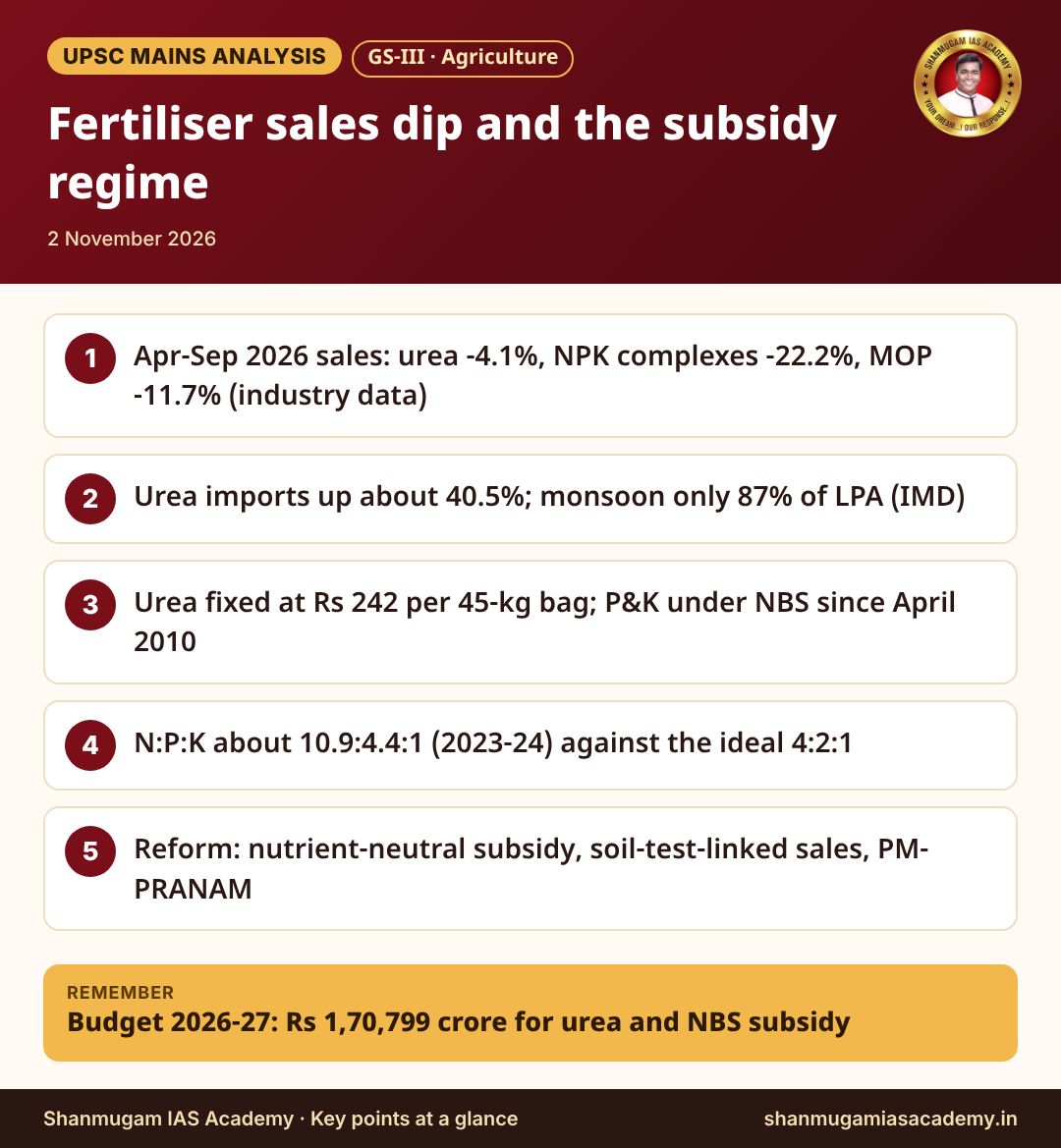
Industry data for the first half of 2026-27 (April–September), reported in late October 2026, show that fertiliser sales fell across every major product. Urea sales slipped 4.1% to about 18.52 million tonnes, but the sharpest fall was in the decontrolled phosphatic and potassic (P&K) group – NPK complex fertilisers down 22.2% and muriate of potash (MOP) down 11.7%, with DAP (−0.6%) and SSP (−1.4%) roughly flat. At the same time, urea imports rose about 40.5% to 5.59 million tonnes. The backdrop is a weak monsoon – the IMD recorded June–September rainfall at 87% of the Long Period Average as El Niño strengthened – and a year in which the West Asia conflict disrupted shipping through the Strait of Hormuz and pushed up import costs. A fall in sales would normally mean a smaller subsidy bill. In India it does not – and that tells us how the subsidy regime is built.
Background: two subsidy systems under one roof
- Urea – price control: urea has a statutory maximum retail price of Rs 242 per 45-kg bag (excluding neem-coating charges and taxes). The Centre pays manufacturers and importers the gap between this price and the cost of production or import, plus freight. So any rise in gas or import prices falls entirely on the Budget, not on the farmer.
- P&K – Nutrient Based Subsidy (NBS), since 1 April 2010: the Centre fixes a subsidy per kg of nutrient (N, P, K, S), usually each season; companies set the retail price. It covers 28 grades including DAP, MOP, NPK complexes and SSP. For Kharif 2026 the Cabinet approved (8 April 2026) about Rs 41,534 crore, some Rs 4,317 crore more than Kharif 2025.
- Budget: the Union Budget 2026-27 provides Rs 1,70,799 crore for the urea and NBS schemes – about 3.2% of central spending (PRS). In May 2026, a Department of Fertilizers official said the bill could rise by around Rs 70,000 crore because of costlier imports (reported, PTI).
- "DBT" in fertilisers: since October 2016 (pan-India by March 2018) the subsidy is released to companies only after the retailer records the sale to an identified buyer (Aadhaar, Kisan Credit Card or Voter ID) on a Point of Sale device at the retail shop. The money still goes to companies, not into farmers' bank accounts.
- PM-PRANAM (June 2023): States that cut chemical fertiliser use below their three-year average get 50% of the subsidy saved as a grant. PRS notes that, as of February 2026, no incentive had yet been released to any State.
- Nano urea: a liquid spray sold in 500 ml bottles. Government data in Parliament (December 2025): 14.11 crore bottles produced and 11.62 crore sold up to November 2025; IFFCO had submitted no adoption evaluation report, and a five-year ICAR network project on nano urea was agreed only in November 2025.
Core analysis: what the H1 2026-27 numbers say
| Product | Sales change (Apr–Sep 2026) | Pricing regime | What it signals |
|---|---|---|---|
| Urea | −4.1% (18.52 mt); imports +40.5% | Fixed MRP, open-ended subsidy | Demand barely moves with rain or cost; import bill rises |
| NPK complexes | −22.2%; production −35.5%, imports −31.4% | NBS – company-set price | Supply squeeze plus price sensitivity hits balanced nutrients first |
| MOP (potash) | −11.7% | NBS – fully imported | Potassium, already the weakest link, falls further |
| DAP | −0.6% | NBS – company-set price | Held up because it is the farmer's default phosphate |
| SSP | −1.4% | NBS | Cheap domestic phosphate/sulphur source; under-used |
The pattern matters more than the totals. When urea falls only 4% while complexes and potash fall 12–22%, the season's nutrient mix tilts further towards nitrogen. India's N:P:K use was already about 10.9:4.4:1 in 2023-24 against an agronomic ideal of 4:2:1 (Department data cited by PRS). A drought-year dip, in other words, can deepen the imbalance rather than correct it.
Why it matters: the dimensions
- Soil health and productivity: excess nitrogen with too little P, K, sulphur and micronutrients lowers the crop response per kg of fertiliser. The Parliamentary Standing Committee (2025) warned that imbalanced fertiliser use can cause multi-nutrient deficiencies and soil degradation; NITI Aayog has stressed organic manure and residue recycling.
- Price signals: the CACP (2025) observed that the higher subsidy on urea relative to P&K drives excess nitrogen use. The Standing Committee (2024) asked for a review of NBS for the same reason. The policy that keeps urea cheap is the policy that keeps soils unbalanced.
- Import dependence and strategic risk: about 89% of potassic and 28% of phosphatic consumption is met by imports; India has no potash reserves and limited phosphate rock. In 2024-25 the country needed 329 lakh tonnes of NPK nutrients but produced 148 lakh tonnes (PRS). Domestic urea plants in turn depend heavily on imported LNG – so 2026's Hormuz disruption hit both supply and the fiscal bill.
- Fiscal priorities: because the urea subsidy is open-ended, a global price shock becomes a Budget shock. Every extra rupee here competes with irrigation, research, storage and other productive farm spending.
- Federal angle: agriculture is a State subject, but fertiliser pricing, allocation and subsidy are Central. States plan the season; the Centre controls the supply tap.
Tamil Nadu angle
Tamil Nadu's main paddy season (samba) runs on the north-east monsoon and Mettur water, so its peak fertiliser demand comes after the kharif months captured in the H1 data. Supply timing is the recurring worry: the State government wrote to the Prime Minister seeking urea, DAP, MOP and NPK allocations in September 2025, and the Chief Minister wrote again in May 2026 asking for uninterrupted urea and DAP supply for kharif. With the South Peninsula receiving only 76% of normal south-west monsoon rain in 2026 (IMD), the rabi-samba allocation and timely movement of stock to delta districts are what students should watch.
Challenges in reforming the regime
- Political economy: the Rs 242 bag is the most visible farm price in India; any increase is read as anti-farmer, so reform is postponed in every election cycle.
- Targeting: PoS data identify the buyer, not the land or the crop, so there is no cap linked to soil-test needs and bulk buying or diversion of cheap urea (for industrial use or across borders) remains possible.
- Weak incentives for States: PM-PRANAM's reward has not yet reached any State, so it has not changed behaviour.
- Evidence gap on alternatives: nano urea was scaled up before long-term independent trials; sales and production have not matched and the Centre gives it no subsidy.
- Supply concentration: P&K raw materials and finished products come from a few countries and routes, so shocks pass straight into availability.
Way forward
- Move towards a nutrient-neutral subsidy: bring urea under a nutrient-based framework in steps, so that a kg of N is not far cheaper than a kg of P or K – with a compensating per-farmer support so small farmers are not hurt.
- Link sales to soil-test advice: use Soil Health Card recommendations and PoS data to set reasonable seasonal quantities per farmer and flag outliers.
- Make PM-PRANAM real: release the first State grants quickly and publish State-wise savings, so the incentive becomes credible.
- Reduce import risk: long-term offtake contracts and joint ventures abroad for rock phosphate and potash, diversified shipping routes, buffer stocks for DAP and MOP, and more SSP and organic/fermented manure use at home.
- Evidence before scale: complete ICAR network trials on nano fertilisers and publish results before further expansion.
- Phase-wise farmer DBT pilots: test cash transfers in a few districts with good land records before any national move.
Mains practice question
Answer framework: Introduction – H1 2026-27 sales dip (urea −4.1%, NPK −22.2%) amid a monsoon at 87% of LPA and West Asia disruption · Body – (a) two regimes: fixed-MRP urea vs NBS (since 2010); (b) distortions: N:P:K about 10.9:4.4:1 vs 4:2:1, soil degradation (Standing Committee, CACP); (c) fiscal and import risk: BE Rs 1,70,799 crore, imports of potash and phosphate; (d) steps so far: neem-coated urea, PoS-based DBT, PM-PRANAM, nano urea – and their limits · Way forward – nutrient-neutral subsidy, soil-test-linked quantities, credible State incentives, import diversification · Conclusion – faculty-view line.
Prelims pointers
- Nutrient Based Subsidy (NBS) – in force since 1 April 2010 for P&K fertilisers; covers 28 grades; urea is outside NBS.
- Urea MRP – Rs 242 per 45-kg bag (excluding neem-coating charges and taxes).
- Fertiliser DBT – effective October 2016; pan-India by March 2018; subsidy paid to companies on PoS-recorded sales.
- PM-PRANAM – approved June 2023; 50% of the subsidy saved by a State is returned to it as a grant.
- Ideal N:P:K ratio – 4:2:1; India about 10.9:4.4:1 in 2023-24.
India does not pay a fertiliser subsidy; it pays a urea subsidy and a smaller, capped subsidy for everything else. As long as nitrogen is priced far below phosphorus and potassium, no campaign or new product will fix the soil. The direction of reform is a "nutrient-neutral subsidy": support each kg of nutrient on an equal footing, tie quantities to soil-test needs, and protect the farmer's income directly rather than the price of one bag. That turns the subsidy from a consumption reward into a soil-health investment.
- A shift to note: from "cheap urea" to "balanced nutrition". Write: "subsidise the soil's need, not the cheapest bag".
- What to watch next: (1) Rabi 2026-27 NBS rates and DAP/MOP availability during the samba and wheat seasons, (2) the final 2026-27 subsidy figure in the Revised Estimates and the next Budget, (3) the first PM-PRANAM grants to States, (4) results of ICAR's nano urea network trials.
- Ready-made conclusion line: "A subsidy that makes one nutrient cheap makes the soil poor – India must move from price control on urea to a nutrient-neutral subsidy that pays for balance."
Sources: Department of Fertilizers / PIB on DBT in fertilisers (17 December 2021); Cabinet decision on NBS for Kharif 2026 (PMIndia, 8 April 2026; ETV Bharat); PRS Legislative Research, Demand for Grants 2026-27 Analysis – Agriculture; CCEA decision on PM-PRANAM and urea subsidy (28 June 2023, Business Today); H1 2026-27 fertiliser data (industry data, as reported by Rural Voice and The Wire, October 2026); Business Standard/PTI (18 May 2026) and Reuters via Fertilizer Daily (June 2026) on the subsidy bill; IFPRI/CGIAR on the West Asia shock; IMD end-of-season monsoon statement (30 September 2026); Rajya Sabha reply on nano urea (PTI, 16 December 2025); Tamil Nadu letters to the PM (AIR News, ETV Bharat, UNI, News Today). Original analysis by Shanmugam IAS Academy.
Link to this page from your website / blog (HTML code)
SI/POLICE Achievers
-

KRISHNA MOORTHY
SI / POLICE SI / POLICE
அறிவோம் அரசியலமைப்பு | MAKING OF CONSTITUTION | UPSC Polity தமிழில் | NITHISH KUMAR
TNPSC குரூப் 1, 2/2A, 4 – நேரடி வகுப்புகள் · கோவை & மதுரை
2006 முதல் சண்முகம் IAS அகாடமி · Classroom & online coaching in Coimbatore and Madurai
