

Mains Analysis: Dams and land rights – the Siang protests, consent and the unfinished promise of rehabilitation in India
3 November 2026 · English Infrastructure & Energy
⬇ Download this analysis as free PDF
இந்தப் பகுப்பாய்வைத் தமிழில் படிக்க →
Topics: Infrastructure · GS-III · UPSC Mains Analysis
Context
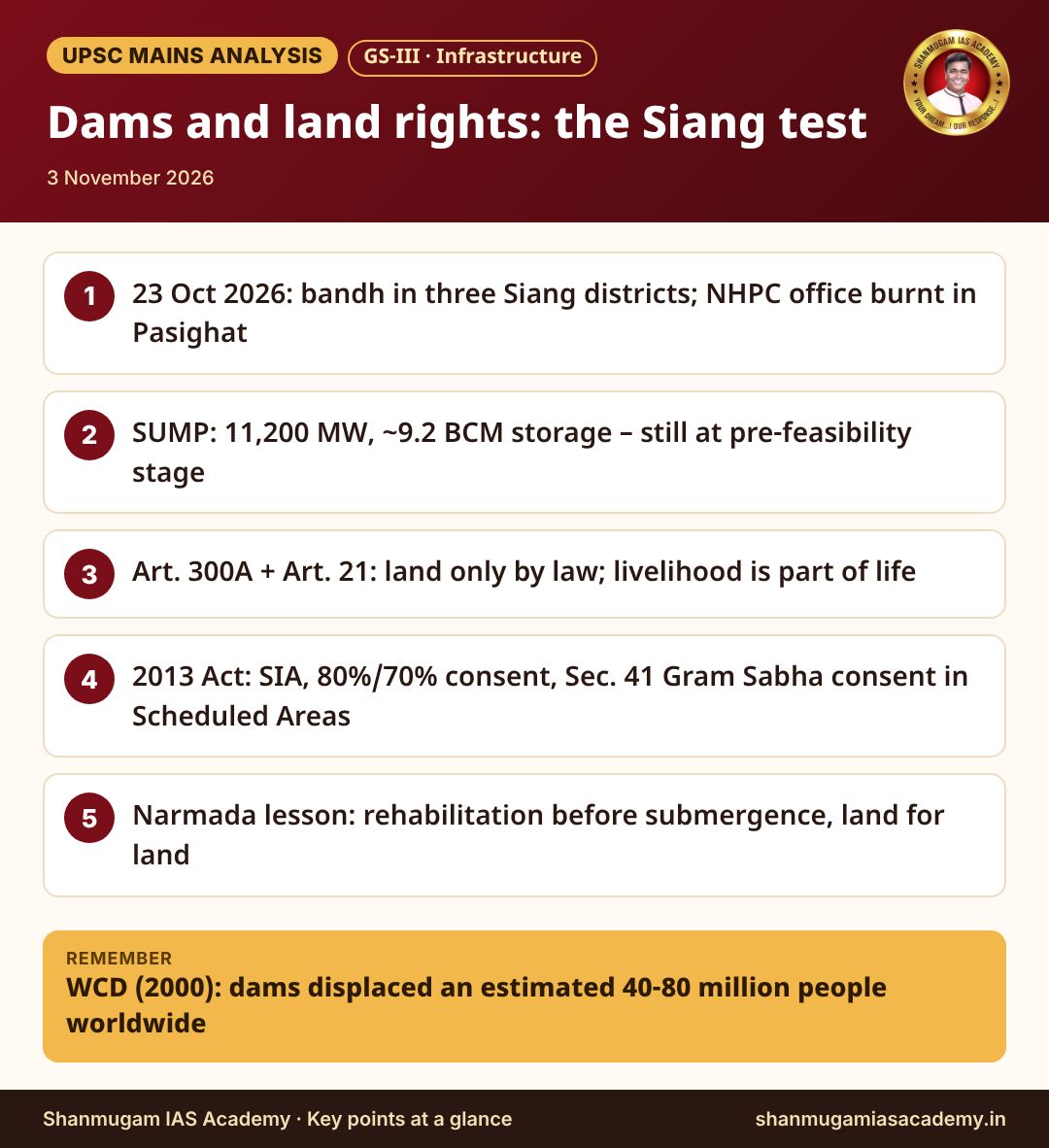
On 23 October 2026 several Adi community organisations observed a 12-hour bandh across Siang, Upper Siang and East Siang districts of Arunachal Pradesh against the proposed Siang Upper Multipurpose Project (SUMP) – an 11,200 MW dam with about 9.2 billion cubic metres of live storage, for which NHPC is preparing a pre-feasibility report (PFR). Their demands: stop the survey and PFR work, withdraw the security forces deployed for it, release detained activists and reinstate suspended gaon buras (village headmen). After the bandh ended, the protest turned violent in Pasighat: an NHPC office and a police station were set on fire, police personnel were injured and the homes of political leaders were attacked. Chief Minister Pema Khandu condemned the violence, invited the groups for talks and repeated that the project is only at the PFR stage. The State and the Centre see SUMP as a strategic water store against China's giant dam upstream on the Yarlung Tsangpo; many villagers see it as a threat to land they have held for generations. The episode raises an old question for India: how do we build dams without breaking the land rights of the people who live where the water will rise?
Background: the legal frame for land and displacement
| Provision | What it says | Relevance to dams |
|---|---|---|
| Article 300A (44th Amendment, 1978) | Property is no longer a fundamental right; no one can be deprived of it "save by authority of law" | The State can acquire land, but only through a fair law and procedure |
| Article 21 | The Supreme Court has read the right to livelihood into the right to life (Olga Tellis, 1985) | Displacement without rehabilitation hits livelihood, not just property |
| Fifth and Sixth Schedules (Art. 244) | Special administration of Scheduled and tribal areas; Samatha (1997) protected tribal land in Scheduled Areas from transfer to private parties | Many dam sites are tribal lands |
| PESA Act, 1996 | Section 4(i): the Gram Sabha or Panchayat must be consulted before land acquisition and before resettling project-affected people in Scheduled Areas | Gives the village a voice before acquisition |
| Forest Rights Act, 2006 | Section 4(5): no forest dweller can be evicted until the recognition and verification of rights is complete. Niyamgiri (2013): the Gram Sabha decides on rights affected by a project | Reservoirs often submerge forest land |
| RFCTLARR Act, 2013 (in force from 1 January 2014) | Mandatory Social Impact Assessment (SIA); consent of 80% of affected families for private and 70% for PPP projects; compensation up to two times market value in rural areas plus 100% solatium; R&R for land-dependent families, not only owners; Section 41 – acquisition in Scheduled Areas only as a last resort and with the prior consent of the Gram Sabha/Panchayat/Autonomous District Council | The core law for any dam built on acquired land |
| National R&R Policy, 2007 | Replaced the first national R&R policy of 2003; its principles were later given legal force by the 2013 Act | Shows the shift from "compensation" to "rehabilitation" |
| Dam Safety Act, 2021 | National Committee and National Dam Safety Authority; State bodies for surveillance and inspection of specified dams | Safety of downstream people – a growing concern in seismic Himalayan valleys |
Past evidence: what India learnt from big dams
- Sardar Sarovar (Narmada): the Narmada Water Disputes Tribunal award (1979) required land for land for displaced families. World Bank funding ended in 1993 (the remaining loan was cancelled at India's request) after an independent review (1992) criticised resettlement. In Narmada Bachao Andolan v. Union of India (2000) the Supreme Court allowed construction to continue but tied each rise in dam height to the completion of rehabilitation (pari passu). The dam was dedicated to the nation in September 2017, yet disputes over rehabilitation went on for years.
- Polavaram (Godavari): declared a national project under the Andhra Pradesh Reorganisation Act, 2014. Its submergence reaches into tribal areas, and Odisha and Chhattisgarh have raised objections about the effect on their tribal villages.
- Ken–Betwa link: foundation stone laid in December 2024; in 2026 villagers facing displacement near the dam site were reported protesting for land for land and fresh Gram Sabha meetings.
- The pattern: Scheduled Tribes are 8.6% of India's population (Census 2011), but form a much larger share of people displaced by development projects. Rehabilitation usually lags behind construction.
Core analysis: benefits of dams vs costs to land-holders
| Dimension | Benefits (why India builds dams) | Costs (who pays) |
|---|---|---|
| Water and food | Irrigation, drinking water, storage for dry months – India has over 6,000 large dams (6,138 completed – National Register of Large Dams, 2023) | Fertile riverbank farmland and grazing land go under water |
| Energy | Clean, flexible hydropower that balances solar and wind | Benefits flow to distant grids; local people may not even get power first |
| Disasters | Flood moderation (Hirakud on the Mahanadi was built partly for this); SUMP is presented as a buffer against sudden upstream releases | Dam failure risk in seismic zones; downstream erosion and changed river flow |
| Strategy | Use-it-or-lose-it water claims on a shared river; storage against an upstream mega-dam | Security deployment can make consultation look like coercion |
| Society and culture | Roads, jobs and services in remote areas | Loss of clan and community land, sacred sites, language and identity; cash compensation rarely restores a way of life |
Why Siang is a special test
- Customary land: in Arunachal Pradesh most land is held by communities and clans under customary practice, not by individual title. A compensation formula built around registered sale deeds fits poorly.
- Consent at the survey stage: the conflict began not over construction but over the PFR survey itself. People want to be asked before the first drill, not after the design is fixed.
- Strategic framing: China approved its lower Yarlung Tsangpo hydropower project in December 2024 and began construction in July 2025. The national-interest argument is real, but it cannot replace local agreement.
- Earlier warnings: the NHRC took suo motu cognizance of an earlier anti-dam protest in Siang district in June 2025 and sought reports from the State.
Challenges
- Consent gap: the 80%/70% consent rule of the 2013 Act does not apply to projects of the government itself – most dams.
- Weak SIAs: social impact studies are often treated as a formality and done after key decisions are taken.
- Valuation: under-reported land prices and undocumented customary rights mean low compensation.
- Rehabilitation lag: people are moved before land, houses and livelihoods are ready.
- Trust deficit: detentions and security deployment during surveys harden opposition and feed misinformation.
Way forward
- Consult before surveys: a written agreement with village councils and community bodies on what will be studied and how results will be shared.
- Make SIA and Environmental Impact Assessment independent and public, in the local language, including downstream impact in Assam.
- Treat customary and forest rights as property: settle FRA claims and record community land before any acquisition.
- Follow the Narmada lesson – rehabilitation before submergence, land for land where possible, and a resettlement plan approved by the people.
- Share benefits: a fixed share of power revenue or free power for the project area, jobs, equity or a local development fund.
- Explore alternatives seriously: smaller or run-of-river designs and different sites, as the World Commission on Dams (2000) advised.
Mains practice question
Answer framework: Introduction – 23 October 2026 bandh and Pasighat violence; SUMP 11,200 MW at PFR stage · Body – (a) benefits of dams: irrigation, hydropower, flood control, strategic storage; (b) legal frame: Art. 300A, Art. 21, Fifth Schedule, PESA, FRA, RFCTLARR 2013 (SIA, consent, Section 41); (c) evidence: Sardar Sarovar, Polavaram, Ken–Betwa; (d) gaps: consent not needed for government projects, weak SIA, customary land · Way forward – points above · Conclusion – faculty-view line.
Prelims pointers
- Siang = Yarlung Tsangpo in Tibet; it becomes the Brahmaputra after joining the Dibang and Lohit in Assam.
- RFCTLARR Act, 2013 – Fourth Schedule lists 13 Central Acts (e.g. National Highways Act, Railways Act, Electricity Act) outside its acquisition procedure.
- PESA Act, 1996 extends Panchayats to Fifth Schedule areas; Arunachal Pradesh is not a Fifth Schedule State.
- Dam Safety Act, 2021 – National Dam Safety Authority (NDSA).
- World Commission on Dams report "Dams and Development" – November 2000.
The key idea here is "free, prior and informed consent" (FPIC) – people affected by a project agree to it without pressure, before decisions are made, and with full information in their own language. The World Commission on Dams recommended it for indigenous peoples in 2000, and India's own laws carry parts of it (PESA consultation, FRA Gram Sabha role, Section 41 of the 2013 Act). Siang shows why the "prior" matters most: the dispute began at the survey stage.
- A shift to note: conflicts now start at the survey, not at construction. Write: "consultation must move upstream – from the project report to the first survey."
- What to watch next: (1) whether the Siang talks produce a written consultation process and the PFR resumes, (2) the SIA and EIA stages, including downstream studies for Assam, (3) progress on China's lower Yarlung Tsangpo project and India–China river data sharing, (4) court and Gram Sabha disputes in Ken–Betwa and Polavaram rehabilitation.
- Ready-made conclusion line: "A dam stores water, but consent stores legitimacy; India needs both to build for the future."
Sources: Reports on the 23 October 2026 bandh and Pasighat violence (PTI via ThePrint, IANS via Morung Express, Free Press Journal, Arunachal24, Business Today, Outlook); Down To Earth (8 October 2026) and The Pioneer (5 October 2026) on SUMP capacity and storage; UNI on the CM's consultation meeting; NHRC press release (2 June 2025); RFCTLARR Act, 2013 (text and Fourth Schedule), PESA Act, 1996, Forest Rights Act, 2006, Dam Safety Act, 2021; World Bank blog on the 2013 Act; CWC National Register of Large Dams 2023; World Bank timeline on Sardar Sarovar; World Commission on Dams framework (International Rivers); reports on China's Yarlung Tsangpo project. Original analysis by Shanmugam IAS Academy.
Link to this page from your website / blog (HTML code)
BANK Achievers
-

R. PRAKASH
BANK BANK
TNPSC பொதுத்தமிழ் | 8th பழைய தமிழ் புத்தகம் | General Tamil MCQ | Group 4
TNPSC குரூப் 1, 2/2A, 4 – நேரடி வகுப்புகள் · கோவை & மதுரை
2006 முதல் சண்முகம் IAS அகாடமி · Classroom & online coaching in Coimbatore and Madurai
