

Bihar – first State with a comprehensive Silt (Sediment) Management Policy; NHAI–Bihar MoU under 'Nadi Sanjeevani'
3 November 2026 · English Environment & Ecology
⬇ Download this article as free PDF
Topics: Environment · 3 November 2026 Current Affairs (UPSC / TNPSC / SSC / RRB)
News
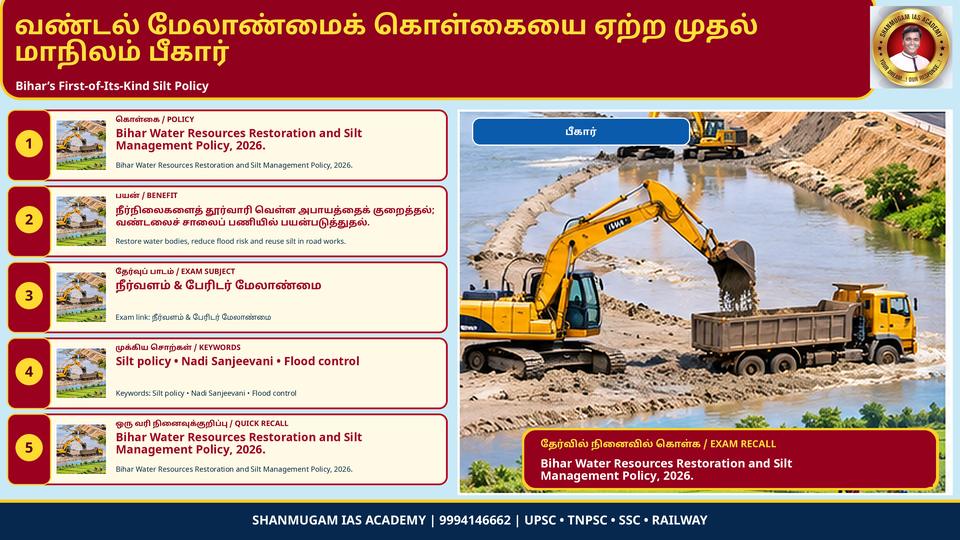
On 3 Nov 2026 in New Delhi, in the presence of Union Road Transport & Highways Minister Nitin Gadkari and Bihar CM Samrat Choudhary, the Bihar Government and the Union Ministry of Road Transport & Highways (MoRTH) signed an MoU under the 'Nadi Sanjeevani' initiative, to be implemented by NHAI. NHAI will desilt rivers and water bodies and use the silt in National Highway works (raising road levels, strengthening embankments) – about 243 lakh cubic metres free of cost for 16 ongoing projects and about 835 lakh cubic metres for 27 upcoming ones. The CM said that with the 'Bihar Water Resources Restoration and Silt Management Policy 2026', approved by the State Cabinet on 15 Sept 2026, Bihar is the first State to adopt a comprehensive silt management framework.
Key facts
| Policy | Bihar Water Resources Restoration and Silt Management Policy 2026 – Cabinet approval 15 Sept 2026 |
| Aim | Restore water-holding and carrying capacity of rivers, barrages, reservoirs; reuse silt for roads, railways, construction |
| Farmers | ₹20,000 per two hectares to clear sand/silt from buried farmland |
| MoU | 3 Nov 2026, New Delhi – 'Nadi Sanjeevani'; MoRTH + Bihar Govt (NHAI implements) |
| Silt volume | About 1,078 lakh cubic metres in all (43 highway projects) |
| National | National Framework for Sediment Management (NFSM) – Ministry of Jal Shakti (DoWR, RD & GR) |
Background
- Geography: seven major rivers enter Bihar from Nepal. Himalayan rivers such as the Kosi, Gandak, Bagmati and Kamla bring huge silt loads that raise river beds and worsen floods. The Kosi, which often shifts its course and floods, is called the 'Sorrow of Bihar'; where it leaves the hills for the plains it has built a huge alluvial fan (megafan).
- 2026 floods: despite a rainfall deficit of over 32%, three major rivers reached peak flood levels and the Ganga's 200-year High Flood Level (HFL) record was broken; the CM said silt has built up to 10 m in some rivers.
- National policy: the Department of Water Resources, River Development & Ganga Rejuvenation (Ministry of Jal Shakti) issued the 'National Framework for Sediment Management' in Oct 2022 after consulting States. It prioritises curbing silt generation at the source over repeated desilting.
- Polity: 'Water' (irrigation, canals, drainage, embankments) is in the State List (Entry 17) of the Seventh Schedule, while regulation of inter-State rivers is in the Union List (Entry 56). Flood control is therefore mainly a State responsibility.
Tamil Nadu link: In 2024 Tamil Nadu simplified rules so that farmers and potters can take silt and clay free of cost from tanks, ponds and canals maintained by the Water Resources and Rural Development departments (G.O. of 25 June 2024; permission online from the Tahsildar). This enriches farmland and restores storage capacity of water bodies. The Cauvery's alluvium makes the Thanjavur delta the 'rice bowl of Tamil Nadu'.
Source: PIB (MoRTH), ETV Bharat, 3 Nov 2026; The NewsMill (ANI), 3 Nov 2026; UNI, 15 Sept 2026; Lok Sabha reply (NFSM); DD India, Dec 2025; DT Next, 9 July 2024
Join our UPSC classroom or online batch: UPSC coaching in Coimbatore · Fees · Call 99941 46662.
Link to this page from your website / blog (HTML code)
TNPSC Achievers
-

ANANDHI
TNPSC TNPSC
Today Current Affairs in Tamil | 05 நவம்பர் 2026 | TNPSC Group 4 முக்கிய வினாக்கள்
TNPSC குரூப் 1, 2/2A, 4 – நேரடி வகுப்புகள் · கோவை & மதுரை
2006 முதல் சண்முகம் IAS அகாடமி · Classroom & online coaching in Coimbatore and Madurai
