

Mains Analysis: Beyond the North–South Fault Lines – Why India Must Act on Climate in Its Own Interest
5 November 2026 · English Environment & Ecology
⬇ Download this analysis as free PDF

இந்தப் பகுப்பாய்வைத் தமிழில் படிக்க →
Topics: Environment · GS-III · UPSC Mains Analysis
UPSC Mains Analysis – current affairs of 5 November 2026 (Shanmugam IAS Academy)
Context
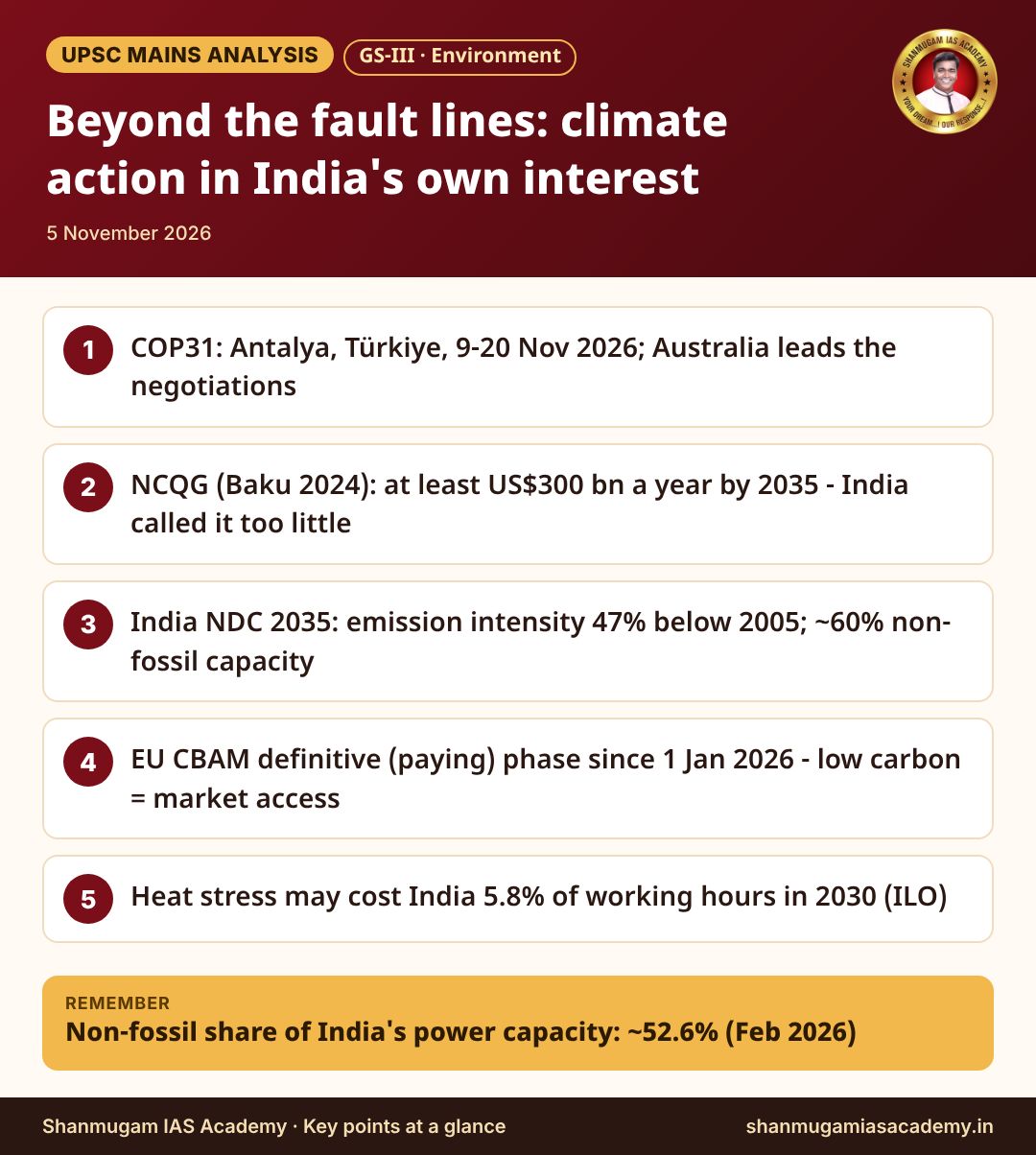
The 31st UN climate conference, COP31, opens in Antalya, Türkiye, on 9 November 2026 (it runs to 20 November). It meets in an unusual setting. The United States – the largest historical emitter – left the Paris Agreement with effect from 27 January 2026 and has announced that it will also leave the UNFCCC itself. The finance goal agreed at Baku in 2024 is widely seen in the developing world as too small, and the Belém conference of 2025 ended without any reference to fossil fuels in its main decision. Meanwhile India has submitted its new climate pledge (NDC) for 2031–2035. For three decades India's climate diplomacy has been organised around the North–South "fault lines" – who caused the problem, who must cut first and who must pay. Those questions still matter. But a new question has become equally important for India: what climate action is in India's own developmental and strategic interest, whatever others do?
Background – how the fault lines were drawn
| Stage | What it meant for the North–South divide |
|---|---|
| 1992 – UNFCCC (Rio) | Principle of common but differentiated responsibilities and respective capabilities (CBDR-RC); developed countries listed in Annex I were to take the lead. |
| 1997 – Kyoto Protocol | Binding emission cuts only for developed countries; developing countries such as India had no reduction targets. |
| 2009 – Copenhagen | Developed countries promised to mobilise US$100 billion a year by 2020 for developing countries (OECD data show it was first met only in 2022). |
| 2015 – Paris Agreement | All countries now make national pledges (NDCs); differentiation continues, and Article 9.1 says developed countries "shall provide" finance. |
| 2024 – COP29, Baku | New Collective Quantified Goal (NCQG): developed countries to take the lead in mobilising at least US$300 billion a year by 2035, with a call to scale up flows from all sources to US$1.3 trillion a year by 2035. India objected to its adoption and called the sum an "optical illusion". |
| 2025 – COP30, Belém | "Global Mutirão" package: call to at least triple adaptation finance by 2035; 59 voluntary indicators for the Global Goal on Adaptation; a just-transition mechanism to be developed; a two-year work programme on climate finance including Article 9.1; dialogues on trade-related climate measures. No fossil-fuel language in the decision. |
India's pledges – where it stands
| Item | 2030 NDC (updated 2022) | NDC 2031–2035 (Cabinet, 25 March 2026) |
|---|---|---|
| Emission intensity of GDP (vs 2005) | 45% lower by 2030 | 47% lower by 2035 |
| Non-fossil share of installed power capacity | 50% by 2030 | About 60% by 2035 |
| Additional carbon sink (forest and tree cover) | 2.5–3 billion t CO2e | 3.5–4.0 billion t CO2e |
| Long-term goal | Net zero by 2070 (announced at COP26, Glasgow, 2021) | Net zero by 2070; aligned with Viksit Bharat@2047 |
Delivery so far (Government data): emission intensity fell about 36% between 2005 and 2020; non-fossil sources were about 52.6% of installed power capacity by February 2026 – the 2030 target met roughly five years early; an additional sink of about 2.29 billion tonnes CO2e was created by 2021. The gap: non-fossil sources still produce a much smaller share of the electricity actually generated than their share of capacity.
Why "self-interest" is the stronger argument – key dimensions
| Dimension | Why climate action serves India first |
|---|---|
| Energy security | India imports close to 90% of its crude oil. Every unit of solar, wind, storage or electric mobility reduces exposure to price shocks, sanctions and shipping disruptions. |
| Industrial competitiveness | The EU's Carbon Border Adjustment Mechanism (CBAM) entered its definitive phase, in which importers must pay for embedded emissions, on 1 January 2026 (steel, aluminium, cement, fertilisers, electricity, hydrogen). The India–EU FTA concluded in January 2026 did not exempt India. Low-carbon steel and aluminium are becoming a condition of market access. |
| Heat and labour productivity | The ILO estimated that heat stress could cost India about 5.8% of working hours in 2030 – equal to about 34 million full-time jobs. Adaptation is an economic policy, not charity. |
| Adaptation and disasters | Floods, cyclones, glacial hazards and heatwaves hit India regardless of who emitted. Resilient infrastructure, early warning and heat action plans protect growth. |
| New industries | Solar modules, batteries, green hydrogen and grid equipment are the growth sectors of this century; the country that makes them gains jobs and strategic leverage. |
| Health | Cutting coal and vehicle pollution improves air quality – a benefit that comes at home, immediately. |
Challenges
- The finance gap is real: US$300 billion a year by 2035, from mixed public and private sources, is far below the needs of developing countries; the cost of capital for clean projects in India remains high.
- Weakened multilateralism: the US exit reduces both finance and pressure on other big emitters; the "fault lines" can harden rather than fade.
- Coal dependence: coal still dominates electricity generation and supports jobs and State revenues in eastern India – a just transition is needed.
- Trade measures: CBAM-type measures can act as disguised protectionism and shift the burden of decarbonisation onto developing-country exporters, especially MSMEs that lack emissions data.
- Adaptation is under-funded and harder to finance through markets than mitigation, though it matters most for India's poor.
Way forward
- Hold the line, but do not wait: keep pressing on CBDR-RC, Article 9.1 and adaptation finance at COP31, while treating domestic targets as national strategy, not as concessions.
- Price carbon at home: make the Carbon Credit Trading Scheme (emission-intensity targets first notified in October 2025 for aluminium, cement, chlor-alkali and pulp and paper, and later extended to more sectors) credible, so that Indian exporters can argue for credit against CBAM.
- From capacity to generation: invest in storage, transmission and grid flexibility so that clean capacity turns into clean electricity.
- Make adaptation a budget line: heat action plans for every city, early warning for every district, climate-proof public works.
- Lower the cost of capital: blended finance, guarantees and MDB reform to bring down the cost of clean projects; use G20 and BRICS platforms for this.
- Plan a just transition for coal regions – reskilling, new industries and State revenue support.
Mains practice question
Answer framework: Introduction – CBDR-RC and the North–South divide; COP31 setting (US exit, NCQG) · Body – (a) equity arguments that remain valid: historical emissions, Article 9.1, finance gap; (b) national-interest drivers: energy security, CBAM, heat stress, new industries, health; (c) India's record: NDC 2035 targets and delivery so far · Way forward – carbon market, grid and storage, adaptation budgeting, just transition · Conclusion – faculty-view line below.
Prelims pointers
- CBDR-RC is in the UNFCCC (1992); the Paris Agreement was adopted at COP21 in 2015.
- NCQG – adopted at COP29, Baku (2024): at least US$300 billion a year by 2035; call for US$1.3 trillion a year from all sources.
- COP30 – Belém, Brazil (November 2025); COP31 – Antalya, Türkiye, 9–20 November 2026, with Australia leading the negotiations.
- India's NDC 2031–2035: 47% lower emission intensity (vs 2005) and about 60% non-fossil power capacity by 2035; net zero by 2070.
- EU CBAM sectors: iron and steel, aluminium, cement, fertilisers, electricity and hydrogen.
The concept to carry into the exam hall is "strategic decarbonisation" – cutting emissions because it strengthens a country's energy security, industry and resilience, not only because a treaty asks for it. It does not replace climate justice; it adds a second, stronger engine. India argues equity abroad and pursues self-interest at home – both can be true at once.
- A shift to note: the climate debate is moving from the negotiating hall to trade, industrial policy and finance. Expect questions that link climate with CBAM, critical minerals and manufacturing.
- What to watch next: (1) COP31 outcomes on the Article 9.1 finance programme and adaptation finance, (2) how trading on India's carbon market takes off and any India–EU understanding on CBAM, (3) whether non-fossil generation – not just capacity – rises fast, (4) how many big emitters strengthen their NDCs without the US.
- Ready-made conclusion line: "India should argue for climate justice in the world and practise strategic decarbonisation at home – because the sun, the wind and a cooler workplace are in its own interest."
Sources: PIB / PM India – Cabinet approval of India's NDC 2031–2035 (25 March 2026); UNFCCC decisions on the NCQG (COP29) and the Global Mutirão (COP30); Australian Government statement on COP31 arrangements (23 November 2025); European Commission – CBAM; ILO, Working on a Warmer Planet (2019); MoEFCC – GHG Emission Intensity Target Rules, 2025. Original analysis by Shanmugam IAS Academy.
Link to this page from your website / blog (HTML code)
SI/POLICE Achievers
-

VISWANATHAN
SI / POLICE SI / POLICE
How Sea Surface Temperature Fuels Deadly Cyclones? Explained Mr V. GOKULA KRISHNAN SHANMUGAM ACADAMY
TNPSC குரூப் 1, 2/2A, 4 – நேரடி வகுப்புகள் · கோவை & மதுரை
2006 முதல் சண்முகம் IAS அகாடமி · Classroom & online coaching in Coimbatore and Madurai
