

Mains Analysis: Curb outward remittances or win back capital inflows? – why India's answer to rupee pressure lies in trust and tax certainty, not a narrower LRS
4 November 2026 · English Economy & Banking
⬇ Download this analysis as free PDF
இந்தப் பகுப்பாய்வைத் தமிழில் படிக்க →
Topics: Economy · GS-III · UPSC Mains Analysis
Context
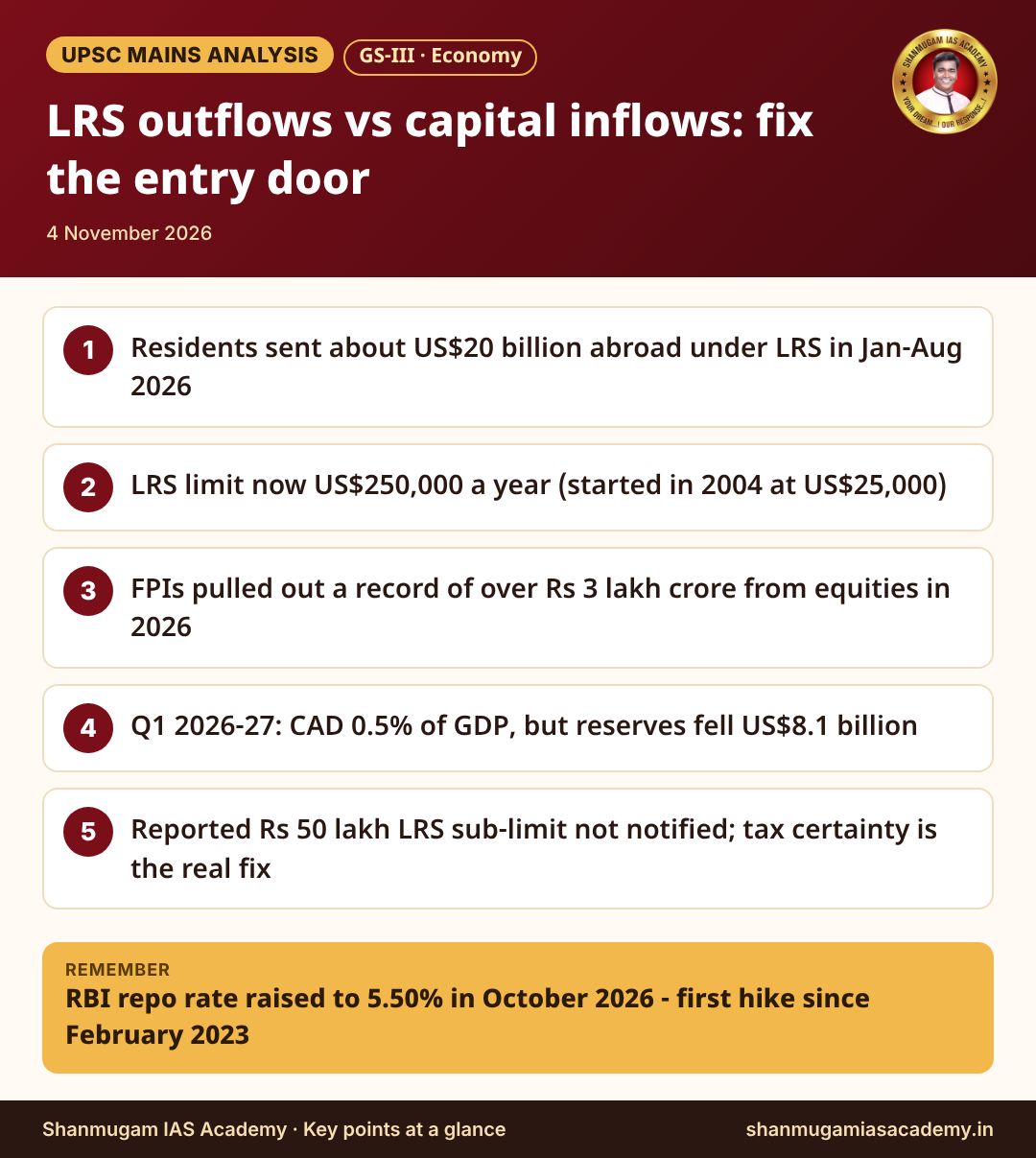
RBI data on the Liberalised Remittance Scheme (LRS) show that resident Indians sent about US$20 billion abroad in January–August 2026, slightly more than in the same months of 2025. Overseas travel is the largest item, and money sent to buy foreign shares and bonds has risen by more than 80% over a year earlier. These outflows come in a difficult year for India's external sector. Foreign portfolio investors (FPIs) have pulled a record of more than Rs 3 lakh crore out of Indian equities in 2026 so far (NSDL data, as reported); the rupee has touched record lows against the US dollar; and in October 2026 the RBI raised the repo rate by 25 basis points to 5.50% – its first increase since February 2023. In October, SBI Research suggested curbs on "non-essential" LRS remittances, and media reports in late October said the RBI was considering a Rs 50 lakh sub-limit within LRS for some purposes such as business travel and pilgrimages. No change has been notified; the overall limit of US$250,000 a year still applies. The policy question is simple to state and hard to answer: should India narrow the exit door for its own residents, or widen the entry door for foreign capital?
Background: what LRS is and how it is taxed
- Origin: LRS was introduced on 4 February 2004 with a limit of US$25,000 a year. The limit has been revised in stages; it is now US$250,000 per financial year (April–March) for current or capital account purposes or both.
- Who can use it: resident individuals, including minors (through a guardian). Companies, firms, HUFs and trusts cannot.
- Legal basis: the Foreign Exchange Management Act (FEMA), 1999, in force from 1 June 2000, which replaced the control-oriented FERA, 1973. Section 5 permits current account transactions, subject to reasonable restrictions under the Current Account Transactions Rules, 2000.
- Safeguards: PAN is mandatory; no remittance for lottery tickets or for margins/margin calls to overseas exchanges, and no capital account remittance to countries FATF identifies as non-cooperative.
- Tax collected at source (TCS): after Union Budget 2026-27, TCS is 2% on education and medical remittances above Rs 10 lakh (nil when the education is loan-funded), a flat 2% on overseas tour packages, and 20% above Rs 10 lakh for other purposes such as investment and gifts. TCS is not an extra tax – it is adjustable against the final income-tax liability, but it locks up cash and creates a trail.
- Precedent: during the 2013 "taper tantrum", the RBI cut the LRS limit on 14 August 2013 from US$200,000 to US$75,000 to support the rupee.
The numbers: exit door versus entry door
| Indicator | Latest reading | What it tells us |
|---|---|---|
| LRS outflows, FY 2025-26 | US$28.98 billion (FY 2024-25: US$29.56 billion); travel about US$16.9 billion | Large but stable; most of it is consumption (travel, relatives, studies), not capital flight |
| LRS outflows, January–August 2026 | About US$20 billion | Investment abroad is the fastest-growing part, from a small base |
| FPI flows into equities, 2026 | Record net outflow of more than Rs 3 lakh crore (as reported) | The real pressure is on the entry side – foreign money leaving |
| Balance of payments, Q1 2026-27 (RBI) | Current account deficit US$4.2 billion (0.5% of GDP); net FPI outflow US$9.6 billion; reserves down US$8.1 billion | A modest current account gap became a reserve loss because capital did not come in |
| Policy rate | Repo raised to 5.50% (October 2026) | Monetary policy is already being used to defend the currency |
Why curbs on LRS are tempting – and why they are a weak tool
| Argument for curbs | Counter-argument |
|---|---|
| Travel and gifts are "non-essential" and could be postponed when the rupee is weak. | Annual LRS outflow is smaller than the FPI outflow of a single bad year; the saving from a sub-limit would be marginal. |
| Investment abroad is growing quickly and could become capital flight. | Diversification by households is normal for a growing middle class; the answer is better domestic returns, not a ban. |
| China manages with an annual individual forex quota. | China keeps a tightly controlled capital account and large surpluses; India wants FPIs and global bond-index investors to trust its openness. |
| India did it in 2013 and it worked. | In 2013 the curbs were a crisis measure, and they were later relaxed; repeating them sends a signal that rules can change overnight. |
The deeper problem is signalling. Capital controls on residents tell foreign investors that the exit door can also be narrowed for them. Investors price that risk, and the result can be fewer inflows – the opposite of the aim.
Challenges
- Global push factors: high US bond yields, the global rush into AI-linked stocks and high oil prices pull money out of emerging markets regardless of Indian policy.
- Tax uncertainty: retrospective taxation (Vodafone, Cairn) was formally ended only by the Taxation Laws (Amendment) Act, 2021, and its memory lingers; frequent changes in capital gains and TCS rules still make investors cautious.
- Compliance friction: TCS locks up the money of honest remitters, while those who misuse LRS find other routes.
- Policy trilemma: India cannot fully control the exchange rate, run an independent monetary policy and keep capital fully open at the same time; every rupee defence uses reserves or interest rates.
- Slow capital account convertibility: the Tarapore committees (1997 and 2006) set preconditions – fiscal discipline, low inflation, strong banks – that are still only partly met, so policy swings between opening and closing.
Way forward
- Keep LRS open and predictable; if any tightening is needed, make it temporary, targeted and announced in advance, with a clear sunset date.
- Build tax certainty: stable capital gains rates for several years, advance rulings and safe harbours for foreign investors, and quick resolution of old disputes under the new Income-tax Act, 2025.
- Rationalise TCS – a low single rate with real-time credit in tax records would keep the trail without blocking honest money.
- Deepen the domestic market so residents can diversify at home – GIFT City funds, international mutual funds and a deeper corporate bond market.
- Attract stable, long-term capital: FDI in manufacturing, infrastructure investment trusts, and steady inclusion in global bond indices – backed by fiscal consolidation that keeps the rupee credible.
Mains practice question
Answer framework: Introduction – LRS (2004, US$250,000 limit) and the 2026 context of FPI outflows and a weak rupee · Body – (a) composition of LRS outflows; (b) arguments for curbs, including the 2013 precedent; (c) costs: signalling, marginal savings, trilemma, compliance burden · Way forward – tax certainty, TCS reform, deeper domestic markets, long-term inflows · Conclusion – faculty-view line below.
Prelims pointers
- LRS: introduced 4 February 2004 (US$25,000); now US$250,000 per financial year; available to resident individuals including minors.
- FEMA, 1999 came into force on 1 June 2000 and replaced FERA, 1973; Section 5 deals with current account transactions.
- India accepted IMF Article VIII obligations (current account convertibility) in August 1994.
- Committees on Capital Account Convertibility: S. S. Tarapore – 1997 and 2006.
- TCS on LRS: 2% for education, medical (above Rs 10 lakh) and overseas tour packages; 20% above Rs 10 lakh for other purposes.
Frame the LRS debate through the "impossible trinity": no country can at the same time fix its exchange rate, run an independent monetary policy and allow free capital movement – it must give up one. When the rupee is defended with reserves, rate hikes and possible limits on residents, India is choosing which corner to give up. The smarter choice is a flexible rupee plus trust-building reforms, rather than closing the capital account step by step.
- A shift to note: India's external risk has moved from the current account (oil, gold) to the capital account (portfolio flows). Expect questions on "capital flow volatility" and "tax certainty".
- What to watch next: (1) whether the reported Rs 50 lakh LRS sub-limit is notified, (2) the RBI's December 2026 policy and the forex reserve trend, (3) FPI flows in the last quarter of 2026 and the next BoP release, (4) any capital gains or TCS changes in Union Budget 2027-28.
- Ready-made conclusion line: "A currency is defended best not by locking the exit door, but by giving capital good reasons to walk in and stay."
Sources: RBI – LRS FAQs and monthly LRS data (2025-26 and 2026); RBI – Developments in India's Balance of Payments, Q1 2026-27 (1 September 2026); RBI – Report of the Committee on Capital Account Convertibility (1997); RBI monetary policy, October 2026; Union Budget 2026-27 (TCS changes); Taxation Laws (Amendment) Act, 2021; NSDL FPI data and SBI Research (15 October 2026) as reported. Original analysis by Shanmugam IAS Academy.
Link to this page from your website / blog (HTML code)
TET Achievers
-

A. MUTHULAKSHMI
TET TET
Today Current Affairs in Tamil | 04 நவம்பர் 2026 | TNPSC Group 4 முக்கிய வினாக்கள்
TNPSC குரூப் 1, 2/2A, 4 – நேரடி வகுப்புகள் · கோவை & மதுரை
2006 முதல் சண்முகம் IAS அகாடமி · Classroom & online coaching in Coimbatore and Madurai
