

Mains Analysis: Engaging Myanmar's military-led government – security, connectivity, rare earths and the limits of India's pragmatism
4 November 2026 · English International
⬇ Download this analysis as free PDF
இந்தப் பகுப்பாய்வைத் தமிழில் படிக்க →
Topics: International Relations · GS-II · UPSC Mains Analysis
Context
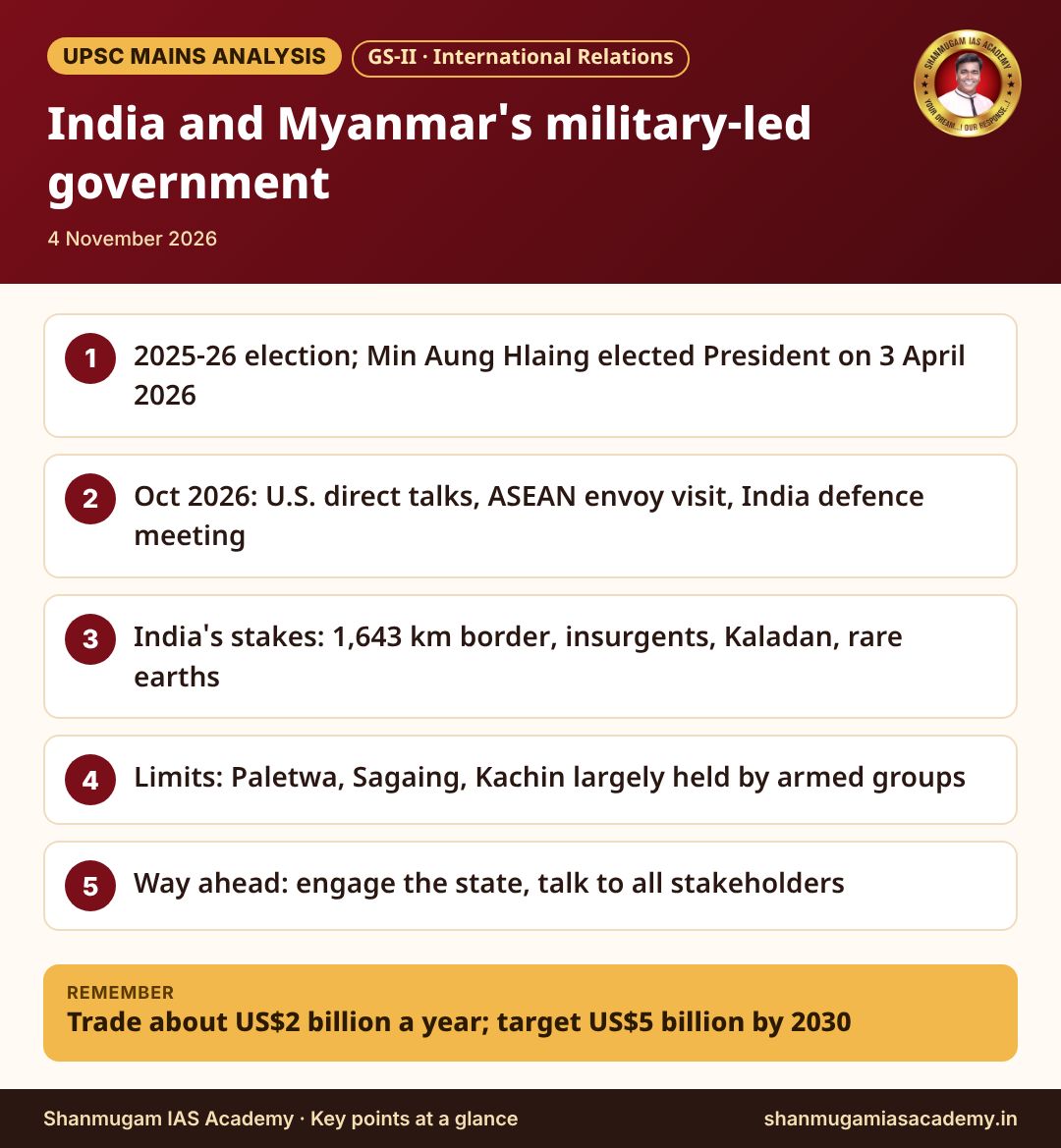
Five years after the coup of 1 February 2021, Myanmar's military has changed its uniform but not its hold on power. After a three-phase election (28 December 2025, 11 January and 25 January 2026) won by the military-backed Union Solidarity and Development Party (USDP), Parliament elected Min Aung Hlaing as President on 3 April 2026; days earlier he had handed over the post of Commander-in-Chief to Gen. Ye Win Oo. Many governments call the polls neither free nor inclusive – the National League for Democracy was dissolved and, because of the civil war, voting was held in only 263 of the country's 330 townships.
In the last few weeks, the world has moved closer to this new set-up. Reuters reported on 8 October 2026 that the United States had opened direct talks with Min Aung Hlaing, and on 2 November that a State Department strategy for Myanmar links peace diplomacy to access to rare earths. ASEAN's special envoy – Philippine Foreign Secretary Theresa Lazaro, representing the 2026 chair – began a humanitarian visit on 28 October. India, which never cut ties, held the third India–Myanmar Defence Cooperation Meeting in Guwahati on 7 October and signed MoUs for five Quick Impact Projects under Mekong–Ganga Cooperation in mid-October. The question for a UPSC aspirant: is India's engagement wise realism, and where are its limits?
Background: from coup to "civilian" president
| When | Development | Why it matters for India |
|---|---|---|
| Feb–Apr 2021 | Military coup; ASEAN agrees the Five-Point Consensus (April 2021), including an end to violence and dialogue | India chose to keep working with the regime while backing ASEAN's plan |
| Jan 2024 | Arakan Army captures Paletwa town in Chin State | Paletwa is the river-to-road point of the Kaladan project |
| Feb 2024 | India decides to fence the entire 1,643 km border and to scrap the Free Movement Regime (FMR) | Opposition from Mizoram and Nagaland; a pass-based regime within 10 km (earlier 16 km) followed |
| Mar 2025 | 7.7-magnitude earthquake (28 March); India launches Operation Brahma | India as first responder – goodwill with the state and people |
| Dec 2025–Apr 2026 | Three-phase election; USDP wins; Min Aung Hlaing elected President (3 April) and sworn in (10 April) | A "civilian" façade gives partners a reason to upgrade ties |
| 30 May–3 Jun 2026 | President's first official visit to India – talks with PM Modi on 1 June, a business conclave in New Delhi | Joint statement: Myanmar will not allow its territory to be used against India; push to finish Kaladan and the Trilateral Highway |
| 15–19 Jun 2026 | State visit to China; Xi Jinping calls for a "China–Myanmar community with a shared future" | China–Myanmar Economic Corridor (CMEC) remains Beijing's flagship |
| Oct 2026 | U.S. direct talks; ASEAN envoy visit; India–Myanmar defence meeting and QIP MoUs | Engagement is now the regional norm, not India's exception |
Core analysis: India's interests vs ground reality
| Interest | What India wants | Ground reality |
|---|---|---|
| Security | No sanctuary for Northeast insurgent groups; cooperation against cyber-scam compounds and drug trafficking | Many camps lie in Sagaing and border areas where the army's control is weak |
| Connectivity | Kaladan Multi-Modal Transit Transport Project (Kolkata–Sittwe by sea, Kaladan river to Paletwa, 109 km road to Mizoram) and the India–Myanmar–Thailand Trilateral Highway | Sittwe port opened in May 2023, but the Paletwa road is unfinished and Paletwa is held by the Arakan Army; highway work slowed by fighting |
| Critical minerals | Heavy rare earths (dysprosium, terbium) to reduce dependence on China | Main deposits are in Kachin State, in mines held by the Kachin Independence Army; ore goes to China for processing |
| Border and people | A secure border without cutting kinship ties of Chin, Mizo, Kuki and Naga communities | Nearly 29,000 Myanmar refugees registered in Mizoram (Mizoram government figures, 2026); fencing and FMR changes are locally unpopular |
| Economy | Trade target of US$5 billion by 2030 (agreed at the 9th Joint Trade Committee, January 2026) | Trade is about US$2 billion a year; border trade points at Moreh–Tamu and Zokhawthar–Rhi are disrupted |
| China factor | Avoid a strategic vacuum on India's eastern flank and in the Bay of Bengal | China is Myanmar's largest economic partner and the main buyer of its rare earths |
Why India engages: the logic of proximity
- Geography: Myanmar is the only ASEAN country that shares both a land and a maritime boundary with India, touching Arunachal Pradesh, Nagaland, Manipur and Mizoram. A neighbour cannot be "isolated" the way a distant country can.
- Stated doctrine: after the June 2026 talks, Foreign Secretary Vikram Misri argued that isolation has not brought democratic change and only leaves room for other powers; India supports a "Myanmar-led and Myanmar-owned" solution.
- Policy intersection: Myanmar sits where Neighbourhood First, Act East and MAHASAGAR meet – land route to Southeast Asia and a Bay of Bengal partner.
- Development footprint: India's assistance portfolio is about US$1.5 billion (MEA), from Sittwe port to community-level Quick Impact Projects – leverage that would be lost by walking away.
- Others are converging: the U.S., which shunned the regime, and ASEAN, which has kept its leader out of its summits, are now talking to Naypyitaw. India's line has become mainstream – but so has the competition.
Challenges
- Legitimacy gap: an election held in only part of the country, with the main opposition dissolved, does not end the civil war. Too close an embrace can hurt India's image as a democracy and with the Myanmar public.
- The state does not control the map: the territories India needs – Paletwa (Kaladan), Sagaing (highway, insurgent camps), Kachin (rare earths) – are wholly or partly held by armed groups. A deal with Naypyitaw alone cannot deliver.
- Humanitarian cost: air strikes continue (the UN Secretary-General condemned a 28 September 2026 strike near a market in Kyauktaw, Rakhine, in which about 50 people were reported killed); more than 3.5 million people are displaced inside Myanmar (UN).
- Northeast spill-over: refugee flows, arms and drug trafficking, and the Manipur conflict make border policy a domestic political issue; Mizoram and Nagaland oppose fencing and the end of free movement.
- Crowded field: China's economic depth and the new U.S. interest in rare earths mean India competes, not leads.
Way forward
- Engage the state, talk to all stakeholders: keep government-to-government channels for security and projects, while maintaining quiet working contacts with the Arakan Army, Chin groups and the KIA that control project and mineral areas.
- Make the border humane and secure: biometric border passes, more border haats and Integrated Check Posts, with the consent of Mizoram, Manipur and Nagaland, rather than a fence-only approach.
- Protect Kaladan with local buy-in: employment and benefit-sharing for Chin and Rakhine communities on the Paletwa road; review alternative road alignments if needed.
- Rare earths with responsibility: start with sampling, processing and recycling partnerships; insist on environmental and community safeguards, as unregulated Kachin mining has polluted rivers.
- Work through ASEAN and BIMSTEC: support the ASEAN chair's humanitarian track and use India's goodwill to press for an end to air strikes, release of political prisoners and an inclusive dialogue.
- People-first aid: more Quick Impact Projects, scholarships, health and disaster support that reach communities directly.
Mains practice question
Answer framework: Introduction – 2021 coup, 2025–26 election, President Min Aung Hlaing; October 2026 U.S./ASEAN/India engagement · Body – (a) why India engages: 1,643 km border, insurgents, Act East, China, Operation Brahma goodwill; (b) returns so far: June 2026 joint statement, defence meeting, QIPs, Sittwe port; (c) limits: Paletwa and Kaladan, Kachin rare earths, Sagaing, refugees in Mizoram, legitimacy gap; (d) the competition: China's CMEC, U.S. rare-earth interest · Way forward – multi-stakeholder approach, humane border, ASEAN track · Conclusion – faculty-view line.
Prelims pointers
- India–Myanmar land border: 1,643 km – Arunachal Pradesh, Nagaland, Manipur, Mizoram. Myanmar also shares a maritime boundary with India.
- Kaladan project: Kolkata – Sittwe port (sea) – Paletwa (Kaladan river) – Zorinpui, Mizoram (road). Sittwe port operational since May 2023.
- ASEAN Five-Point Consensus on Myanmar: April 2021. The Philippines chairs ASEAN in 2026.
- Operation Brahma: India's relief after the 28 March 2025 earthquake in Myanmar.
- Mekong–Ganga Cooperation (India + Cambodia, Laos, Myanmar, Thailand, Vietnam) funds Quick Impact Projects.
- Border trade points: Moreh (Manipur)–Tamu and Zokhawthar (Mizoram)–Rhi.
The concept to carry into the exam hall is "calibrated engagement" – working with whoever holds power in a neighbour, but adjusting the depth of that engagement to concrete results (security, projects, humanitarian access) and keeping channels open to other stakeholders. India's Myanmar policy has been strong on the first half and thin on the second. The October 2026 moves by the U.S. and ASEAN make it urgent: if everyone engages Naypyitaw, India's advantage will come from relationships the others do not have – with the border communities and ethnic groups next door.
- A shift to note: Myanmar's value is moving from "land bridge to ASEAN" to "rare-earth source" – geo-economics is now driving geopolitics. Write: "In Myanmar, minerals are the new connectivity."
- What to watch next: (1) whether ASEAN restores Myanmar's top-level seat at its summits, (2) the U.S. sanctions decision on Myanmar's leaders, (3) progress on the Paletwa road and any Kaladan arrangement with the Arakan Army, (4) the first India-bound rare-earth shipment from Kachin.
- Ready-made conclusion line: "Geography makes engagement with Myanmar compulsory; only inclusiveness can make it productive."
Sources: PMO / pmindia.gov.in – India–Myanmar Joint Statement (June 2026); MEA – India–Myanmar bilateral brief (July 2026); Ministry of Defence statement on the 3rd Defence Cooperation Meeting (as reported by Telangana Today and Indian Defence News); Embassy of India, Yangon and ANI on the Quick Impact Project MoUs; China MFA on the Xi–Min Aung Hlaing talks (16 June 2026); Reuters reports of 8 October and 2 November 2026 on U.S.–Myanmar talks; The Star, Moemaka and Myanmar Now on the ASEAN envoy's visit; The Star/AFP on the election and presidential vote; Tribune, Business Today and Sentinel on the border and FMR; Al Jazeera and Dawn on Paletwa; MINING.COM/Reuters on rare earths; UN/AP and Al Jazeera on the Kyauktaw air strike; Stimson Center; Organiser on Mizoram refugee figures. Original analysis by Shanmugam IAS Academy.
Link to this page from your website / blog (HTML code)
TNPSC Achievers
-
HAKKIM
TNPSC TNPSC
Today Current Affairs in Tamil | 04 நவம்பர் 2026 | TNPSC Group 4 முக்கிய வினாக்கள்
TNPSC குரூப் 1, 2/2A, 4 – நேரடி வகுப்புகள் · கோவை & மதுரை
2006 முதல் சண்முகம் IAS அகாடமி · Classroom & online coaching in Coimbatore and Madurai
