

3,300-year-old Egyptian scarab amulet found in Israel – spotted by a 17-year-old American student
4 November 2026 · English History, Art & Culture
⬇ Download this article as free PDF
Topics: History · 4 November 2026 Current Affairs (UPSC / TNPSC / SSC / RRB)
News
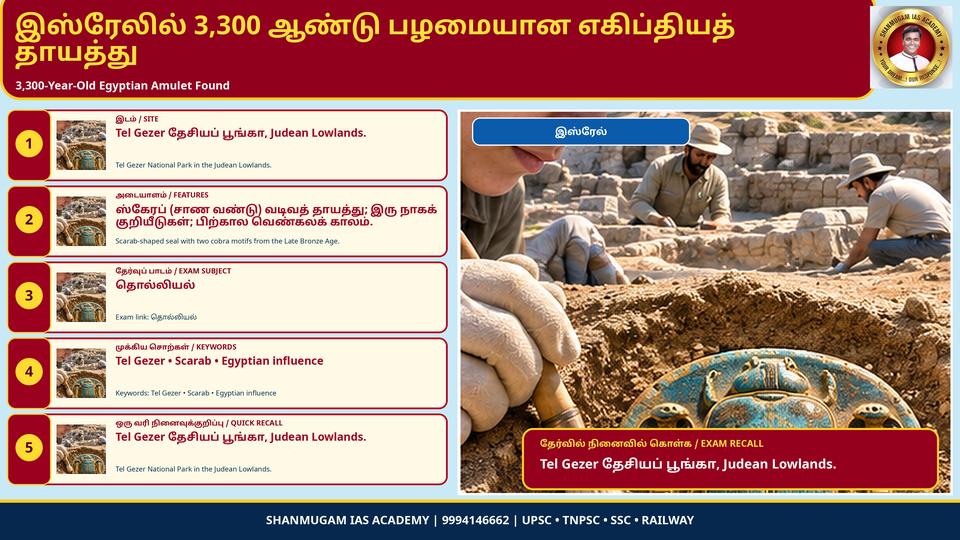
The Israel Antiquities Authority (IAA) announced on 3 Nov 2026 that Shiloh Attoun, a 17-year-old American student on a school trip to Tel Gezer National Park in the Judean Lowlands (Shephelah), found a small Egyptian-style scarab (dung-beetle-shaped) amulet lying on the ground. It shows two cobras (uraei) above the Egyptian hieroglyph 'nb' ('lord'). Prof. Ido Koch of Tel Aviv University dated it to the Late Bronze Age, about 3,300 years ago. It has joined Israel's National Treasures collection, and the student received a certificate of appreciation.
Key facts
| Announced | 3 Nov 2026 – Israel Antiquities Authority (IAA) |
| Site | Tel Gezer National Park, Judean Lowlands (Shephelah) |
| Finder | Shiloh Attoun (17), US student – JNF-USA Muss High School in Israel |
| Object | Scarab (dung-beetle-shaped) amulet/seal; two uraeus cobras over the 'nb' (lord) sign |
| Date | Late Bronze Age – about 3,300 years ago (Prof. Ido Koch, Tel Aviv Univ.) |
| Parallel | A similar scarab with three snakes was found earlier at Tel Megiddo |
Background
- History: the scarab copies the dung beetle, sacred to the ancient Egyptians as a symbol of creation and new life; scarabs were sometimes used as seals. The uraeus (cobra) was the Egyptian symbol of royalty and protection, worn on the Pharaoh's crown. Scarabs in Israel reflect Egypt's cultural influence during its periods of rule over the region (Canaan).
- Site: Gezer was one of the most important Canaanite cities, controlling a strategic crossroads in the Judean Lowlands; today it is Tel Gezer National Park. A 'tel' is a mound built up from layer upon layer of settlement over centuries.
- Script: Egyptian hieroglyphs were deciphered by Jean-François Champollion in 1822 with the help of the Rosetta Stone (found in 1799), which carries one decree in hieroglyphic, Demotic and Greek; the stone is in the British Museum, London.
- Indian link: the Indus (Harappan) civilisation also used seals in trade; most were made of soft steatite; the 'unicorn' is the commonest motif; the 'Pashupati' seal was found at Mohenjo-daro.
Tamil Nadu link: ancient Tamilakam traded with Egypt by sea. At Quseir al-Qadim, a Red Sea port of Egypt, an Indian storage jar of the 1st century BCE inscribed 'paanai oRi' in Tamil-Brahmi was found; epigraphist Iravatham Mahadevan read it (The Hindu, 21 Nov 2007). A Tamil-Brahmi pottery inscription was also found (1995) at Berenike, another Red Sea port.
Source: The Times of Israel, 3 Nov 2026; JNS (Cleveland Jewish News), 3 Nov 2026 (IAA announcement); The Hindu, 21 Nov 2007; Hindu Press International, 20 Feb 2008; harappa.com
Join our UPSC classroom or online batch: UPSC coaching in Coimbatore · Fees · Call 99941 46662.
Link to this page from your website / blog (HTML code)
BANK Achievers
-

PREETHA
BANK BANK
How Sea Surface Temperature Fuels Deadly Cyclones? Explained Mr V. GOKULA KRISHNAN SHANMUGAM ACADAMY
TNPSC குரூப் 1, 2/2A, 4 – நேரடி வகுப்புகள் · கோவை & மதுரை
2006 முதல் சண்முகம் IAS அகாடமி · Classroom & online coaching in Coimbatore and Madurai
