

Assam: government employees practising polygamy to be dismissed and barred from future government jobs
4 November 2026 · English Polity & Governance
⬇ Download this article as free PDF
Topics: Governance · 4 November 2026 Current Affairs (UPSC / TNPSC / SSC / RRB)
News
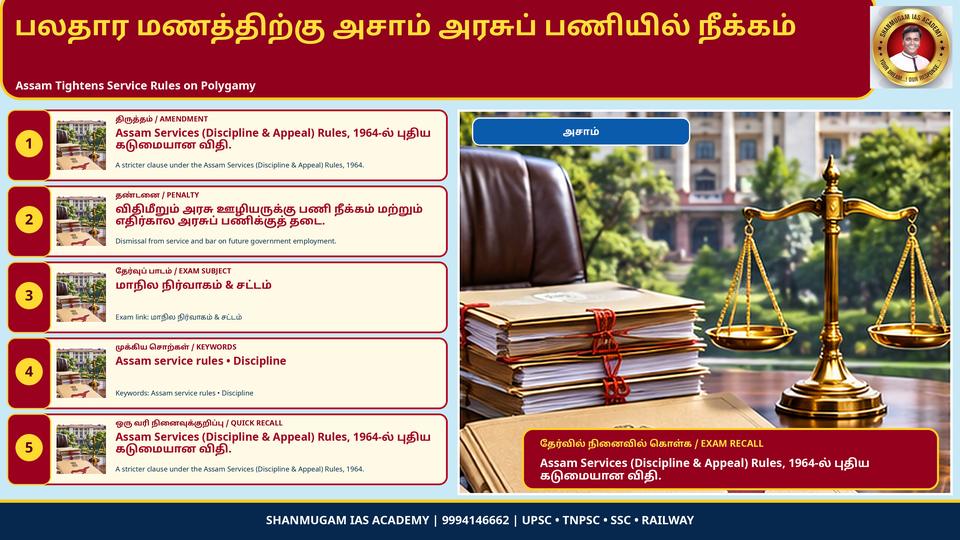
On 3 Nov 2026 (Tuesday), the Assam Cabinet chaired by Chief Minister Himanta Biswa Sarma decided to amend the 'Assam Services (Discipline and Appeal) Rules, 1964'. A government employee found guilty of polygamy in disciplinary proceedings will be dismissed from service and barred from future government jobs. Earlier, remarrying without prior permission while a spouse was alive attracted only action such as suspension. The CM said the rule applies to all religions and follows the State's Uniform Civil Code (UCC) push.
Key facts
| Decision | 3 Nov 2026 – Assam Cabinet; CM Himanta Biswa Sarma |
| Rules amended | Assam Services (Discipline and Appeal) Rules, 1964 – amended (Rule 7 – penalties) |
| Penalty | Dismissal (earlier suspension) + bar on future government jobs; only after guilt is proved in proceedings |
| Polygamy Bill | Assam Prohibition of Polygamy Bill, 2025 – passed Nov 2025; second marriage – up to 7 years, concealing earlier marriage – up to 10 years; not applicable to Sixth Schedule areas and tribal communities |
| Assam UCC | Assam Uniform Civil Code Bill, 2026 – passed 27 May 2026; third State after Uttarakhand and Gujarat; awaiting President's assent; Scheduled Tribes excluded |
| Same meeting | CBI probe recommended into the July 2026 floods in Sivasagar and Charaideo; Assam's first Defence Park at Nellie |
Background
- Constitution: Article 44 (Part IV – Directive Principles) – the State shall endeavour to secure a Uniform Civil Code for citizens throughout India; under Article 37 these are not enforceable by courts. Article 25 – freedom of conscience and religion, subject to public order, morality and health; it does not bar laws for social welfare and reform [25(2)(b)].
- Laws: Hindu Marriage Act, 1955 – Section 5(i) requires monogamy; Section 17 makes bigamy punishable (formerly IPC 494, 495 → now Section 82 of the Bharatiya Nyaya Sanhita). The Special Marriage Act, 1954 also requires monogamy. Muslim personal law (Shariat Application Act, 1937) permits up to four wives. For Central employees, Rule 21 of the CCS (Conduct) Rules, 1964 bars remarriage while a spouse is living without government permission.
- Judgments: Sarla Mudgal v. Union of India (1995) – converting to Islam to remarry does not dissolve the first Hindu marriage; it is still bigamy; the Supreme Court stressed the need for a UCC. Shah Bano (1985) – maintenance for a divorced Muslim woman; Shayara Bano (2017) – instant triple talaq struck down.
- State UCCs: Goa's Portuguese Civil Code (1867) continued after liberation. Uttarakhand was the first to enforce a UCC passed by its own legislature (27 Jan 2025); Gujarat and Assam later passed Bills. A committee was formed on 30 Oct 2026 to frame Assam's UCC rules.
Tamil Nadu link: to give legal validity to 'Self-Respect marriages' – held without a priest, before relatives and friends, by exchanging garlands/rings or tying the thali – Section 7-A was inserted into the Hindu Marriage Act, 1955 under CM C.N. Annadurai (decided 1967, law in 1968). The monogamy condition applies to these marriages too.
Source: India TV, Open Magazine, The NewsMill, 3–4 Nov 2026; DD News (27 Nov 2025); Free Press Journal (27 May 2026); News On AIR (Gujarat UCC, Mar 2026); Business Standard (Uttarakhand UCC); The News Minute (Section 7-A)
Join our UPSC classroom or online batch: UPSC coaching in Coimbatore · Fees · Call 99941 46662.
Link to this page from your website / blog (HTML code)
TNPSC Achievers
-

ANNAMALAI
TNPSC TNPSC
How Sea Surface Temperature Fuels Deadly Cyclones? Explained Mr V. GOKULA KRISHNAN SHANMUGAM ACADAMY
TNPSC குரூப் 1, 2/2A, 4 – நேரடி வகுப்புகள் · கோவை & மதுரை
2006 முதல் சண்முகம் IAS அகாடமி · Classroom & online coaching in Coimbatore and Madurai
