

Mains Analysis: Half of India's power capacity is now non-fossil – why the harder test is generation, storage and transmission, not megawatts
8 November 2026 · English Infrastructure & Energy
⬇ Download this analysis as free PDF
இந்தப் பகுப்பாய்வைத் தமிழில் படிக்க →
Topics: Energy · GS-III · UPSC Mains Analysis
UPSC Mains Analysis – current affairs of 8 November 2026 (Shanmugam IAS Academy)
Context
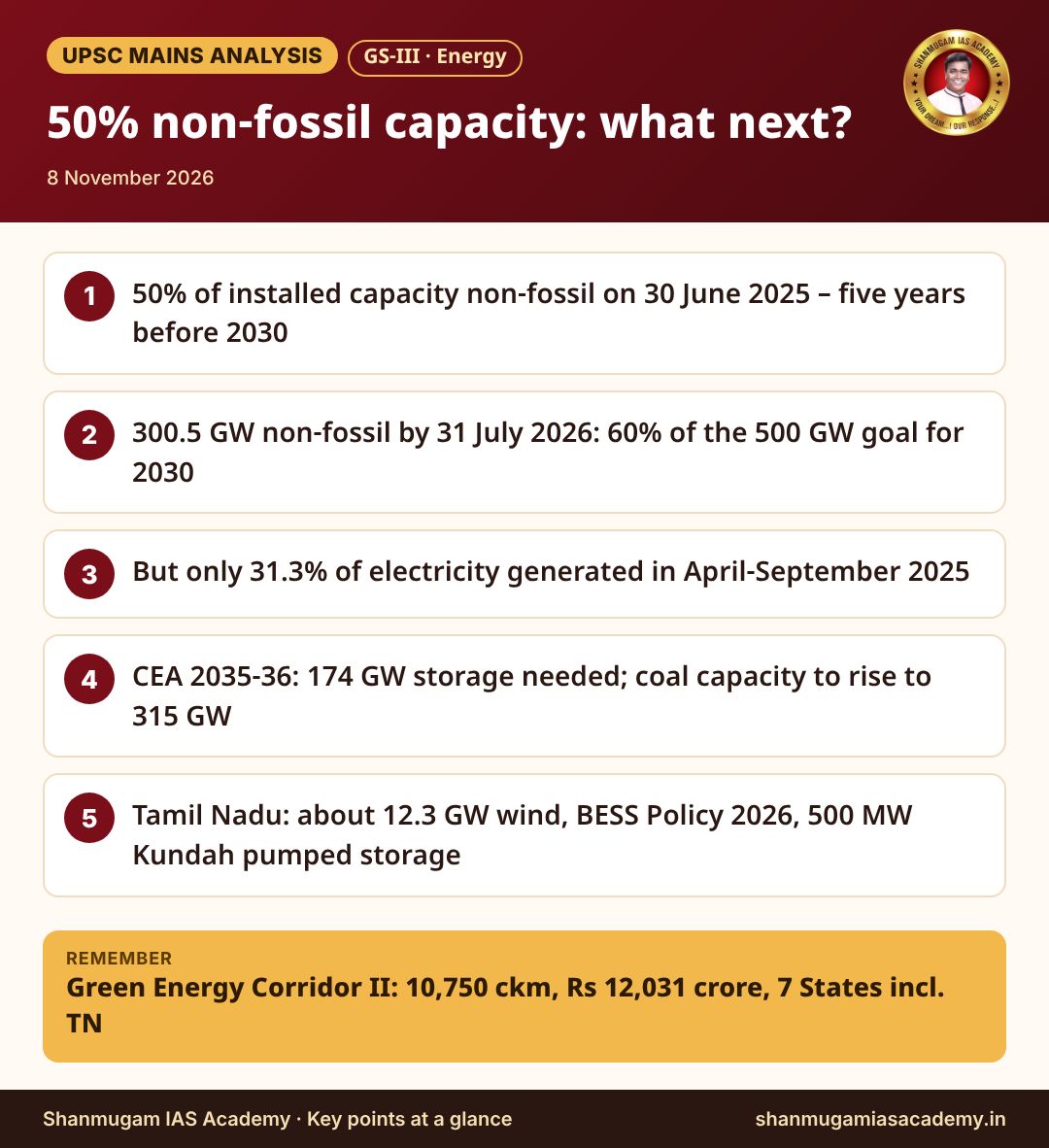
On 2 November 2026, inaugurating the Bharat Renewable Energy Summit and Expo at Bharat Mandapam, New Delhi (2–5 November, held alongside the 9th Assembly of the International Solar Alliance), the Prime Minister said that more than half of India's installed power capacity is now non-fossil – a 2030 commitment met in 2025, five years early. The milestone was first recorded on 30 June 2025, when renewables (about 184.6 GW), large hydro and nuclear together made up half of installed capacity. By 31 July 2026, MNRE data showed 300.5 GW of non-fossil capacity – over 54% of about 552 GW, and 60% of the 500 GW goal for 2030.
The question for an aspirant is not whether this is an achievement – it is – but what it measures. Capacity is what India can produce at full output; generation is what it actually produces. The two tell different stories.
Background: the target and the path
| Milestone | What it says |
|---|---|
| COP26, Glasgow (2021) | India announced 500 GW of non-fossil capacity by 2030 and net zero by 2070 |
| Updated NDC (August 2022) | About 50% of cumulative installed electric power capacity from non-fossil sources by 2030 |
| 30 June 2025 | 50% crossed; renewables about 184.6 GW (announced by MNRE, 14 July 2025) |
| 30 September 2025 | Total capacity crossed 500 GW (500.89 GW); non-fossil 256.09 GW, just over 51% |
| 31 July 2026 | Non-fossil 300.5 GW – solar 164.59 GW, wind 58.14 GW, hydro 57.24 GW, bio-power 11.75 GW, nuclear 8.78 GW |
| CEA plan (March 2026) | National Generation Adequacy Plan 2026-27 to 2035-36: 1,121 GW by 2035-36, about 70% (786 GW) non-fossil |
Core analysis: what the 50% means – and what it does not
| Question | What the 50% shows | What it does not show |
|---|---|---|
| Capacity | Half of the installed megawatts are non-fossil | How many hours those megawatts actually run |
| Generation | Clean output is rising fast | In April–September 2025, with over half the capacity, non-fossil sources gave only 31.3% of electricity (301.3 billion units) – CEA data |
| Timing | Solar meets the midday load | Evening peak demand still needs coal, hydro or storage |
| Emissions | New additions are mostly clean | Coal output crossed 1 billion tonnes in 2025-26 for the second year running |
| Next goal | 60% of the 500 GW goal is installed | About 200 GW more by 2030 – plus the grid and storage to use it |
Why the gap exists: a solar plant produces only in daylight and a wind farm mainly in the windy season, so each megawatt of solar or wind yields far fewer units in a year than a megawatt of coal or nuclear that can run day and night. Capacity share therefore always runs ahead of generation share. The gap is a feature of variable power, not a statistical trick – but it means a capacity target alone cannot measure decarbonisation.
Three tests after the milestone
1. Storage – shifting clean power to when it is needed. The CEA plan for 2035-36 needs about 174 GW of storage: 80 GW / 321 GWh of battery storage (BESS) and 94 GW / 567 GWh of pumped storage. Pumped hydro offers long duration and long life; batteries are quick to build and respond in seconds. Viability Gap Funding for BESS and State rules that make storage part of new solar projects are early steps; rooftop solar, now spreading under PM Surya Ghar, adds to the midday surplus that storage must shift.
2. Transmission – the wires decide. Solar and wind are strongest in Rajasthan, Gujarat, Tamil Nadu and Karnataka, while demand is spread across the country. CEA's 2022 plan for integrating over 500 GW of renewables by 2030 needs 50,890 circuit km of new transmission lines (including 8,120 ckm of HVDC) costing about Rs 2.44 lakh crore. Inside States, the Green Energy Corridors carry the load:
| Scheme | Scope | Status |
|---|---|---|
| GEC Phase I (intra-State) | 8 States incl. Tamil Nadu; 9,700 ckm, 22,600 MVA; about 24 GW; Rs 10,141.68 crore | Target 2022 missed due to land, right-of-way and supply issues; about 20 GW commissioned and works nearly complete (January 2026) |
| GEC Phase II (CCEA, 6 January 2022) | 7 States incl. Tamil Nadu; 10,750 ckm, 27,500 MVA; about 20 GW; Rs 12,031.33 crore with 33% central assistance | Planned for 2021-22 to 2025-26; reported to be now aimed at 2026-27 |
Lines take longer to build than solar parks. When generation is ready before evacuation, clean power is curtailed or plants wait idle – lost energy and lost investor confidence.
3. Coal – from baseload to backstop. On 30 June 2026 fossil plants were still 251.5 GW (45.82%) of capacity. The CEA plan raises coal capacity to 315 GW by 2035-36, and expects coal to supply roughly half of the electricity generated even then. The reason is reliability: India's peak demand rises every year, and until storage is large enough, coal covers the evening peak and the low-wind, cloudy days. The real shift is in role – coal plants must learn to run flexibly, ramping down at noon and up after sunset, instead of running flat.
Tamil Nadu angle
- Wind pioneer: about 12.3 GW of wind (MNRE data, mid-2026) – second only to Gujarat – and over 14 GW of solar. Many turbines in the Muppandal and Kayathar belts are old; repowering them with taller, larger machines can raise output from the same windy sites.
- Grid: Tamil Nadu is in both Green Energy Corridor phases; seasonal wind and midday solar both need evacuation and balancing.
- Storage: the TN BESS Policy 2026 aims at no less than 2.5 GW / 10 GWh of batteries and asks new solar plants of 1 MW and above to add storage of at least 10% of capacity (four-hour); the 500 MW Kundah pumped-storage project in the Nilgiris is under construction.
- Offshore wind: the Union Cabinet's Viability Gap Funding scheme (19 June 2024, total outlay Rs 7,453 crore) covers 1 GW – 500 MW off Gujarat and 500 MW off Tamil Nadu.
Challenges
- Measuring the wrong thing: targets in GW reward installation, not delivered clean units at the right time.
- Grid lag: transmission, substations and right of way move slower than solar construction.
- Storage cost and supply chains: battery cells are largely imported; pumped storage needs suitable sites and long approvals.
- Coal lock-in: plants built now will run for decades; without flexibility rules they crowd out cheaper clean power.
- Distribution and State finances: DISCOMs buy the power; delayed payments raise risk for every new project.
Way forward
- Add a generation and "firm" target: track the share of clean units generated and of clean power available at the evening peak, alongside GW installed.
- Build lines before parks: plan transmission corridors and pooling substations ahead of renewable zones; fast-track right of way.
- Storage at scale: use both batteries and pumped hydro, with long-term contracts and domestic cell manufacturing.
- Flexible coal: retrofit plants for lower minimum load and faster ramping; pay them for availability, not just energy.
- Repower and go offshore: a clear repowering framework for old wind sites in Tamil Nadu and Gujarat; complete the first offshore projects.
- Just transition: reskilling and new industries for coal regions as coal moves from baseload to backstop.
Mains practice question
Answer framework: Introduction – 50% reached on 30 June 2025, five years early; 300.5 GW by 31 July 2026; PM at the Bharat Renewable Energy Summit, 2 November 2026 · Body – (a) capacity vs generation: 31.3% of generation in April–September 2025, and why variable power yields fewer units; (b) storage: CEA need of 174 GW by 2035-36 (BESS + pumped storage); (c) transmission: CEA 50,890 ckm plan, GEC I and II and their delays; (d) coal's role: 315 GW by 2035-36, flexibility; (e) Tamil Nadu example: wind, BESS Policy 2026, Kundah, offshore · Way forward – generation and firm-power targets, lines before parks, flexible coal, just transition · Conclusion – faculty-view line.
Prelims pointers
- Non-fossil capacity = renewables (solar, wind, small hydro, bio-power) + large hydro + nuclear.
- 50% non-fossil share of installed capacity reached on 30 June 2025 (announced by MNRE on 14 July 2025).
- Total installed capacity crossed 500 GW on 30 September 2025 (500.89 GW).
- Green Energy Corridor Phase II: approved 6 January 2022; 7 States; 10,750 ckm; Rs 12,031.33 crore; 33% central financial assistance.
- Offshore wind VGF: total outlay Rs 7,453 crore for 1 GW (500 MW each off Gujarat and Tamil Nadu), approved 19 June 2024.
- CEA National Generation Adequacy Plan (2026-27 to 2035-36): 1,121 GW by 2035-36; storage 174 GW.
The concept to carry into the exam hall is "firm clean power" – clean electricity that is available whenever the grid needs it, not only when the sun shines or the wind blows. It is built by pairing solar and wind with storage, hydro, nuclear and strong transmission. The first phase of India's transition was measured in megawatts installed; the next will be measured in firm clean power delivered at the evening peak. Write it this way: "The 2030 test is not 500 GW, but how much of the evening peak clean power can serve."
- A shift to note: the debate is moving from capacity targets to integration – storage, transmission and the flexible use of coal. An answer that quotes both the capacity share and the generation share will stand out.
- What to watch next: (1) completion of Green Energy Corridor Phase II and the approval of the next phase, (2) whether the non-fossil share of generation keeps rising each year, (3) the first tenders and projects under the TN BESS Policy 2026 and the commissioning of Kundah pumped storage, (4) progress on India's first offshore wind projects off Tamil Nadu and Gujarat.
- Ready-made conclusion line: "India has won the race to install clean megawatts; the next race is to make them firm – and that will be won on the grid, not on the solar farm."
Sources: PIB/MNRE statement of 14 July 2025 as reported by Down To Earth and Deccan Herald; Ministry of Power data (30 September 2025) as reported by Enerdata and Infrastructure Today; MNRE data for 31 July 2026 as reported by Mercom, Renewable Watch and IANS; CEA generation data for April–September 2025 as reported by KNN India and CarbonCopy; Rajya Sabha reply of 20 July 2026 (PSU Watch) and Power Peak Digest on June 2026 capacity; Ministry of Coal via ANI (Open) and IANS on coal output; CEA National Generation Adequacy Plan as reported by Down To Earth, Millennium Post and SolarQuarter; CEA transmission plan (December 2022) as reported by Down To Earth and Renewable Watch; PIB (6 January 2022), Down To Earth, Saur Energy and Outlook Business on Green Energy Corridors; PTI (Siasat) and Republic on the 2 November 2026 summit; MNRE data via WindInsider and Renewable Watch, Construction World, DT Next and Down To Earth on Tamil Nadu; PTI (The Week) on the offshore wind VGF. Original analysis by Shanmugam IAS Academy.
Link to this page from your website / blog (HTML code)
BANK Achievers
-

Kousik
BANKING BANKING
வாஞ்சிநாதன் | Vanchinathan | Maniyachi Incident 1911 | TNPSC Group 1, 2, 2A, 4 | NITHISH KUMAR
TNPSC குரூப் 1, 2/2A, 4 – நேரடி வகுப்புகள் · கோவை & மதுரை
2006 முதல் சண்முகம் IAS அகாடமி · Classroom & online coaching in Coimbatore and Madurai
