

Mains Analysis: The 2026 US midterms – what a Democratic-majority Congress means for India–US trade, technology, defence, H-1B visas and the Quad
8 November 2026 · English International
⬇ Download this analysis as free PDF
இந்தப் பகுப்பாய்வைத் தமிழில் படிக்க →
Topics: International Relations · GS-II · UPSC Mains Analysis
UPSC Mains Analysis – current affairs of 8 November 2026 (Shanmugam IAS Academy)
Context
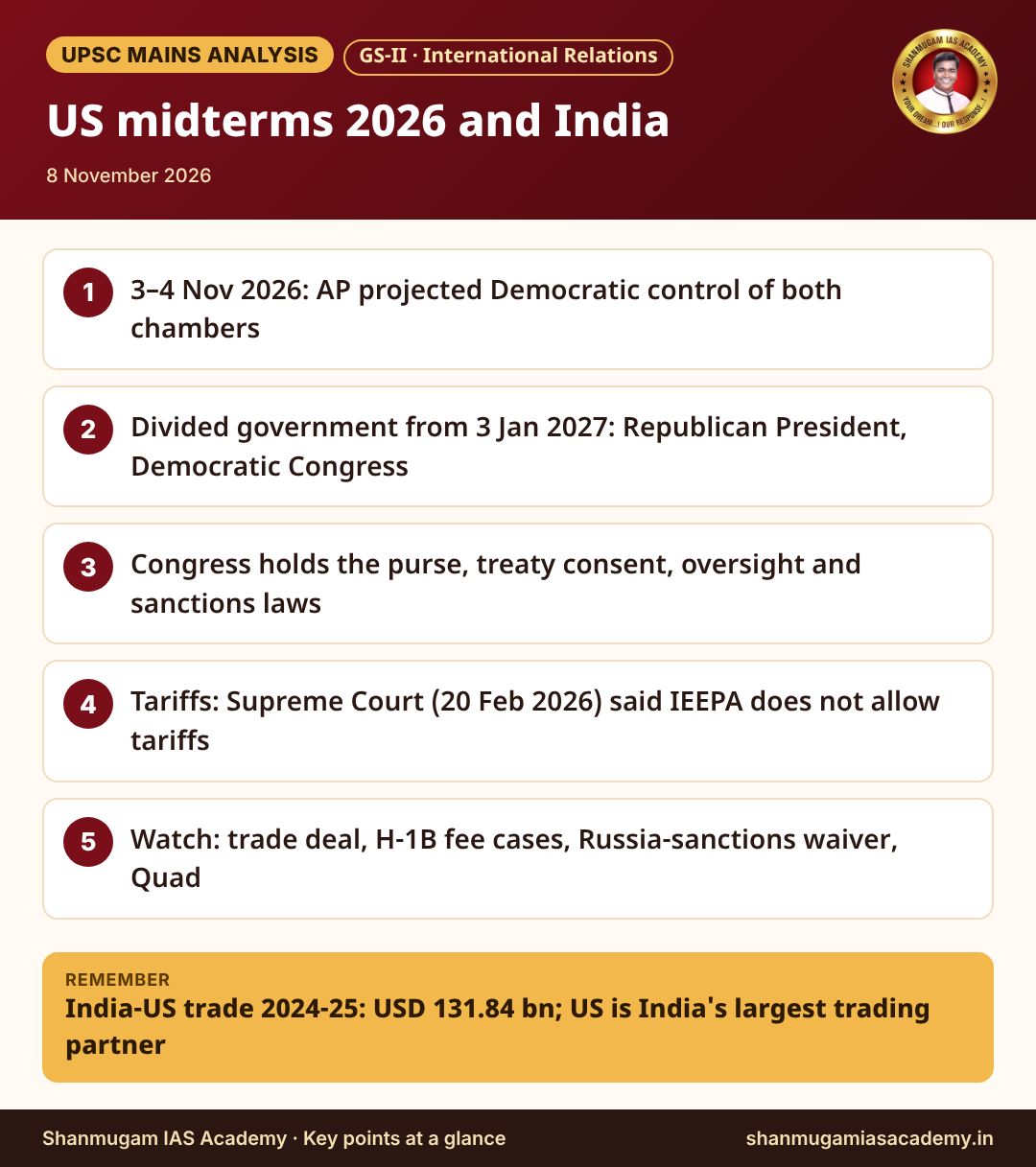
The United States held its midterm elections on 3 November 2026: all 435 seats of the House of Representatives and 35 of the 100 Senate seats were contested. Before the vote, Republicans held both chambers (53–47 in the Senate, counting the two independents who caucus with Democrats). The Associated Press (AP) called the Senate for the Democrats late on 3 November (US time), after Democrats flipped seven Republican-held seats – South Carolina, North Carolina, Texas, Ohio, Kansas, Maine and Iowa. AP and other networks also projected Democratic control of the House on 4 November. In short, AP projected Democratic control of both chambers; some individual races were still being counted when this article was written (6 November), so final seat totals are not given here.
When the new (120th) Congress meets on 3 January 2027, the US will have divided government: a Republican President, Donald Trump, and a Congress led by the other party. For India the question is practical, not partisan: which parts of the relationship does Congress actually control, and what may change?
Background: how Congress constrains a US President
| Tool | Where it comes from | Why it matters for India |
|---|---|---|
| Power of the purse | Article I: Congress lays taxes and duties and passes all appropriations | Tariffs are a tax power. On 20 February 2026 the US Supreme Court held in Learning Resources, Inc. v. Trump that IEEPA, an emergency law, does not authorise the President to impose tariffs |
| Treaties and trade deals | Article II: treaties need consent of two-thirds of the Senate; trade law changes need Congress | The India–US civil nuclear agreement needed an Act of Congress (2008). Fast-track Trade Promotion Authority lapsed in July 2021, so a deal that changes US law goes back to Congress |
| Oversight | Committee hearings, subpoenas, reports | Hearings on tariffs, visas, arms sales and China policy shape the agenda the executive negotiates with India |
| Sanctions laws | Statutes such as CAATSA (2017) and the Sanctioning Russia and Iran Act of 2026 | They bind the President but usually allow waivers – and Congress can scrutinise how those waivers are used |
| Arms sales | Arms Export Control Act: major sales are notified to Congress, which can try to block them by joint resolution | Big-ticket deals with India (aircraft, drones, engines) pass through this review |
Core analysis: what a changed Congress means, area by area
| Area | Where things stand (as of 6 November 2026) | What Congress can do |
|---|---|---|
| Trade and tariffs | After the Supreme Court ruling, a temporary global surcharge under Section 122 (Trade Act of 1974) ran from 24 February 2026 and expired on 24 July 2026 at the end of its 150-day legal limit, because Congress did not extend it. In July 2026, after a forced-labour investigation, USTR imposed a 10% Section 301 tariff on Indian goods (initially proposed at 12.5%); Section 232 goods such as steel and auto parts are outside it. India and the US announced a framework for an interim trade agreement in February 2026 | Hold hearings; refuse or grant extensions of time-limited tariffs; approve or reject any trade agreement that needs a change in US law. It cannot easily cancel tariffs the executive imposes under existing statutes such as Section 301 or 232 |
| Technology and defence | 10-year "Framework for the US-India Major Defence Partnership" signed in Kuala Lumpur on 31 October 2025; India has been a Major Defence Partner since 2016 | Review arms sales; fund co-development through the annual defence budget law (NDAA); support has been bipartisan, which gives continuity |
| H-1B and immigration | A September 2025 proclamation set a $100,000 payment on certain new H-1B petitions; a proclamation of 18 September 2026 extended it to 21 September 2027. Federal courts have ruled against the fee and the litigation was continuing in early November 2026. Indians have received over 70% of approved H-1B petitions in recent years | Only Congress can change the annual statutory cap (65,000 plus 20,000 for US advanced-degree holders) or write fees into law; it can also question rules through hearings |
| Russia sanctions | The 25% extra tariff linked to India's Russian-oil purchases was removed in February 2026. The Sanctioning Russia and Iran Act, signed in September 2026, allows tariffs of up to 100% on countries that buy Russian oil; in mid-October 2026 the President waived most of these sanctions and tariffs | Congress can review the waiver through hearings and oversight, and the President can withdraw it – a Congress led by the other party may question it more closely |
| Quad and Indo-Pacific | The 11th Quad Foreign Ministers' Meeting was held in New Delhi on 26 May 2026 and launched the Indo-Pacific Maritime Surveillance Collaboration (IPMSC), along with initiatives on critical minerals and energy security | Fund Indo-Pacific programmes and maritime-domain awareness; Indo-Pacific strategy has had support in both parties |
Why it matters for India
- The US system is plural: foreign policy is made by the White House, but laws, money and approvals come from Congress. A changed Congress adds more voices – and more veto points – to India–US decisions.
- Trade is now more "institutional": the Supreme Court has ruled that the emergency law IEEPA does not authorise tariffs – tariffs need authority given by Congress – and the Section 122 surcharge ended when Congress did not act. Any lasting tariff relief for India will need either executive action under existing laws or a deal that Congress can accept.
- Sanctions remain a risk for strategic autonomy: CAATSA (over the S-400 purchase) and the 2026 Russia sanctions law both depend on presidential waivers. More oversight of waivers makes India's energy and defence choices a subject of congressional debate.
- People-to-people ties: students, H-1B professionals and the Indian-American community link the two societies; the visa cap and any lasting fee are matters of US law.
Challenges
- Gridlock: divided government often slows legislation; a trade deal or visa reform may wait.
- More executive action: when laws are hard to pass, Presidents tend to use proclamations and existing statutes – which then face court challenges, as with the H-1B fee and IEEPA tariffs. This creates uncertainty for Indian exporters and workers.
- Two calendars: the US presidential election of 2028 will shape positions in Congress from 2027, so long negotiations can be overtaken by politics.
- Issue-linkage: trade, Russian oil, visas and defence are discussed separately in India but may be linked in US debates.
Way forward
- Engage both branches: regular contact with committee leaders in both parties, the Senate and House India Caucuses, and staff – not only the executive.
- Close a durable trade agreement: aim for a text that can survive changes in the executive and, where needed, approval in Congress.
- Protect the defence pipeline: keep projects under the 2025 framework on schedule, so that they are seen as joint industrial assets in congressional districts.
- Reduce sanctions exposure: diversify crude sources and defence suppliers in a planned way, so that waivers are less often needed.
- Use the Quad's practical agenda: maritime surveillance, critical minerals and energy security give Congress concrete programmes to fund.
- Diaspora and talent: argue the case for skilled migration with data on innovation and jobs created in the US.
Mains practice question
Answer framework: Introduction – 3 November 2026 midterms; AP projected Democratic control of both chambers; divided government from 3 January 2027 · Body – (a) constitutional tools: purse, treaties (two-thirds Senate), oversight, sanctions laws, arms-sale review; (b) India areas: tariffs (Supreme Court 20 Feb 2026, Section 122 expiry, 10% Section 301), defence framework 2025, H-1B cap and fee, CAATSA and the 2026 Russia law, Quad; (c) limits of Congress: executive action under existing laws · Way forward – two-branch engagement, durable trade deal, diversification · Conclusion – faculty-view line.
Prelims pointers
- US House: 435 members, two-year term; Senate: 100 members, six-year term, about one-third elected every two years.
- Midterm elections: held midway through a presidential term; the new Congress meets on 3 January (20th Amendment).
- Treaties need the advice and consent of two-thirds of the Senate (Article II, Section 2).
- CAATSA: Countering America's Adversaries Through Sanctions Act, 2017; Section 231 covers transactions with Russia's defence sector.
- Learning Resources, Inc. v. Trump (20 February 2026): IEEPA does not authorise tariffs.
- H-1B annual cap: 65,000 plus 20,000 for holders of US advanced degrees.
The concept to carry into the exam hall is "divided government" – when the President belongs to one party and at least one chamber of Congress is controlled by the other. It does not stop foreign policy, but it raises the cost of change: laws are harder to pass, executive orders are watched more closely and every waiver becomes a debate. For India this means that a promise from the White House is strongest when Congress can also support it.
- A shift to note: the India–US debate is moving from "Who is President?" to "Which branch decides?". Write: "In a system of checks and balances, durable partnerships are built with institutions, not only with leaders."
- What to watch next: (1) final seat totals in both chambers once all races are called, (2) the progress and legal form of the India–US trade agreement, (3) court rulings and any legislation on the H-1B fee, (4) whether the Russia-sanctions waiver stays in place, and any congressional review of it.
- Ready-made conclusion line: "Elections in Washington change the route, not the destination, of India–US partnership – if India engages both ends of Pennsylvania Avenue."
Sources: Associated Press calls as reported by Al Jazeera and TIME (4 November 2026); CBS News and Northeastern University News on projections and flipped seats; Euronews; US Constitution (Articles I and II, 20th Amendment); Jones Day and Global Trade Alert on the Supreme Court ruling and Section 122; Z2Data on the Section 122 expiry; Business Standard and DT Next (PTI) on the 10% Section 301 duty; India Briefing on the February 2026 framework; Outlook India and Outlook Business, Deccan Chronicle and UNI on the Sanctioning Russia and Iran Act and its waiver; SHRM and Mintz on the H-1B fee; National Herald on H-1B shares; US State Department and ThePrint on the Quad; Outlook and Tribune on the 2025 defence framework; DT Next (PTI) on 2024-25 trade data. Original analysis by Shanmugam IAS Academy.
Link to this page from your website / blog (HTML code)
BANK Achievers
-

R. RAMYA
BANK BANK
வாஞ்சிநாதன் | Vanchinathan | Maniyachi Incident 1911 | TNPSC Group 1, 2, 2A, 4 | NITHISH KUMAR
TNPSC குரூப் 1, 2/2A, 4 – நேரடி வகுப்புகள் · கோவை & மதுரை
2006 முதல் சண்முகம் IAS அகாடமி · Classroom & online coaching in Coimbatore and Madurai
