

'Vetri Veedu Thittam': ₹3,500 crore for 70,000 rural houses in phase 1
9 November 2026 · English
⬇ Download this article as free PDF
Topics: Tamil Nadu Government Schemes · UPSC Prelims · TNPSC · SSC · Current Affairs
Current affairs of 9 November 2026 (Shanmugam IAS Academy) – explained for UPSC, TNPSC and other competitive exams
News
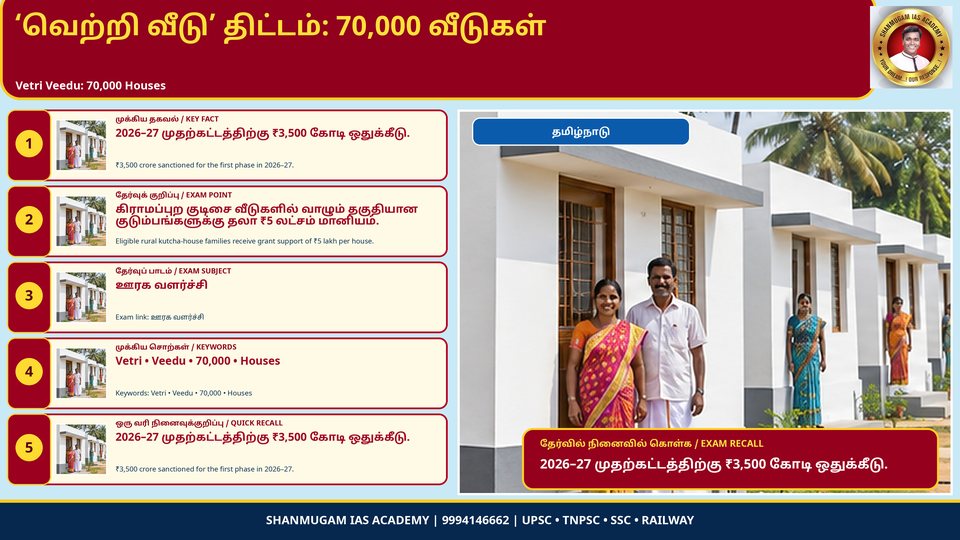
As the first phase of the 'Vetri Veedu Thittam', which gives permanent concrete houses to poor rural families living in huts, the Tamil Nadu Government issued a G.O. sanctioning ₹3,500 crore for 70,000 houses in 2026-27 (reported on 6 November 2026). The order was issued by Dharmendra Pratap Yadav, Principal Secretary, Rural Development and Panchayat Raj Department. Each house gets ₹5 lakh, paid into the beneficiary's bank account in four instalments; it must be 360–500 sq ft with a kitchen and a concrete roof. Of the ₹3,500 crore, ₹2,600 crore is State funds and ₹900 crore comes from State Finance Commission grants to village panchayats. People living in huts, mud-walled houses or houses with unsafe roofs get priority; beneficiaries are chosen through a door-to-door survey on a mobile app, with lists displayed at panchayat offices. Households without toilets get ₹12,000 under Swachh Bharat Mission (Gramin), and bank loans carry a 3% interest subsidy. Announced by Finance Minister N. Marie Wilson in the 2026-27 State Budget (5 August 2026), the scheme is the first phase of the 'Vetri Thamizhagam' goal of 5 lakh rural houses.
Key facts for the exam
| Point | Details |
|---|---|
| Scheme | Vetri Veedu Thittam (State scheme) |
| Announced | TN Budget 2026-27, 5 Aug 2026 |
| Phase 1 | 70,000 houses (2026-27) |
| Outlay | ₹3,500 cr (State ₹2,600 cr + SFC grants ₹900 cr) |
| Per house | ₹5 lakh in 4 instalments |
| Size | 360–500 sq ft; kitchen, RCC roof |
| Quotas | SC/ST 40%; PwD 5%; Collector's discretionary 5% |
| Excluded | Income above ₹2.5 lakh a year; earlier govt-housing beneficiaries |
| Department | Rural Development & Panchayat Raj |
| Scheme period | 2026-27 to 2030-31 |
Background
- Central scheme history: 'Indira Awaas Yojana', begun in 1985-86 as a sub-scheme of the Rural Landless Employment Guarantee Programme (RLEGP), became an independent scheme in 1996. In 2016 it was restructured as 'Pradhan Mantri Awaas Yojana–Gramin' (PMAY-G): ₹1.20 lakh assistance in the plains and ₹1.30 lakh in hilly/difficult areas, a minimum area of 25 sq m, and a 60:40 Centre–State share.
- Constitution: the Eleventh Schedule, added by the 73rd Amendment (1992), lists 29 subjects for Panchayats; entry 10 is 'rural housing'. Under Article 243-I, the Governor constitutes a State Finance Commission every five years to review panchayat finances and recommend their share of State revenue. The scheme's ₹900 crore comes from these grants.
- Earlier TN schemes: 'Kalaignar Kanavu Illam', launched in 2024, aimed at 8 lakh concrete houses by 2030 for a 'hut-free Tamil Nadu' (1 lakh houses in each of the first two years). Before that, schemes such as the 'Chief Minister's Solar Powered Green House Scheme' ran. Reports on the G.O. do not say whether Vetri Veedu formally replaces them, but Budget reports say the unit assistance was raised from ₹3.10 lakh to ₹5 lakh.
- Socio-economics: Swachh Bharat Mission (Gramin) was launched on 2 October 2014 and gives ₹12,000 for an individual household toilet. For extra funds, beneficiaries can get a community-investment loan of up to ₹50,000 at 6% through the Tamil Nadu State Rural Livelihoods Mission (the State arm of DAY-NRLM). A permanent house improves safety for women and children, health and disaster resilience.
What is this news about?
As the first phase of the 'Vetri Veedu Thittam', which gives permanent concrete houses to poor rural families living in huts, the Tamil Nadu Government issued a G.O. sanctioning ₹3,500 crore for 70,000 houses in 2026-27 (reported on 6 November 2026).
What are the key facts to remember for the exam?
Scheme: Vetri Veedu Thittam (State scheme); Announced: TN Budget 2026-27, 5 Aug 2026; Phase 1: 70,000 houses (2026-27); Outlay: ₹3,500 cr (State ₹2,600 cr + SFC grants ₹900 cr).
What is the background to this news?
Central scheme history: 'Indira Awaas Yojana', begun in 1985-86 as a sub-scheme of the Rural Landless Employment Guarantee Programme (RLEGP), became an independent scheme in 1996.
Practise more: Weekly current affairs · Daily subject quiz · Knowledge nugget
Sources: Daily Thanthi; DT Next; DT Next (Budget); LiveChennai; DT Next (KKI); PMAY-G. Compiled by Shanmugam IAS Academy.
Link to this page from your website / blog (HTML code)
BANK Achievers
-

REVATHI
BANKING BANKING
Indian Polity in Tamil | 100 அரசியலமைப்பு வினா விடை | TNPSC Group 4 Preparation 2026
TNPSC குரூப் 1, 2/2A, 4 – நேரடி வகுப்புகள் · கோவை & மதுரை
2006 முதல் சண்முகம் IAS அகாடமி · Classroom & online coaching in Coimbatore and Madurai
