

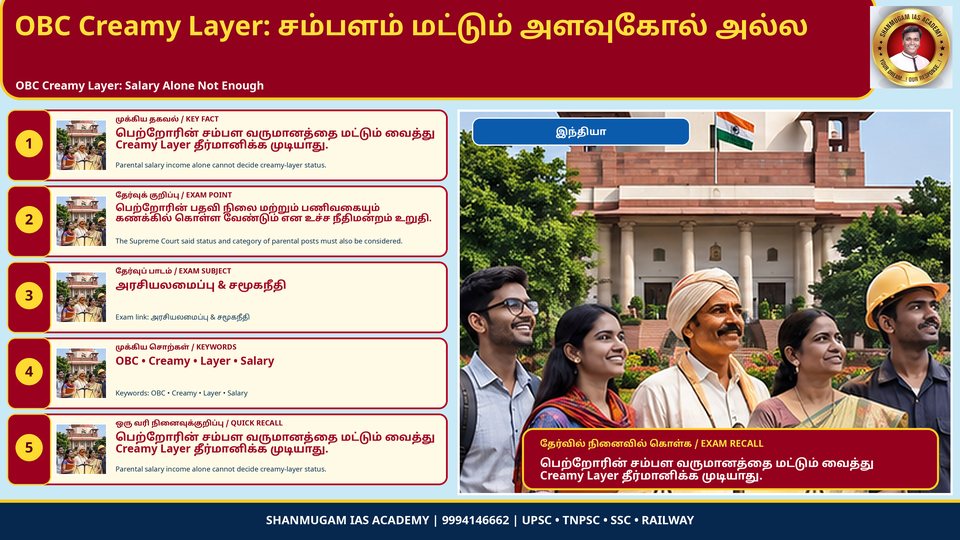
SC: parents' salary alone can't decide OBC creamy layer
9 November 2026 · English Polity & Governance
⬇ Download this article as free PDF
Topics: Polity & Judiciary · UPSC Prelims · TNPSC · SSC · Current Affairs
Current affairs of 9 November 2026 (Shanmugam IAS Academy) – explained for UPSC, TNPSC and other competitive exams
News
On 6 November 2026 the Supreme Court reaffirmed its 11 March 2026 verdict that OBC 'creamy layer' status cannot be decided on parents' salary income alone. A bench of Justices P.S. Narasimha and R. Mahadevan (Union of India v. Rohith Nathan) rejected the Centre's plea under Article 142 to apply the verdict only prospectively, finding 'no convincing or reasonable justification'. It held that the UPSC civil services candidates concerned are non-creamy layer and entitled to consequential allotment, without reducing others' seniority or reopening concluded selections. The six-month deadline to implement the verdict was extended by two months. In March the Court had held that the status and category of the parent's post (1993 Office Memorandum) is the primary test and that a 2004 clarificatory letter cannot override the parent policy. Excluding children of PSU, bank or private employees on salary alone, while children of Group C and D government staff with similar income are not excluded, was held to be hostile discrimination under Articles 14 and 16. The Madras, Delhi and Keralam High Courts and the Central Administrative Tribunal had earlier ruled in favour of the candidates.
Key facts for the exam
| Point | Details |
|---|---|
| Case | Union of India v. Rohith Nathan |
| Bench | Justices P.S. Narasimha and R. Mahadevan |
| Main verdict | 11 March 2026 (authored by Justice Mahadevan) |
| Latest order | 6 Nov 2026 – prospective plea rejected; deadline +2 months |
| Test | Status and category of parent's post (1993 OM) |
| Articles | 14 and 16 – hostile discrimination |
| Income limit | ₹8 lakh (since 2017); salary and farm income excluded |
| OBC quota | 27% in central posts |
Background
- History: The First Backward Classes Commission was headed by Kaka Kalelkar (1953). The Second, set up in 1979 by the Morarji Desai government and headed by B.P. Mandal, recommended 27% OBC reservation in 1980; the V.P. Singh government implemented it in 1990.
- Judiciary: Indra Sawhney v. Union of India (1992, nine judges – the 'Mandal case') upheld 27% reservation, required exclusion of the advanced 'creamy layer' among OBCs and held that total reservation should normally not exceed 50%. The Office Memorandum of 8 September 1993 followed, based on the Justice R.N. Prasad expert committee. Income limit: ₹1 lakh (1993) → ₹2.5 lakh (2004) → ₹4.5 lakh (2008) → ₹6 lakh (2013) → ₹8 lakh (2017).
- Constitution: Article 15(4) – special provisions for socially and educationally backward classes (First Amendment, 1951); Article 16(4) – reservation in posts for backward classes not adequately represented. The 102nd Amendment (2018) gave the National Commission for Backward Classes constitutional status under Article 338B; the 105th Amendment (2021) restored States' power to prepare their own backward class lists.
- Economy and society: The creamy-layer rule aims to ensure that reservation benefits reach the genuinely backward among OBCs. The dispute stems from the incomplete fixing of 'equivalence' between PSU/private posts and government posts; the Court declined to set a timeline, saying this lies in the executive and legislative domain.
What is this news about?
On 6 November 2026 the Supreme Court reaffirmed its 11 March 2026 verdict that OBC 'creamy layer' status cannot be decided on parents' salary income alone. A bench of Justices P.S. Narasimha and R. Mahadevan (Union of India v. Rohith Nathan) rejected the Centre's plea under Article 142 to apply the verdict only prospectively, finding 'no convincing or reasonable justification'.
What are the key facts to remember for the exam?
Case: Union of India v. Rohith Nathan; Bench: Justices P.S. Narasimha and R. Mahadevan; Main verdict: 11 March 2026 (authored by Justice Mahadevan); Latest order: 6 Nov 2026 – prospective plea rejected; deadline +2 months.
What is the background to this news?
History: The First Backward Classes Commission was headed by Kaka Kalelkar (1953). The Second, set up in 1979 by the Morarji Desai government and headed by B.P. Mandal, recommended 27% OBC reservation in 1980; the V.P. Singh government implemented it in 1990.
Practise more: Weekly current affairs · Daily subject quiz · Knowledge nugget
Sources: ThePrint (PTI, 6.11.2026); LiveLaw; Business Standard; DT Next (PTI). Compiled by Shanmugam IAS Academy.
Link to this page from your website / blog (HTML code)
BANK Achievers
-

SURYA
BANK BANK
Indian Polity in Tamil | 100 அரசியலமைப்பு வினா விடை | TNPSC Group 4 Preparation 2026
TNPSC குரூப் 1, 2/2A, 4 – நேரடி வகுப்புகள் · கோவை & மதுரை
2006 முதல் சண்முகம் IAS அகாடமி · Classroom & online coaching in Coimbatore and Madurai
