Topics: Economy & Energy · UPSC Prelims · TNPSC · SSC · Current Affairs
Current affairs of 9 November 2026 (Shanmugam IAS Academy) – explained for UPSC, TNPSC and other competitive exams
News
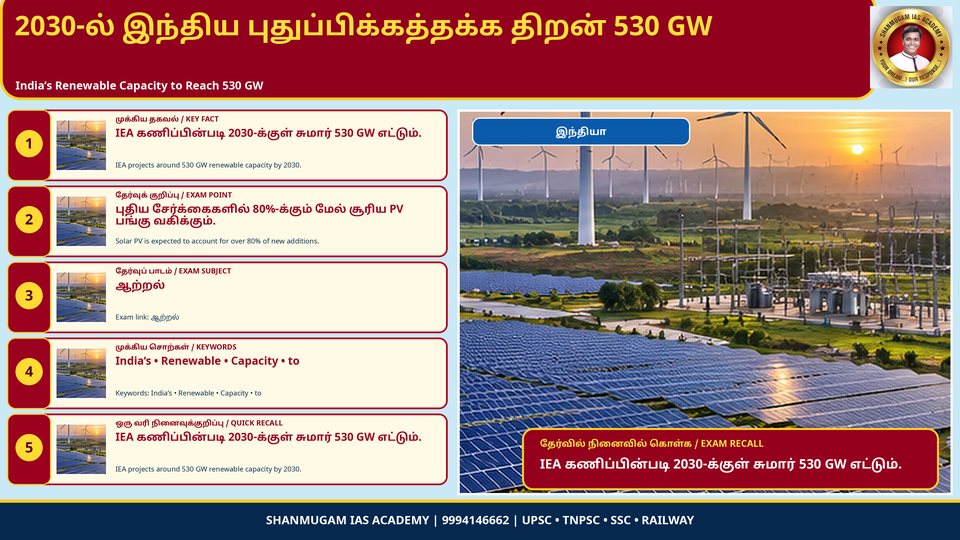
The International Energy Agency (IEA) released its 'India Renewable Energy Market Report 2026' on 5 November 2026 at the Bharat Renewable Energy Summit in New Delhi. It projects India's renewable power capacity to rise to about 530 GW by 2030. Solar PV accounts for more than 80% of this growth; by 2030 solar will exceed 350 GW, wind will approach 90 GW and hydropower about 75 GW. India's renewable capacity crossed 300 GW in 2026, roughly quadrupling over the past decade. The report says renewables saved India over $100 billion in coal and gas import costs during 2011–2025. India met its goal of 50% of installed power capacity from non-fossil sources in 2025, five years ahead of schedule. The IEA describes India as the world's second-largest growth market for renewables (some reports: 'second-fastest-growing').
Key facts for the exam
Point
Details
Report
India Renewable Energy Market Report 2026
Released by
International Energy Agency (IEA), 5 Nov 2026, New Delhi
2030 projection
About 530 GW renewable capacity
Solar PV
Over 350 GW by 2030; 80%+ of growth
Wind / Hydro
About 90 GW / about 75 GW (2030)
Current status
Crossed 300 GW in 2026
Import savings
Over $100 billion in 2011–25
50% non-fossil capacity
Achieved 2025 (target was 2030)
IEA
Founded 1974 within OECD framework; HQ Paris; Executive Director Fatih Birol
Background
History: After the 1973 oil crisis caused by the Arab oil embargo during the Arab–Israeli war, the IEA was created in November 1974 within the OECD framework to safeguard oil supplies. Today it also studies the clean-energy transition. Its flagship annual publication is the World Energy Outlook.
India–IEA: India has been an IEA 'Association country' since March 2017; full membership requires OECD membership, so India is not yet a full member (talks on full membership are under way). The IEA is headquartered in Paris, France.
Economy: Renewables cut coal imports, helping the current account and energy security. The IEA estimates that without solar, wind and bioenergy added since 2010, India's coal imports in 2025 would have been about 110 million tonnes higher. Transmission, storage, land and the finances of power distribution companies remain key challenges.
Policy: The COP26 (Glasgow, 2021) 'Panchamrit' pledges include 500 GW of non-fossil capacity by 2030. The IEA's projection of about 530 GW of renewables is in line with this goal. The nodal Union ministry is the Ministry of New and Renewable Energy (MNRE).
Tamil Nadu link: Tamil Nadu: The 648 MW solar plant at Kamuthi, Ramanathapuram district, was billed as the world's largest single-location solar plant when it was dedicated in 2016. The Muppandal wind farm in Kanniyakumari district is one of India's oldest large wind clusters. The National Institute of Wind Energy (NIWE) is at Pallikaranai, Chennai.
Frequently asked questions
What is this news about?
The International Energy Agency (IEA) released its 'India Renewable Energy Market Report 2026' on 5 November 2026 at the Bharat Renewable Energy Summit in New Delhi. It projects India's renewable power capacity to rise to about 530 GW by 2030.
What are the key facts to remember for the exam?
Report: India Renewable Energy Market Report 2026; Released by: International Energy Agency (IEA), 5 Nov 2026, New Delhi; 2030 projection: About 530 GW renewable capacity; Solar PV: Over 350 GW by 2030; 80%+ of growth.
What is the background to this news?
History: After the 1973 oil crisis caused by the Arab oil embargo during the Arab–Israeli war, the IEA was created in November 1974 within the OECD framework to safeguard oil supplies.
Sources: ANI via Asianet Newsable; Sarkaritel; OilPrice.com; pv magazine; Down To Earth (IEA membership talks); IEA; Business Standard (Kamuthi). Compiled by Shanmugam IAS Academy.
Download this news item as a free PDF – Shanmugam IAS Academy edition