

Mahabharata, Arthashastra, Rajatarangini join UNESCO Asia-Pacific list
9 November 2026 · English History, Art & Culture
⬇ Download this article as free PDF
Topics: Art & Culture · UPSC Prelims · TNPSC · SSC · Current Affairs
Current affairs of 9 November 2026 (Shanmugam IAS Academy) – explained for UPSC, TNPSC and other competitive exams
News
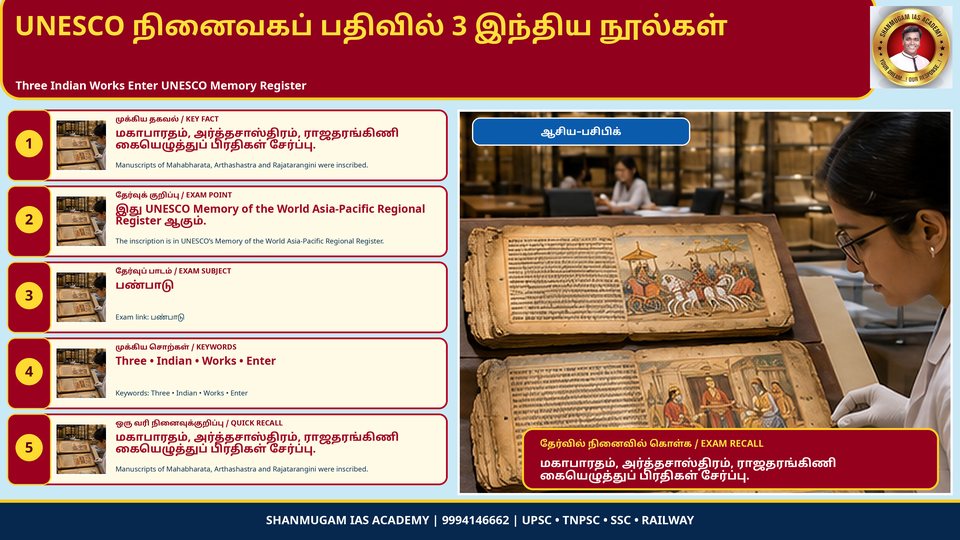
Three ancient Indian manuscripts were announced on 5 November 2026 as added to UNESCO's Memory of the World Asia-Pacific Regional Register. The decision was taken at the 11th session of the Memory of the World Committee for Asia and the Pacific (MOWCAP) in Jakarta, Indonesia. They are the birch-bark (bhurjapatra) Mahabharata manuscript at the Bhandarkar Oriental Research Institute (BORI), Pune; Kautilya's Arthashastra palm-leaf manuscript at the Oriental Research Institute, Mysuru; and Kalhana's Rajatarangini manuscript at the Oriental Research Library, Srinagar. The Arthashastra manuscript is a complete 16th-century palm-leaf copy in Grantha script; the Rajatarangini is in Sharada script. The Indira Gandhi National Centre for the Arts (IGNCA) prepared the nomination dossiers for all three. India now has six entries on this regional register; in 2024 the illustrated Ramcharitmanas manuscripts of Tulsidas, the Panchatantra and the Sahrdayaloka-Locana were added. Union Culture Minister Gajendra Singh Shekhawat called it a landmark recognition of India's documentary heritage.
Key facts for the exam
| Point | Details |
|---|---|
| Register | UNESCO Memory of the World – Asia-Pacific Regional Register |
| Decision | 11th MOWCAP session, Jakarta; announced 5 Nov 2026 |
| Mahabharata | Birch-bark manuscript – BORI, Pune |
| Arthashastra | 16th-c. Grantha palm-leaf – Oriental Research Institute, Mysuru |
| Rajatarangini | Kalhana (1148–49 CE); Sharada script – Srinagar |
| Nominated by | IGNCA, New Delhi |
| India on regional register | 6 in all (3 in 2024, 3 in 2026) |
| International register (2025) | Bhagavad Gita, Natyashastra |
Background
- UNESCO Memory of the World: launched in 1992 to protect documentary heritage (manuscripts, archives, audio-visual records). It has international, regional and national registers. World Heritage (1972 Convention) covers sites; Memory of the World covers documents. UNESCO is headquartered in Paris.
- History – Rajatarangini: Kalhana wrote this Sanskrit history of the kings of Kashmir in 1148–49 CE in eight 'tarangas' (about 7,826 verses); it is hailed as India's first systematic historical work. The Arthashastra, a treatise on statecraft and economy in 15 books, is attributed to Kautilya (Chanakya/Vishnugupta), minister of Chandragupta Maurya. R. Shamasastry identified its manuscript at Mysuru in 1905 and later published it.
- Mahabharata – BORI: Founded in 1917, BORI, Pune, began the Critical Edition of the Mahabharata in 1919 with V.S. Sukthankar as general editor and completed it in 1966. The birch-bark manuscript acquired in Kashmir in 1875 by Indologist Georg Bühler is the most authentic witness of the old Kashmiri version. BORI's Rigveda manuscripts entered the international register in 2007.
- Science – writing material: Bhurjapatra is the inner bark of the Himalayan birch (Betula utilis), used for writing in Kashmir and north India. In south India palm leaf was the main medium; most old Tamil texts survive as palm-leaf manuscripts.
What is this news about?
Three ancient Indian manuscripts were announced on 5 November 2026 as added to UNESCO's Memory of the World Asia-Pacific Regional Register. The decision was taken at the 11th session of the Memory of the World Committee for Asia and the Pacific (MOWCAP) in Jakarta, Indonesia.
What are the key facts to remember for the exam?
Register: UNESCO Memory of the World – Asia-Pacific Regional Register; Decision: 11th MOWCAP session, Jakarta; announced 5 Nov 2026; Mahabharata: Birch-bark manuscript – BORI, Pune; Arthashastra: 16th-c. Grantha palm-leaf – Oriental Research Institute, Mysuru.
What is the background to this news?
UNESCO Memory of the World: launched in 1992 to protect documentary heritage (manuscripts, archives, audio-visual records).
Practise more: Weekly current affairs · Daily subject quiz · Knowledge nugget
Sources: PTI via The Week; ThePrint; UNESCO; UNESCO Memory of the World Register. Compiled by Shanmugam IAS Academy.
Link to this page from your website / blog (HTML code)
TNPSC Achievers
-

VENKATASALAM
TNPSC TNPSC
Indian Polity in Tamil | 100 அரசியலமைப்பு வினா விடை | TNPSC Group 4 Preparation 2026
TNPSC குரூப் 1, 2/2A, 4 – நேரடி வகுப்புகள் · கோவை & மதுரை
2006 முதல் சண்முகம் IAS அகாடமி · Classroom & online coaching in Coimbatore and Madurai
