

Mains Analysis: OBC creamy layer – status, not salary alone
11 November 2026 · English
⬇ Download this analysis as free PDF
இந்தப் பகுப்பாய்வைத் தமிழில் படிக்க →
Topics: Social Justice – Reservation and Backward Classes · GS-II · UPSC Mains Analysis
Key takeaways
- On 6 November 2026 the Supreme Court refused to make its Rohith Nathan judgment (11 March 2026) prospective-only and applied it to the pending CSE-2025 service allocation.
- The rule: a PSU or private-sector parent's salary alone cannot put an OBC candidate in the creamy layer; the status of the parent's post must be weighed under the 1993 OM.
- For UPSC: Articles 14, 15(4), 16(4), Indra Sawhney (1992), equivalence of posts and the Rs 8 lakh limit unchanged since 2017 – GS-II social justice.
Why in news
On 6 November 2026, a Supreme Court bench of Justices P.S. Narasimha and R. Mahadevan rejected the Union Government's plea to apply its judgment of 11 March 2026 in Union of India v. Rohith Nathan only prospectively. That judgment had held that the salary or income of a parent working in a public sector undertaking (PSU) or in the private sector cannot, by itself, decide whether an OBC candidate falls in the creamy layer; the status and category of the parent's post must be examined under the 1993 office memorandum (OM). The candidates concerned had cleared Civil Services Examinations held between 2012 and 2017 and had won before the Central Administrative Tribunal and the Madras, Delhi and Kerala High Courts.
In its order of 6 November the Court clarified that concluded selections and the seniority of others will not be reopened, that service allocation for CSE-2025 (still pending) must follow the creamy-layer principle as interpreted in March, and that the Government remains free to frame its own creamy-layer policy. It refused to fix any timeline for the Government to establish equivalence of posts, and extended the time to comply with its directions for the parties by two months.
Background: how the creamy layer is decided
| Milestone | What it means |
|---|---|
| Articles 15(4), 16(4) and 340 | Allow special provisions and reservation for backward classes; Article 340 provides for a commission to study their conditions (the Mandal Commission, 1979–80). |
| Indra Sawhney v. Union of India (1992) | Nine-judge bench upheld 27% OBC reservation in central posts but required exclusion of the creamy layer; fixed the 50% ceiling as a rule. |
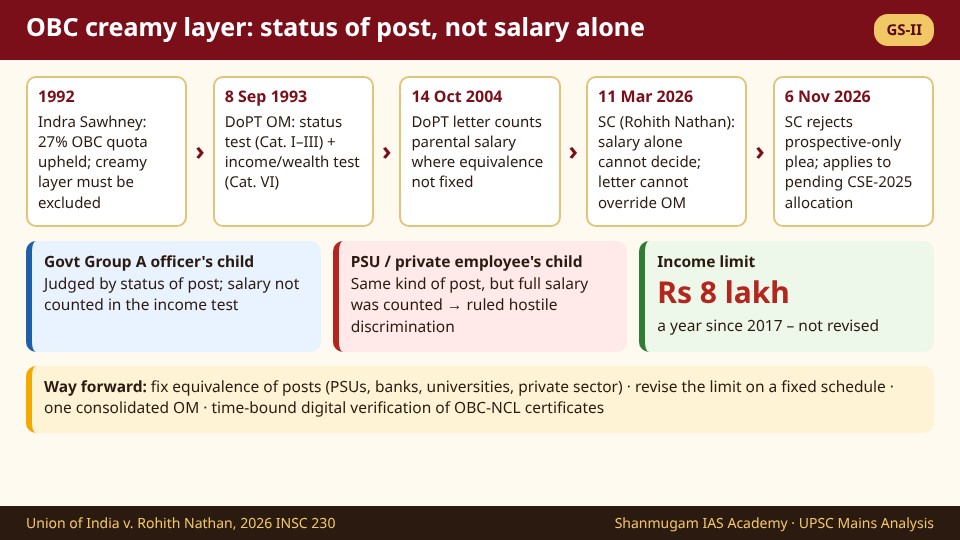
| DoPT OM of 8 September 1993 | Based on an expert committee: Categories I–III exclude by status (constitutional posts; Group A/Class I and certain Group B officers; armed forces officers of the rank of Colonel and above); Category V by land and property holdings; Category VI is an income/wealth test (also used for professionals and business people under Category IV), in which salary and agricultural income are not counted. |
| Category II(C) | Employees of PSUs, banks, insurance bodies, universities and private employers are to be treated like government officers once equivalence of their posts is fixed; until then the income/wealth test applies. |
| DoPT letter of 14 October 2004 | Its paragraph 9 counted parental salary as a separate test where equivalence was not fixed – the root of the dispute. |
| Income limit | Rs 1 lakh (1993) → Rs 2.5 lakh (2004) → Rs 4.5 lakh (2008) → Rs 6 lakh (2013) → Rs 8 lakh (2017); not revised since. |
| 2017 CPSE equivalence | Board-level and managerial posts in central public sector enterprises were brought on par with Group A; many other bodies still have no equivalence. |
What the Court decided – and why it matters
- A clarification cannot add a new condition: the Court held that the 2004 letter cannot override the 1993 OM. Making income alone decisive was "clearly unsustainable in law".
- Equals must be treated equally: the child of a Group A government officer is judged by the status of the post, while salary is not counted in the income test. Counting the full salary of a PSU or private employee in the same position amounted to hostile discrimination on these facts – an Article 14 problem.
- The goal stays the same: the Court also called exclusion of the creamy layer a constitutional imperative, so that benefits reach the genuinely backward. The ruling is about how to exclude, not whether.
- Limited reach: the order of 6 November confines the relief to the parties and intervenors; others who are similarly placed must go to the proper forum, where the March interpretation may be considered.
The real problem: consistency
- Equivalence still pending: without a clear table matching PSU, bank, university, autonomous-body and private-sector posts with government grades, officials fall back on income – the very approach the Court has now rejected.
- A frozen ceiling: DoPT norms call for a review of the income limit every three years, yet it has stayed at Rs 8 lakh since 2017. The Parliamentary Committee on the Welfare of OBCs (August 2025) called a revision the "need of the hour".
- Two kinds of unfairness: a ceiling that is too low keeps out families who are not advanced; a test that ignores salaries can let well-off families keep the benefit. A single, rule-based method avoids both.
- Uneven benefit within OBCs: the Rohini Commission (set up 2017, report 2023) examined sub-categorisation because a few communities take a large share of seats – a separate issue from the creamy layer, but part of the same equity question.
- Litigation cost: candidates from CSE-2012 had to wait until 2026 for relief. Unclear rules shift policy-making to courts, case by case.
Faculty view
Write this as an equality question, not a quota question. The creamy layer exists so that reservation under Article 16(4) reaches those who are still socially backward; a test that treats a government officer's child and a PSU officer's child differently for the same kind of post fails that purpose. The answer the Court points to is administrative, not judicial: fix equivalence of posts, revise the income limit on a published schedule, and apply one rule everywhere. Avoid taking sides between "income" and "status" – the 1993 scheme uses both, each in its own place.
Way forward
- Notify equivalence of posts for PSUs, public sector banks, insurance bodies, universities, autonomous bodies and, as far as possible, the private sector, through a standing DoPT committee.
- Revise the income/wealth limit at fixed intervals using an objective index, as the DoPT norms already envisage.
- Issue one consolidated, updated creamy-layer OM so that clarifications cannot change the parent policy.
- Digital, time-bound verification of OBC (non-creamy layer) certificates before the final result, so that toppers are not left without allocation for years.
- Use the Rohini Commission findings and caste data to ensure that benefits within the OBC list are spread more evenly.
Glossary – Creamy layer
The socially advanced section among the Other Backward Classes (OBCs) that is kept out of OBC reservation. The Supreme Court required its exclusion in Indra Sawhney (1992). For central posts it is identified under the DoPT office memorandum of 8 September 1993: children of holders of constitutional posts and of Group A/Class I and certain Group B officers are excluded by the status of the post; others by an income/wealth test (Rs 8 lakh a year since 2017), in which income from salaries and agricultural land is not counted.
Asked before in UPSC
A direct GS question on the OBC creamy layer has not appeared in recent UPSC Mains papers. The closest earlier question on reservation and its enforcement:
1. "Whether National Commission for Scheduled Castes (NCSC) can enforce the implementation of constitutional reservation for the Scheduled Castes in the religious minority institutions? Examine." – GS-II, 2018 (10 marks)
Use today's topic for questions on Articles 14–16, social justice and the role of the judiciary in policy.
Mains practice question
"Exclusion of the creamy layer is essential for social justice, but it must be applied consistently." Examine in the light of the Supreme Court's rulings of 2026 on the creamy-layer status of children of PSU and private-sector employees. (15 marks, 250 words)
FAQ
What did the Supreme Court decide in Union of India v. Rohith Nathan (11 March 2026)?
That a parent's salary or income from a PSU or private job cannot by itself put an OBC candidate in the creamy layer; the status and category of the parent's post must be considered under the 1993 OM, and a 2004 clarificatory letter cannot override that OM.
What happened on 6 November 2026?
The Court rejected the Centre's plea for prospective-only application, said concluded selections will not be reopened, applied the interpretation to the pending CSE-2025 allocation, left policy to the Government, set no timeline for equivalence and gave two more months to comply.
What is the current creamy-layer income limit for central purposes?
Rs 8 lakh a year, fixed in 2017. Income from salaries and agricultural land is not counted in this income/wealth test.
Sources: Supreme Court of India – judgment in Union of India v. Rohith Nathan, 2026 INSC 230 (11 March 2026) and order in M.A. Nos. 3313–3315 of 2026 in C.A. Nos. 2827–2829 of 2018 (6 November 2026); DoPT OM No. 36012/22/93-Estt.(SCT) of 8 September 1993; report of the Parliamentary Committee on the Welfare of OBCs (August 2025); PTI. Topic from the editorial page of The Hindu, 11 November 2026; analysis is our own.
Related on our site: UPSC Mains Analysis – all articles · UPSC glossary · UPSC Mains answer-writing practice · Free PDF downloads
Link to this page from your website / blog (HTML code)
BANK Achievers
-

ARUN VIGNESH
BANKING BANKING
TNPSC Group 4 PYQ Discussion 🔥 இது நம்ம குரூப் 4! | Speed Revision | Shanmugam IAS Academy
TNPSC குரூப் 1, 2/2A, 4 – நேரடி வகுப்புகள் · கோவை & மதுரை
2006 முதல் சண்முகம் IAS அகாடமி · Classroom & online coaching in Coimbatore and Madurai
