

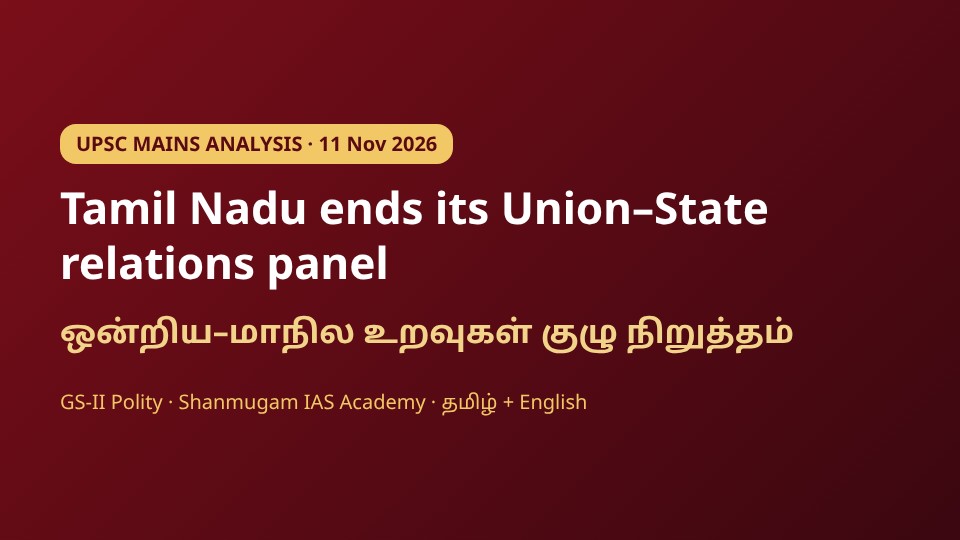
Mains Analysis: Tamil Nadu ends its Union-State relations panel
11 November 2026 · English Polity & Governance
⬇ Download this analysis as free PDF
இந்தப் பகுப்பாய்வைத் தமிழில் படிக்க →
Topics: Polity – Federalism and Centre–State Relations · GS-II · UPSC Mains Analysis
Key takeaways
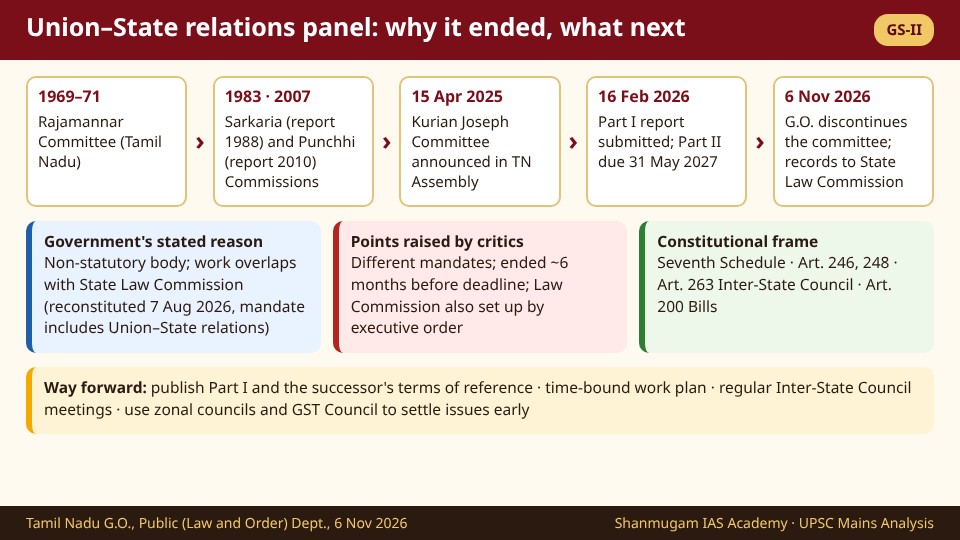
- By a G.O. of 6 November 2026, Tamil Nadu discontinued the Justice Kurian Joseph High-Level Committee on Union–State Relations (announced 15 April 2025; Part I report 16 February 2026).
- Stated reason: a non-statutory body overlapping with the State Law Commission, reconstituted on 7 August 2026; critics say the mandates differ and the work was ended early.
- For UPSC: Seventh Schedule, Article 263 Inter-State Council, Rajamannar, Sarkaria and Punchhi reports, Governor and State Bills – GS-II federalism.
Why in news
By a Government Order dated 6 November 2026, issued by the Public (Law and Order) Department, the Tamil Nadu Government discontinued, with immediate effect, the High-Level Committee on Union–State Relations headed by former Supreme Court judge Justice Kurian Joseph. The committee was announced in the Assembly on 15 April 2025 by the then Chief Minister M.K. Stalin, with retired IAS officer K. Ashok Vardhan Shetty and former State Planning Commission vice-chairman M. Naganathan as members (Naganathan later resigned after the change of government). It submitted Part I of its report on 16 February 2026; Part II was due by 31 May 2027.
Government's stated reason: the order describes the committee as a non-statutory body whose functions have "considerable similarity and overlap" with those of the Tamil Nadu State Law Commission, which was reconstituted on 7 August 2026 with a mandate that includes Union–State and inter-State relations. The committee's Secretary has been told to hand over all records to the Law Commission. Criticism: political parties including the DMK, the main opposition party, and the Manithaneya Makkal Katchi condemned the decision; critics argue that the two bodies have different mandates and that the committee was ended more than six months before its final deadline. Reports also note that the Law Commission, too, is a body created by executive order, not by a statute.
Background: studies on Centre–State relations
| Body | Year | Key focus |
|---|---|---|
| Rajamannar Committee (set up by Tamil Nadu) | 1969–71 | First State-level review of Centre–State relations; sought more autonomy, an Inter-State Council and changes in the Seventh Schedule and Governor's role. |
| Administrative Reforms Commission (first) | 1966–70 | Report on Centre–State relations (1969) suggested an Inter-State Council under Article 263 and persons of long public experience, not active politicians, as Governors. |
| Sarkaria Commission (Union) | 1983–88 | Strong Centre but cooperative federalism; consultation on Concurrent List laws; Inter-State Council under Article 263; restraint in Article 356. |
| Punchhi Commission (Union) | 2007–10 | Fixed term and limits for Governors; time limit for decisions on State Bills; "localised emergency" provisions. |
| Kurian Joseph Committee (Tamil Nadu) | 2025–26 | Part I (Feb 2026): timelines for Governors on State Bills; review of education, health, delimitation and GST arrangements. |
Constitutional frame
- Seventh Schedule and Article 246: Union, State and Concurrent Lists; residuary powers rest with Parliament (Article 248). The 42nd Amendment (1976) moved education, forests and three other subjects from the State List to the Concurrent List.
- Article 263: the President may set up an Inter-State Council for coordination. It was set up in 1990.
- Governor and State Bills (Article 200): the Supreme Court set timelines in State of Tamil Nadu v. Governor of Tamil Nadu (April 2025); in November 2025, a Constitution Bench answering a Presidential Reference under Article 143 opined that courts cannot fix such timelines.
- Fiscal links: Finance Commission (Article 280), GST Council (Article 279A), and the share of cesses and surcharges outside the divisible pool.
Analysis: what the episode tells us
- Executive committees have no fixed life: a committee formed by a government order can be ended by another order. Statutory or constitutional status (as with the Finance Commission) gives continuity; advisory panels do not have it.
- Overlap is a valid ground in principle: governments routinely merge bodies with similar tasks to avoid duplication. The test is whether the successor body has the mandate, expertise and time to complete the work.
- The concern of continuity: critics point out that Part I is already done and Part II was due by May 2027; studies that span changes of government are often left incomplete, and the cost of restarting is high.
- What matters for federalism is the forum, not the panel: State-level reports carry weight only if they are taken up in national forums – the Inter-State Council, zonal councils, the GST Council and Parliament. These forums meet irregularly.
- Transparency: placing Part I of the report and the Law Commission's terms of reference in the public domain would allow informed debate, whichever body carries the work forward.
Faculty view
Do not write this as a political controversy; write it as a question of institutional design in a federal system. Present the Government's stated reason (overlap with a reconstituted Law Commission) and the critics' points (different mandates, loss of continuity) side by side, then move to the larger issue: India has had many reports on Centre–State relations – Rajamannar, Sarkaria, Punchhi – but weak follow-up. Strong answers end with institutional fixes such as a regular Inter-State Council, consultation on Concurrent List laws and timelines on State Bills, rather than with opinions on any government.
Way forward
- Whichever body continues the study, publish its terms of reference and a time-bound work plan; release Part I for public comment.
- Give the State Law Commission a clear legal basis and adequate research staff if it is to handle a review of this scale.
- Revive the Inter-State Council with a fixed calendar (the Punchhi Commission suggested at least three meetings a year) and a standing secretariat.
- Use zonal councils and the GST Council as regular venues to settle Centre–State issues before they reach court.
- States can share and compare their federalism studies so that national reform proposals rest on common evidence.
Glossary – Inter-State Council
A body the President may set up under Article 263 to inquire into disputes between States, investigate subjects of common interest to the Union and the States, and recommend better coordination of policy. Set up in 1990 on the Sarkaria Commission's advice, it is chaired by the Prime Minister; members include the Chief Ministers of all States and of Union Territories with legislatures, Administrators of other UTs and six Union Cabinet Ministers. It is advisory and meets rarely; its 11th meeting was held in 2016.
Asked before in UPSC
1. "Though the federal principle is dominant in our Constitution and that principle is one of its basic features, but it is equally true that federalism under the Indian Constitution leans in favour of a strong Centre, a feature that militates against the concept of strong federalism. Discuss." – GS-II, 2014 (12½ marks)
2. "The concept of cooperative federalism has been increasingly emphasised in recent years. Highlight the drawbacks in the existing structure and the extent to which cooperative federalism would answer the shortcomings." – GS-II, 2015 (12½ marks)
Mains practice question
States have periodically set up committees to review Centre–State relations, from the Rajamannar Committee (1969) to recent panels. Examine the value of such State-level reviews and suggest how their recommendations can be taken forward within India's federal institutions. (15 marks, 250 words)
FAQ
Why did the Tamil Nadu Government discontinue the Justice Kurian Joseph Committee?
The G.O. of 6 November 2026 says the committee was non-statutory and its functions overlapped considerably with those of the State Law Commission, reconstituted on 7 August 2026 with a mandate covering Union–State and inter-State relations. Records are to be handed over to the Law Commission.
What did Part I of the committee's report recommend?
Submitted on 16 February 2026, it recommended, among other things, mandatory timelines for Governors to act on State Bills and changes relating to education, health, delimitation and the GST regime.
Which constitutional article provides for an Inter-State Council?
Article 263. The Council was set up in 1990 on the Sarkaria Commission's recommendation and is chaired by the Prime Minister.
Sources: Government of Tamil Nadu, Public (Law and Order) Department G.O. dated 6 November 2026 (as reported); PTI, IANS and The Hindu (7–8 November 2026); reports of 15 April 2025 on the Assembly announcement; Constitution of India; reports of the Sarkaria (1988) and Punchhi (2010) Commissions; Inter-State Council Secretariat. Topic from the editorial page of The Hindu, 11 November 2026; analysis is our own.
Related on our site: UPSC Mains Analysis – all articles · UPSC glossary · UPSC Mains answer-writing practice · Free PDF downloads
Link to this page from your website / blog (HTML code)
TET Achievers
-

DHANALAKSHMI
TNTET TNTET
TNPSC Group 4 PYQ Discussion 🔥 இது நம்ம குரூப் 4! | Speed Revision | Shanmugam IAS Academy
TNPSC குரூப் 1, 2/2A, 4 – நேரடி வகுப்புகள் · கோவை & மதுரை
2006 முதல் சண்முகம் IAS அகாடமி · Classroom & online coaching in Coimbatore and Madurai
