

ISRO clears 200-second test of GSLV-F19 cryogenic engine
11 November 2026 · English Science & Technology
⬇ Download this article as free PDF
Topics: Space Science · UPSC Prelims · TNPSC · SSC · Current Affairs
Current affairs of 11 November 2026 (Shanmugam IAS Academy) – explained for UPSC, TNPSC and other competitive exams
News
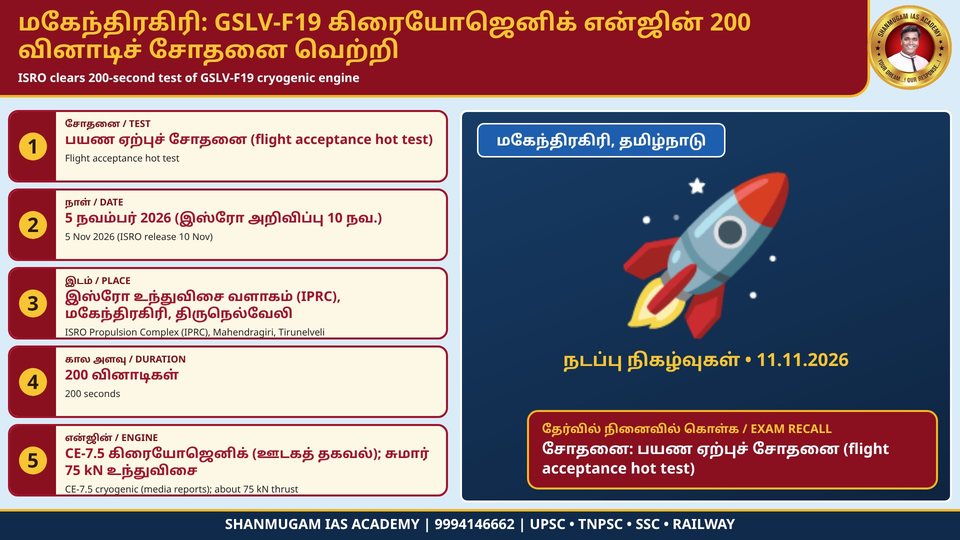
The flight acceptance hot test of the cryogenic engine earmarked for the next GSLV mission, GSLV-F19, was conducted at the ISRO Propulsion Complex (IPRC), Mahendragiri, Tirunelveli district, on 5 November 2026. The engine was fired for 200 seconds; both the main engine and the gas generator ignited as planned. ISRO announced on 10 November that the performance was satisfactory and consistent with pre-test predictions. The engine will be integrated into the cryogenic stage of GSLV-F19, which will launch NVS-04, the next satellite of the NavIC navigation system. Media reports identify it as the CE-7.5 engine that powers the third stage of GSLV Mk II. Earlier, on 30 October 2026, GSLV-F18 successfully launched NVS-03. Such a ground test of each mission's engine before launch is standard practice.
Key facts for the exam
| Point | Details |
|---|---|
| Test | Flight acceptance hot test |
| Date | 5 Nov 2026 (ISRO release 10 Nov) |
| Place | ISRO Propulsion Complex (IPRC), Mahendragiri, Tirunelveli |
| Duration | 200 seconds |
| Engine | CE-7.5 cryogenic (media reports); about 75 kN thrust |
| Propellants | Liquid hydrogen + liquid oxygen |
| Mission | GSLV-F19 – NVS-04 navigation satellite |
| Previous flight | GSLV-F18 – NVS-03 (30 Oct 2026) |
Background
- A cryogenic engine uses super-cold liquid propellants: hydrogen liquefies at about −253°C and oxygen at about −183°C. They give a higher specific impulse than solid or storable liquid propellants, so they are used in upper stages to send heavy satellites to geosynchronous transfer orbit (GTO). A kerosene–liquid oxygen pair is called 'semi-cryogenic'.
- History: In 1991 India signed a cryogenic technology deal with Russia's Glavkosmos. After the US imposed sanctions in 1992 citing the Missile Technology Control Regime (MTCR), Russia dropped the technology transfer and supplied only a few KVD-1 cryogenic stages. ISRO built the CE-7.5 indigenously; GSLV-D3 failed in April 2010, and on 5 January 2014 GSLV-D5 (GSAT-14) succeeded with the indigenous cryogenic stage.
- ISRO's rockets: the CE-7.5 powers the third stage of GSLV Mk II, while the CE-20 powers the C25 upper stage of the bigger LVM3. To replace LVM3's L110 liquid stage, ISRO is building the SC120 stage with the 2,000-kN-class SE2000 semi-cryogenic engine; its power-head tests are also being run at Mahendragiri.
- NavIC (Navigation with Indian Constellation) is India's regional navigation system, covering India and about 1,500 km beyond its borders. Its satellites operate in geostationary (GEO) and inclined geosynchronous (GSO) orbits. NVS-03 carries an indigenous atomic clock and L1, L5 and S-band signals.
What is this news about?
The flight acceptance hot test of the cryogenic engine earmarked for the next GSLV mission, GSLV-F19, was conducted at the ISRO Propulsion Complex (IPRC), Mahendragiri, Tirunelveli district, on 5 November 2026.
What are the key facts to remember for the exam?
Test: Flight acceptance hot test; Date: 5 Nov 2026 (ISRO release 10 Nov); Place: ISRO Propulsion Complex (IPRC), Mahendragiri, Tirunelveli; Duration: 200 seconds.
What is the background to this news?
A cryogenic engine uses super-cold liquid propellants: hydrogen liquefies at about −253°C and oxygen at about −183°C. They give a higher specific impulse than solid or storable liquid propellants, so they are used in upper stages to send heavy satellites to geosynchronous transfer orbit (GTO).
Practise more: Weekly current affairs · Daily subject quiz · Knowledge nugget
Sources: ISRO; Voice&Data; News On AIR; Telangana Today. Compiled by Shanmugam IAS Academy.
Link to this page from your website / blog (HTML code)
BANK Achievers
-

S. SRIDHARAN
BANK BANK
நடப்பு நிகழ்வுகள் 12 - 11- 2026 | Today Current Affairs in Tamil | TNPSC Group 4 வினா விடை
TNPSC குரூப் 1, 2/2A, 4 – நேரடி வகுப்புகள் · கோவை & மதுரை
2006 முதல் சண்முகம் IAS அகாடமி · Classroom & online coaching in Coimbatore and Madurai
