

SC: foreign divorce does not automatically end an Indian marriage
12 November 2026 · English Polity & Governance
⬇ Download this article as free PDF
Topics: Polity & Judiciary · UPSC Prelims · TNPSC · SSC · Current Affairs
Current affairs of 12 November 2026 (Shanmugam IAS Academy) – explained for UPSC, TNPSC and other competitive exams
News
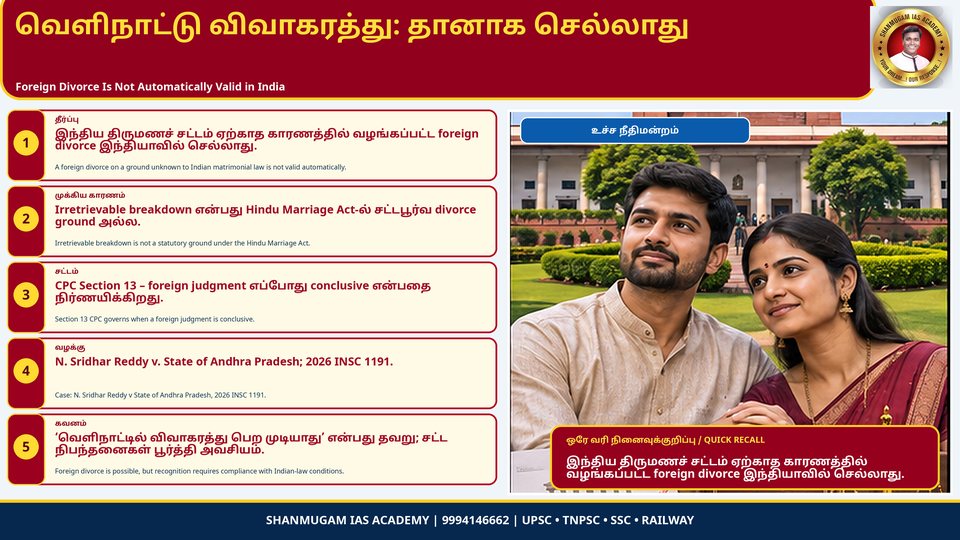
A Supreme Court bench of Justices Prashant Kumar Mishra and Shree Chandrashekhar held on 3 Nov 2026 (Tuesday) that a divorce granted abroad does not automatically dissolve a marriage solemnised in India under the Hindu Marriage Act, 1955. A decree based only on irretrievable breakdown is not valid here, and must pass the test of Section 13 of the CPC. Taking British citizenship did not shield the husband (who obtained a UK divorce decree on the ground of irretrievable breakdown and remarried in the UK in 2014) from bigamy proceedings; proceedings against his parents and second wife were quashed. The couple married on 18 Apr 2003 at Sattenapalli (Andhra Pradesh); the husband became a British citizen in Feb 2013, and the first wife filed a complaint under IPC Section 494 in Feb 2016. The first wife had objected to the UK court's jurisdiction, so she did not submit to it; bigamy is a continuing offence, so delay in filing was no ground to quash; and the court found no material that the parents or the second wife knowingly took part. The Court applied Y. Narasimha Rao (1991) and its 2026 ruling in Kishorekumar Mohan Kale v. Kashmira Kale.
Key facts for the exam
| Point | Details |
|---|---|
| Bench | Justices Prashant Kumar Mishra, Shree Chandrashekhar |
| Foreign decree | UK court (Cambridge County Court), 2013–14 |
| Test for foreign judgments | Section 13, CPC |
| Offence | Bigamy – IPC 494 (now BNS Section 82) |
| Result | Bigamy case against husband continues |
Background
- CPC Section 13: a foreign judgment is not conclusive if, among other things, the court lacked jurisdiction, it was not on the merits, it ignored Indian law, or natural justice was denied. Section 44A deals with executing decrees from reciprocating countries.
- Y. Narasimha Rao v. Y. Venkata Lakshmi (1991): a foreign divorce is recognised only if it is granted on a ground available under the law under which the couple married.
- Irretrievable breakdown is not a ground in the Hindu Marriage Act; only the Supreme Court can dissolve such a marriage using Article 142 (Shilpa Sailesh case, 2023). Section 13B gives divorce by mutual consent.
What is this news about?
A Supreme Court bench of Justices Prashant Kumar Mishra and Shree Chandrashekhar held on 3 Nov 2026 (Tuesday) that a divorce granted abroad does not automatically dissolve a marriage solemnised in India under the Hindu Marriage Act, 1955.
What are the key facts to remember for the exam?
Bench: Justices Prashant Kumar Mishra, Shree Chandrashekhar; Foreign decree: UK court (Cambridge County Court), 2013–14; Test for foreign judgments: Section 13, CPC; Offence: Bigamy – IPC 494 (now BNS Section 82).
What is the background to this news?
CPC Section 13: a foreign judgment is not conclusive if, among other things, the court lacked jurisdiction, it was not on the merits, it ignored Indian law, or natural justice was denied.
Practise more: Weekly current affairs · Daily subject quiz · Knowledge nugget
Sources: ThePrint/PTI (5 Nov 2026); LiveLaw (3 Nov 2026); Telangana Today (3 Nov 2026). Compiled by Shanmugam IAS Academy.
Link to this page from your website / blog (HTML code)
TNPSC Achievers
-

KALPANA
TNPSC TNPSC
TNPSC Group 4 PYQ Discussion 🔥 இது நம்ம குரூப் 4! | Speed Revision | Shanmugam IAS Academy
TNPSC குரூப் 1, 2/2A, 4 – நேரடி வகுப்புகள் · கோவை & மதுரை
2006 முதல் சண்முகம் IAS அகாடமி · Classroom & online coaching in Coimbatore and Madurai
