

India's 183rd seismological observatory opens at Kishtwar, Jammu & Kashmir – 4th in the UT
5 November 2026 · English Science & Technology
⬇ Download this article as free PDF
Topics: Science · 5 November 2026 Current Affairs (UPSC / TNPSC / SSC / RRB)
News
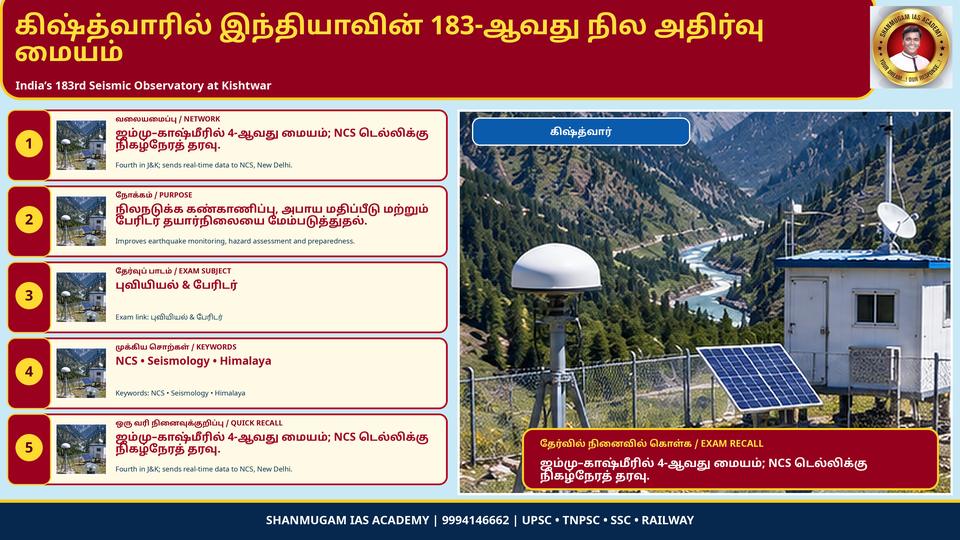
Dr Jitendra Singh, Union Minister of State (Independent Charge) for Earth Sciences, inaugurated India's 183rd seismological observatory at Kishtwar, Jammu & Kashmir, on 2 Nov 2026. It is the fourth in J&K – the others are at Jammu, Srinagar and Udhampur. Fitted with modern digital seismic equipment, it will send real-time data to the 24x7 earthquake monitoring centre of the National Center for Seismology (NCS) in New Delhi, strengthening earthquake monitoring and disaster preparedness in the Himalaya. Officials said Kishtwar 'sits in the middle of a fault line'.
Key facts
| Inauguration | 2 Nov 2026 – Dr Jitendra Singh (Ministry of Earth Sciences) |
| Count | India's 183rd; 4th in J&K (Jammu, Srinagar, Udhampur, Kishtwar) |
| Earlier | 153rd observatory – Udhampur, 21 June 2022 |
| NCS network | About 84 stations in 2014 → 168 by Aug 2025 → 183 now |
| Other facilities | 4 Doppler weather radars in J&K (Banihal, Jot, Jammu, Srinagar); 4 more in 2027 at Doda, Kishtwar, Anantnag, Baramulla |
| Kishtwar | Chenab valley; Kiru (624 MW), Kwar (540 MW) on the Chenab; Pakal Dul (1,000 MW) on its tributary, the Marusudar |
Background
- Body: the National Center for Seismology (NCS) is the Government of India's nodal agency for monitoring earthquake activity; it was set up in Aug 2014 under the Ministry of Earth Sciences. Its work includes 24x7 monitoring, a seismological data centre and city seismic microzonation studies.
- History: after the 1897 Shillong plateau earthquake, India's first seismological observatory was set up at Alipore, Calcutta, on 1 Dec 1898. The national network grew to 6 stations in 1940, 15 in 1960 and 18 in 1970.
- Seismic zones: the Bureau of Indian Standards (BIS) code IS 1893 divides India into four zones, II to V (V = highest risk). IS 1893:2025, issued in Nov 2025, added a new 'Zone VI' covering the whole Himalaya and the Andaman & Nicobar Islands, but BIS withdrew it in March 2026 – the 2016 standard is back in force.
- Science: the point underground where a quake starts is the 'focus' (hypocentre); the point on the surface directly above it is the 'epicentre'. The Richter scale, devised by Charles Richter in 1935, is a logarithmic scale of an earthquake's 'magnitude' (energy released); the 'intensity' of shaking and damage is measured on the Mercalli scale. A seismograph records seismic waves.
Tamil Nadu link: according to the Ministry of Earth Sciences' Lok Sabha reply (20 Mar 2020), Tamil Nadu lies in seismic Zones II and III. Chennai, Tiruvallur, Vellore, Chengalpattu, Ranipet, Kanniyakumari, Tirupattur and Tiruppur are in Zone III; Tiruchirappalli, Madurai, Thanjavur, Nagapattinam, Ramanathapuram, Thoothukudi and others in Zone II; Coimbatore, Salem, the Nilgiris, Kancheepuram and some others straddle both.
Source: Daily Excelsior, 2 Nov 2026; The Tribune, 3 Nov 2026; seismo.gov.in (NCS); PIB – Ministry of Earth Sciences, 6 Aug 2025; ETV Bharat, 11 Mar 2026 (IS 1893:2025 withdrawn); Ministry of Earth Sciences – Lok Sabha reply, 20 Mar 2020
Join our UPSC classroom or online batch: UPSC coaching in Coimbatore · Fees · Call 99941 46662.
Link to this page from your website / blog (HTML code)
BANK Achievers
-

KIRUTHIKA
BANK BANK
Today Current Affairs in Tamil | 06 நவம்பர் 2026 | TNPSC Group 4 முக்கிய வினாக்கள்
TNPSC குரூப் 1, 2/2A, 4 – நேரடி வகுப்புகள் · கோவை & மதுரை
2006 முதல் சண்முகம் IAS அகாடமி · Classroom & online coaching in Coimbatore and Madurai
